School of Psychology, Social Work and Social Policy, Division of Education, Arts and Social Sciences, University of South Australia Adelaide, SA, Australia.
Front Psychol. 2010 Nov 16;1:182. doi: 10.3389/fpsyg.2010.00182. eCollection 2010.
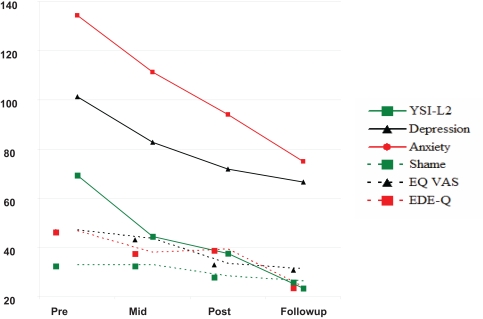
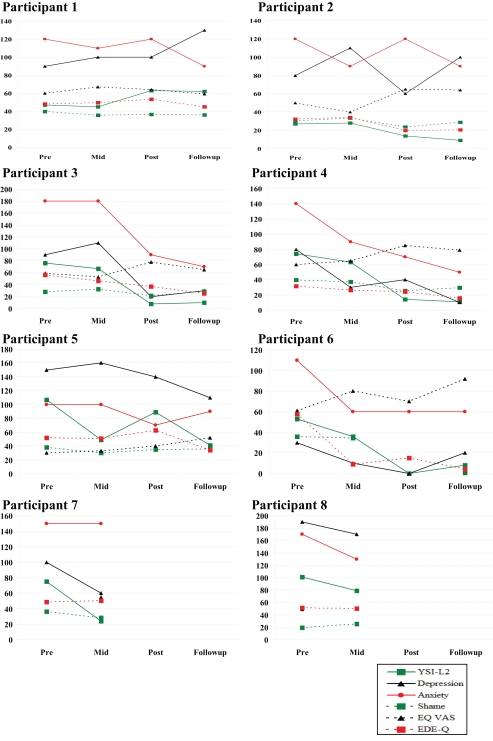
This paper describes the use of Group Schema Therapy for Eating Disorders (ST-E-g) in a case series of eight participants with chronic eating disorders and high levels of co-morbidity. Treatment was comprised of 20 sessions which included cognitive, experiential, and interpersonal strategies, with an emphasis on behavioral change. Specific schema-based strategies focused on bodily felt-sense and body-image, as well as emotional regulation skills. Six attended until end of treatment, two dropped-out at mid-treatment. Eating disorder severity, global schema severity, shame, and anxiety levels were reduced between pre- and post-therapy, with a large effect size at follow-up. Clinically significant improvement in eating severity was found in four out of six completers. Group completers showed a mean reduction in schema severity of 43% at post-treatment, and 59% at follow-up. By follow-up, all completers had achieved over 60% improvement in schema severity. Self-report feedback suggests that group factors may catalyze the change process in schema therapy by increasing perceptions of support and encouragement to take risks and try out new behaviors, whilst providing a de-stigmatizing and de-shaming therapeutic experience.
本文描述了团体图式治疗在 8 名患有慢性饮食障碍和高度共病的参与者的病例系列中的应用。治疗包括 20 次治疗,包括认知、体验和人际策略,重点是行为改变。特定的基于图式的策略侧重于身体感觉和身体形象,以及情绪调节技能。6 人参加了治疗结束,2 人在治疗中期退出。治疗前后,饮食障碍严重程度、总体图式严重程度、羞耻感和焦虑水平均降低,随访时效果显著。6 名完成者中有 4 名在饮食严重程度方面有显著改善。团体完成者在治疗后图式严重程度平均降低 43%,随访时降低 59%。随访时,所有完成者的图式严重程度均提高了 60%以上。自我报告反馈表明,团体因素可能通过增加对支持和鼓励的感知来促进图式治疗的改变过程,以冒险和尝试新行为,同时提供去污名化和去羞耻化的治疗体验。