Centre de Recherche Clinique Étienne-Lebel, 3001-12th Avenue North, Sherbrooke, QC J1H5N4, Canada.
BMC Musculoskelet Disord. 2011 Aug 15;12:185. doi: 10.1186/1471-2474-12-185.
Skeletal muscle atrophy is a serious concern for the rehabilitation of patients afflicted by prolonged limb restriction. This debilitating condition is associated with a marked activation of NFκB activity. The ubiquitin-proteasome pathway degrades the NFκB inhibitor IκBα, enabling NFκB to translocate to the nucleus and bind to the target genes that promote muscle atrophy. Although several studies showed that proteasome inhibitors are efficient to reduce atrophy, no studies have demonstrated the ability of these inhibitors to preserve muscle function under catabolic condition.
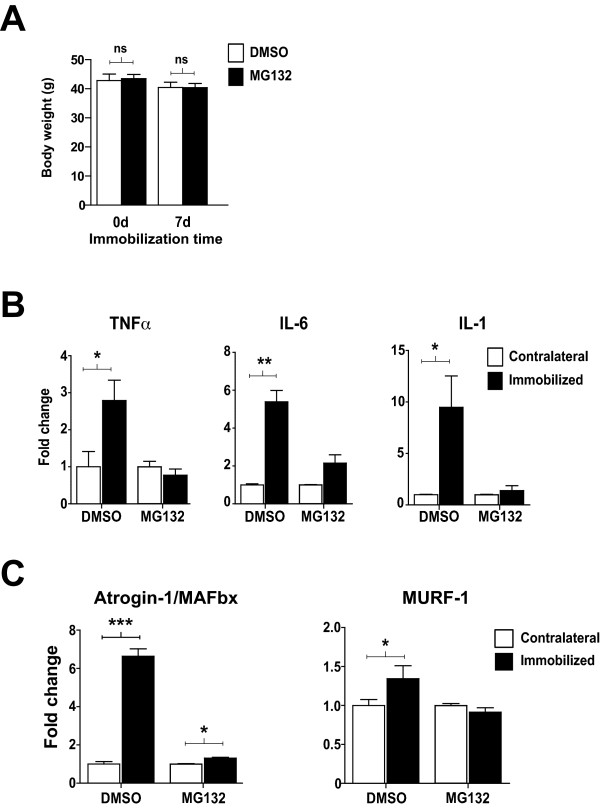
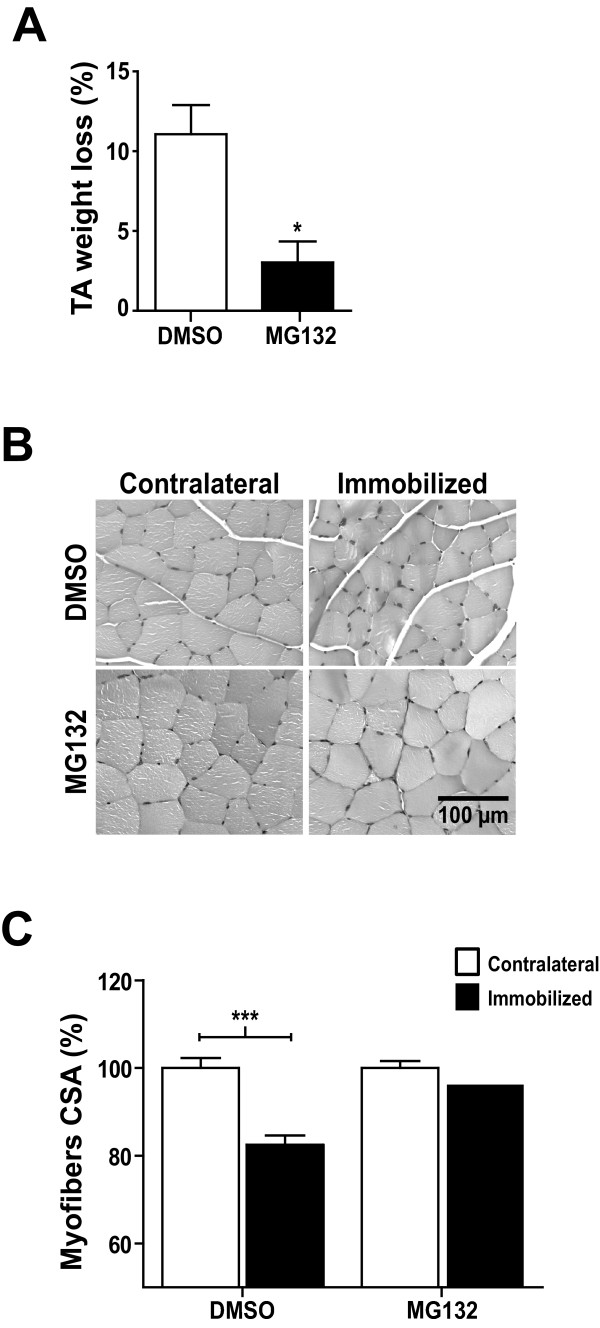
We recently developed a new hindlimb immobilization procedure that induces significant skeletal muscle atrophy and used it to show that an inflammatory process characterized by the up-regulation of TNFα, a known activator of the canonical NFκB pathway, is associated with the atrophy. Here, we used this model to investigate the effect of in vivo proteasome inhibition on the muscle integrity by histological approach. TNFα, IL-1, IL-6, MuRF-1 and Atrogin/MAFbx mRNA level were determined by qPCR. Also, a functional measurement of locomotors activity was performed to determine if the treatment can shorten the rehabilitation period following immobilization.
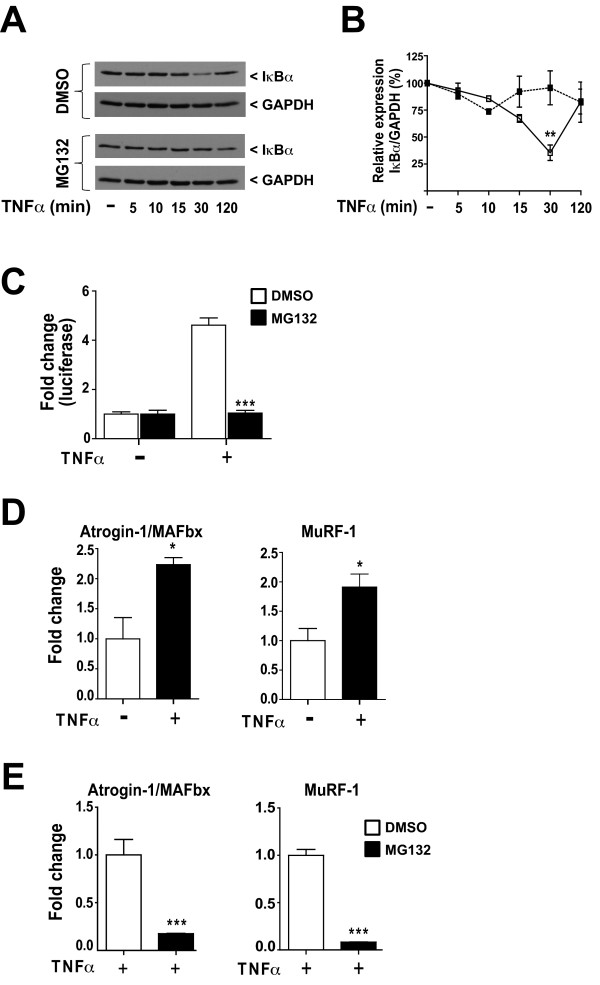
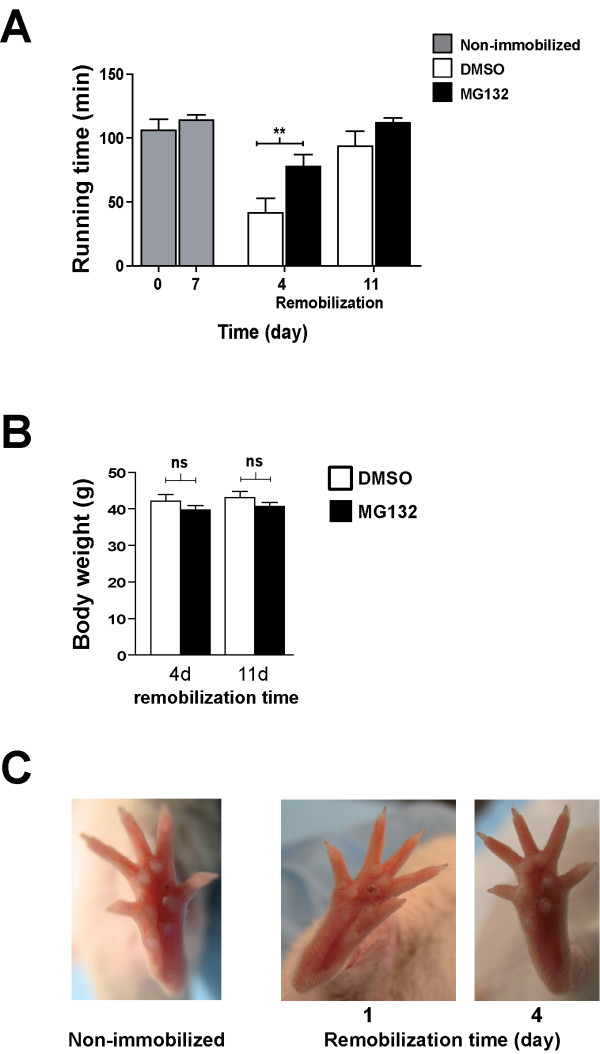
In the present study, we showed that the proteasome inhibitor MG132 significantly inhibited IκBα degradation thus preventing NFκB activation in vitro. MG132 preserved muscle and myofiber cross-sectional area by downregulating the muscle-specific ubiquitin ligases atrogin-1/MAFbx and MuRF-1 mRNA in vivo. This effect resulted in a diminished rehabilitation period.
These finding demonstrate that proteasome inhibitors show potential for the development of pharmacological therapies to prevent muscle atrophy and thus favor muscle rehabilitation.
骨骼肌萎缩是长期肢体受限患者康复的严重问题。这种使人衰弱的疾病与 NFκB 活性的显著激活有关。泛素-蛋白酶体途径降解 NFκB 抑制剂 IκBα,使 NFκB 易位到细胞核并与促进肌肉萎缩的靶基因结合。尽管几项研究表明蛋白酶体抑制剂有效地减少萎缩,但尚无研究表明这些抑制剂在分解代谢条件下保留肌肉功能的能力。
我们最近开发了一种新的后肢固定程序,该程序可导致明显的骨骼肌萎缩,并使用该程序表明以 TNFα 上调为特征的炎症过程与萎缩有关,TNFα 是经典 NFκB 途径的已知激活剂。在这里,我们使用该模型通过组织学方法研究体内蛋白酶体抑制对肌肉完整性的影响。通过 qPCR 测定 TNFα、IL-1、IL-6、MuRF-1 和 Atrogin/MAFbx mRNA 水平。此外,还进行了运动活动的功能测量,以确定治疗是否可以缩短固定后的康复期。
在本研究中,我们表明蛋白酶体抑制剂 MG132 可显著抑制 IκBα 降解,从而阻止 NFκB 在体外激活。MG132 通过下调肌肉特异性泛素连接酶 atrogin-1/MAFbx 和 MuRF-1 mRNA 在体内保存肌肉和肌纤维横截面积。这种作用导致康复期缩短。
这些发现表明蛋白酶体抑制剂具有开发药理学疗法以预防肌肉萎缩的潜力,从而有利于肌肉康复。