Spallek Jacob, Zeeb Hajo, Razum Oliver
Bielefeld University, Faculty of Health Sciences, Department of Epidemiology & International Public Health, Universitätsstraße 25, 33501 Bielefeld, Germany.
Emerg Themes Epidemiol. 2011 Aug 15;8(1):6. doi: 10.1186/1742-7622-8-6.
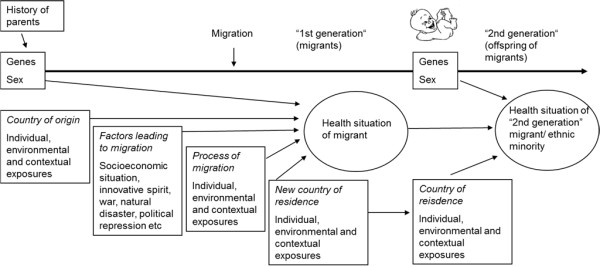
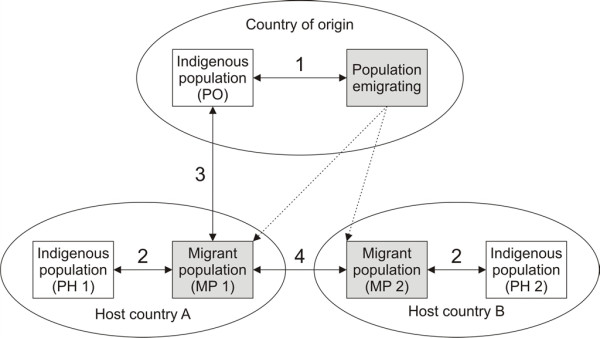
Empirical findings show that morbidity and mortality risks of migrants can differ considerably from those of populations in the host countries. However, while several explanatory models have been developed, most migrant studies still do not consider explicitly the situation of migrants before migration. Here, we discuss an extended approach to understand migrant health comprising a life course epidemiology perspective.The incorporation of a life course perspective into a conceptual framework of migrant health enables the consideration of risk factors and disease outcomes over the different life phases of migrants, which is necessary to understand the health situation of migrants and their offspring. Comparison populations need to be carefully selected depending on the study questions under consideration within the life course framework.Migrant health research will benefit from an approach using a life course perspective. A critique of the theoretical foundations of migrant health research is essential for further developing both the theoretical framework of migrant health and related empirical studies.
实证研究结果表明,移民的发病率和死亡率风险可能与东道国人口的风险有很大差异。然而,尽管已经开发了几种解释模型,但大多数移民研究仍然没有明确考虑移民迁移前的情况。在此,我们讨论一种扩展方法,从生命历程流行病学的角度来理解移民健康。将生命历程视角纳入移民健康的概念框架,可以考虑移民在不同生命阶段的风险因素和疾病结果,这对于理解移民及其后代的健康状况是必要的。需要根据生命历程框架内所考虑的研究问题仔细选择对照人群。移民健康研究将受益于采用生命历程视角的方法。对移民健康研究的理论基础进行批判,对于进一步发展移民健康的理论框架和相关实证研究至关重要。