Wernicke Caroline M, Grunewald Thomas Gp, Hendrik Juenger, Kuci Selim, Kuci Zyrafete, Koehl Ulrike, Mueller Ingo, Doering Michaela, Peters Christina, Lawitschka Anita, Kolb Hans-Jochem, Bader Peter, Burdach Stefan, von Luettichau Irene
Children's Cancer Research and Roman Herzog Comprehensive Cancer Center, Department of Pediatrics, Klinikum rechts der Isar, Technische Universität München, Kölner Platz 1, 80804 Munich, Germany.
Medical Life Science and Technology Center, TUM Graduate School, Technische Universität München, Boltzmannstrasse 17, 85748 Garching, Germany.
Int Arch Med. 2011 Aug 15;4(1):27. doi: 10.1186/1755-7682-4-27.
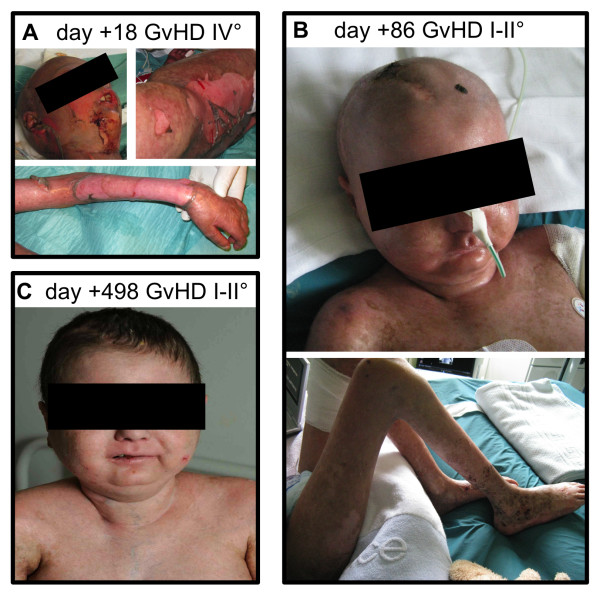
Severe acute graft versus host disease (GvHD) is a life-threatening complication after allogeneic hematopoietic stem cell transplantation. Human mesenchymal stromal cells (MSCs) play an important role in endogenous tissue repair and possess strong immune-modulatory properties making them a promising tool for the treatment of steroid-refractory GvHD. To date, a few reports exist on the use of MSCs in treatment of GvHD in children indicating that children tend to respond better than adults, albeit with heterogeneous results.We here present a review of the literature and the clinical course of two instructive pediatric patients with acute steroid-refractory GvHD after haploidentical stem cell transplantation, which exemplify the beneficial effects of third-party transplanted MSCs in treatment of acute steroid-refractory GvHD. Moreover, we provide a meta-analysis of clinical studies addressing the outcome of patients with steroid-refractory GvHD and treatment with MSCs in adults and in children (n = 183; 122 adults, 61 children). Our meta-analysis demonstrates that the overall response-rate is high (73.8%) and confirms, for the first time, that children indeed respond better to treatment of GvHD with MSCs than adults (complete response 57.4% vs. 45.1%, respectively).These data emphasize the significance of this therapeutic approach especially in children and indicate that future prospective studies are needed to assess the reasons for the observed differential response-rates in pediatric and adult patients.
严重急性移植物抗宿主病(GvHD)是异基因造血干细胞移植后一种危及生命的并发症。人间充质基质细胞(MSCs)在内源性组织修复中发挥重要作用,并具有强大的免疫调节特性,使其成为治疗类固醇难治性GvHD的一种有前景的工具。迄今为止,关于MSCs用于治疗儿童GvHD的报道较少,表明儿童往往比成人反应更好,尽管结果存在异质性。我们在此对文献以及两例单倍体干细胞移植后急性类固醇难治性GvHD的典型儿科患者的临床病程进行综述,这两例患者例证了第三方移植的MSCs在治疗急性类固醇难治性GvHD中的有益作用。此外,我们对针对类固醇难治性GvHD患者以及成人和儿童使用MSCs治疗的临床研究进行了荟萃分析(n = 183;122例成人,61例儿童)。我们的荟萃分析表明总体缓解率很高(73.8%),并首次证实儿童确实比成人对MSCs治疗GvHD的反应更好(完全缓解率分别为57.4%和45.1%)。这些数据强调了这种治疗方法的重要性,尤其是在儿童中,并表明未来需要进行前瞻性研究来评估儿童和成人患者中观察到的不同反应率的原因。