Institute for Clinical Evaluative Sciences, Toronto, Ontario, Canada.
Clin Infect Dis. 2011 Sep;53(5):413-21. doi: 10.1093/cid/cir442.
Previous studies suggest that obesity may be a risk factor for complications from pandemic influenza A(H1N1) infection. We aimed to examine the association between obesity and respiratory hospitalizations during seasonal influenza epidemics and to determine the extent of this association among individuals without established risk factors for serious complications due to influenza infection.
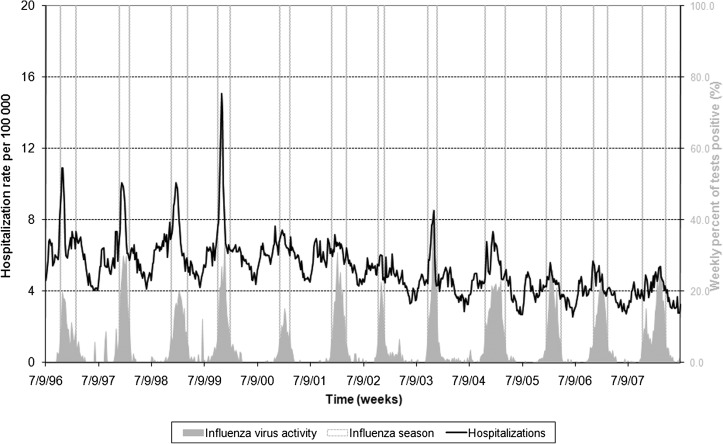
We conducted a cohort study over 12 influenza seasons (1996-1997 through 2007-2008) of 82545 respondents to population health surveys in Ontario, Canada. We included individuals aged 18-64 years who had responded to a survey within 5 years prior to the start of an influenza season. We used logistic regression to examine the association between self-reported body mass index (BMI) and hospitalization for selected respiratory diseases (pneumonia and influenza, acute respiratory diseases, and chronic lung diseases), both in the entire cohort and stratified by chronic condition status.
Obese class I (BMI, 30-34.9) (odds ratio [OR], 1.45 [95% confidence interval {CI}, 1.03-2.05]) and obese class II or III (BMI, ≥35) individuals (OR, 2.12 [95% CI, 1.45-3.10]) were more likely than normal weight individuals to have a respiratory hospitalization during influenza seasons. Among obese class II or III individuals, the association was present both for those without previously identified risk factors (OR, 5.10 [95% CI, 2.53-10.24]) and for those with 1 risk factor (OR, 2.11 [95% CI, 1.10-4.06]).
Severely obese individuals with and without chronic conditions are at increased risk for respiratory hospitalizations during influenza seasons. They should be considered a priority group for preventive influenza measures, such as vaccination and treatment with antiviral medications.
先前的研究表明,肥胖可能是大流行性甲型 H1N1 流感感染并发症的一个危险因素。我们旨在研究肥胖与季节性流感流行期间呼吸道住院之间的相关性,并确定在没有因流感感染而导致严重并发症的既定危险因素的个体中,这种相关性的程度。
我们对加拿大安大略省的人群健康调查的 82545 名应答者进行了 12 个流感季节(1996-1997 年至 2007-2008 年)的队列研究。我们纳入了年龄在 18-64 岁之间、在流感季节开始前 5 年内曾对调查做出过应答的个体。我们使用逻辑回归来检验自我报告的体重指数(BMI)与选定的呼吸道疾病(肺炎和流感、急性呼吸道疾病以及慢性肺部疾病)住院之间的相关性,该相关性在整个队列中以及在慢性疾病状况分层中均进行了检验。
肥胖 I 级(BMI,30-34.9)(比值比[OR],1.45[95%置信区间{CI},1.03-2.05])和肥胖 II 级或 III 级(BMI,≥35)个体(OR,2.12[95% CI,1.45-3.10])比正常体重个体更有可能在流感季节发生呼吸道住院。在肥胖 II 级或 III 级个体中,这种相关性既存在于没有先前确定的危险因素的个体中(OR,5.10[95% CI,2.53-10.24]),也存在于有 1 个危险因素的个体中(OR,2.11[95% CI,1.10-4.06])。
患有和不患有慢性疾病的严重肥胖个体在流感季节发生呼吸道住院的风险增加。他们应被视为预防流感措施(如疫苗接种和抗病毒药物治疗)的优先群体。