Department of Radiation Oncology, Huntsman Cancer Institute, University of Utah, Salt Lake City, UT 84112, USA.
J Appl Clin Med Phys. 2011 Jan 31;12(3):3429. doi: 10.1120/jacmp.v12i3.3429.
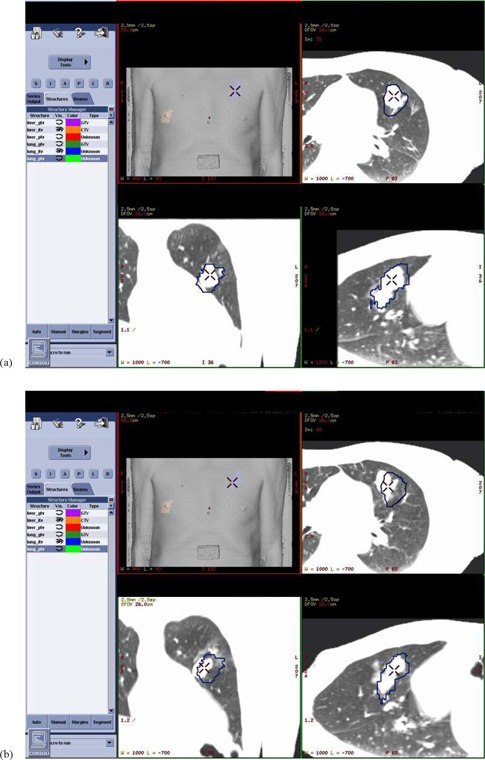
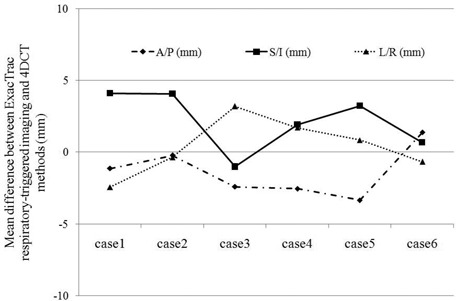
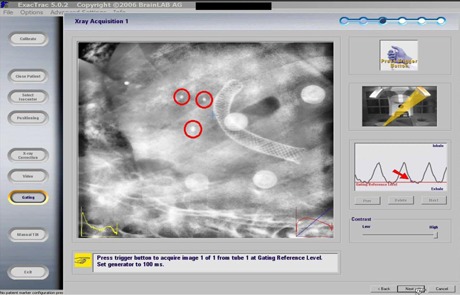
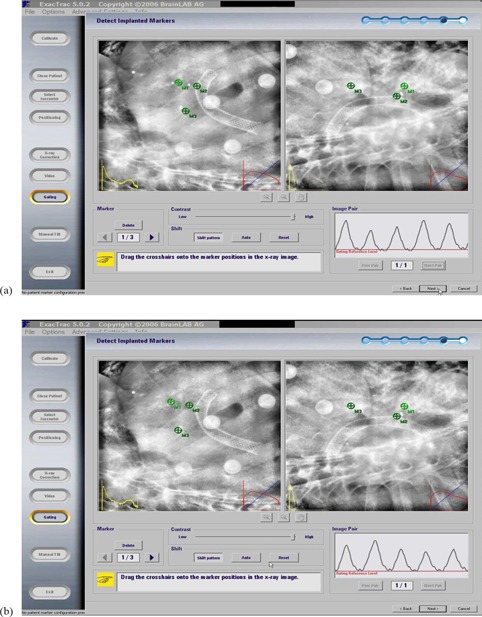
For Stereotactic Body Radiation Therapy (SBRT) treatment of lung and liver, we quantified the differences between two image guidance methods: 4DCT and ExacTrac respiratory-triggered imaging. Five different patients with five liver lesions and one lung lesion for a total of 19 SBRT delivered fractions were studied. For the 4DCT method, a manual registration process was used between the 4DCT image sets from initial simulation and treatment day to determine the required daily image-guided corrections. We also used the ExacTrac respiratory-triggered imaging capability to verify the target positioning, and calculated the differences in image guidance shifts between these two methods. The mean (standard deviation) of the observed differences in image-guided shifts between 4DCT and ExacTrac respiratory-triggered image guidance was left/right (L/R) = 0.4 (2.0) mm, anterior/posterior (A/P) = 1.4 (1.7) mm, superior/inferior (S/I) = 2.2 (2.0) mm, with no difference larger than 5.0 mm in any given direction for any individual case. The largest error occurred in the S/I direction, with a mean of 2.2 mm for the six lesions. This seems reasonable, because respiratory motion and the resulting imaging uncertainties are most pronounced in this S/I direction. Image guidance shifts derived from ExacTrac triggered imaging at two extreme breathing phases (i.e., full exhale vs. full inhale), agreed well (less than 2.0 mm) with each other. In summary, two very promising image guidance methods of 4DCT and ExacTrac respiratory-triggered imaging were presented and the image guidance shifts were comparable for the patients evaluated in this study.
对于立体定向体部放射治疗(SBRT)治疗肺部和肝脏,我们量化了两种图像引导方法之间的差异:4DCT 和 ExacTrac 呼吸触发成像。研究了总共 19 个 SBRT 分次治疗的 5 个不同的肝脏病变和 1 个肺部病变的 5 个不同患者。对于 4DCT 方法,在初始模拟和治疗日之间使用 4DCT 图像集的手动配准过程来确定所需的每日图像引导校正。我们还使用 ExacTrac 呼吸触发成像功能来验证目标定位,并计算这两种方法之间的图像引导移位差异。4DCT 和 ExacTrac 呼吸触发图像引导之间观察到的图像引导移位差异的平均值(标准差)为左右(L/R)= 0.4(2.0)mm,前后(A/P)= 1.4(1.7)mm,上下(S/I)= 2.2(2.0)mm,在任何给定方向上没有任何个体病例的差异大于 5.0mm。最大误差发生在 S/I 方向,六个病变的平均值为 2.2mm。这似乎是合理的,因为呼吸运动和由此产生的成像不确定性在这个 S/I 方向上最为明显。在两个极端呼吸阶段(即完全呼气与完全吸气)下,从 ExacTrac 触发成像获得的图像引导移位彼此吻合良好(小于 2.0mm)。总之,本文提出了两种非常有前途的图像引导方法,即 4DCT 和 ExacTrac 呼吸触发成像,并且在本研究中评估的患者中,图像引导移位是可比的。