Department of Radiation Oncology, University of Colorado School of Medicine, Aurora, Colorado.
Department of Radiation Oncology, University of Colorado School of Medicine, Aurora, Colorado.
Int J Radiat Oncol Biol Phys. 2019 Jan 1;103(1):268-275. doi: 10.1016/j.ijrobp.2018.08.021. Epub 2018 Aug 24.
Motion often hinders the safe delivery of ablative doses of radiation in the treatment of pancreatic tumors. Real-time tumor-tracking methods are an emerging technique to increase the accuracy of delivery. In this study, we report on a large, retrospective cohort of pancreatic patients treated with real-time, fiducial-based, kV-image guidance of stereotactic body radiation therapy (SBRT). The purpose of our study was to determine the impact of real-time tracking on treatment accuracy, tumor dose, and clinical workflow.
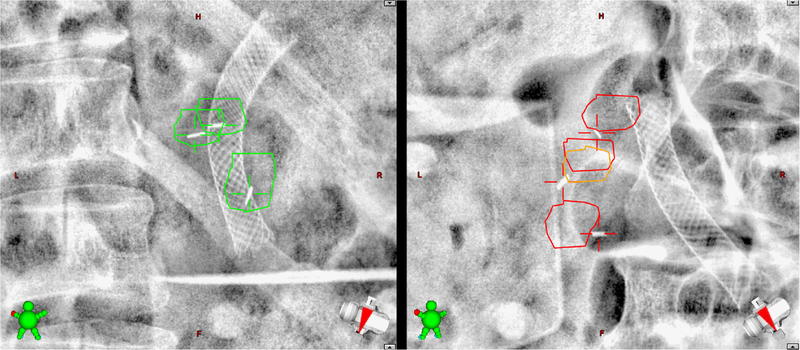
Real-time tracking data from 68 patients treated with pancreatic SBRT were analyzed. The kV images orthogonal to the treatment beam were acquired in real time during treatment to visualize the location of implanted fiducial markers. Positional corrections were made if the fiducial markers were observed >3 mm from the expected reference position. We recorded the frequency and nature of treatment interventions resulting from real-time tracking and derived a neural network-based dosimetric model to calculate the impact of these in-treatment interventions on target dose.
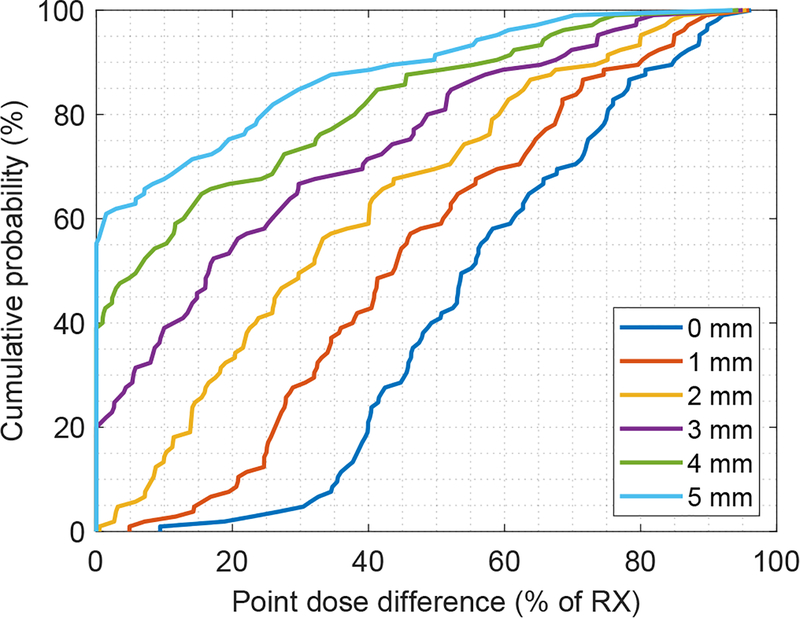
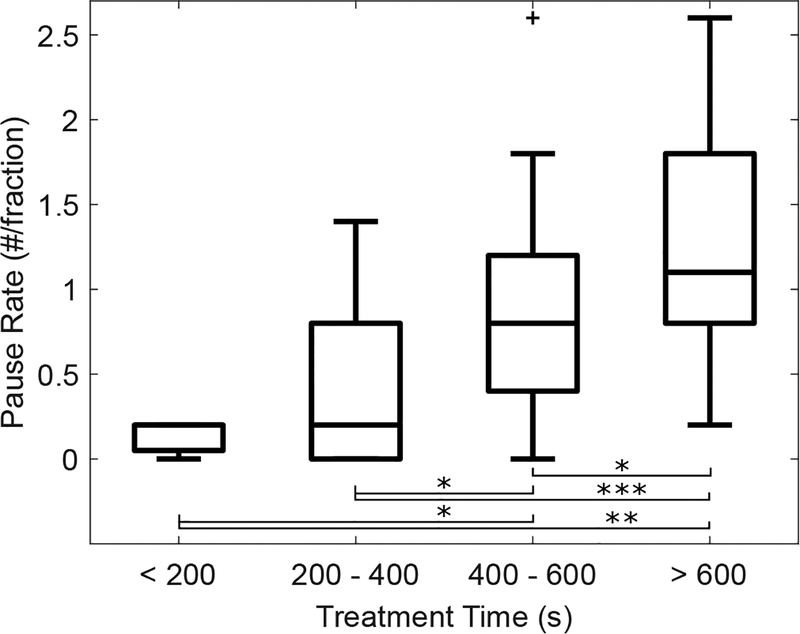
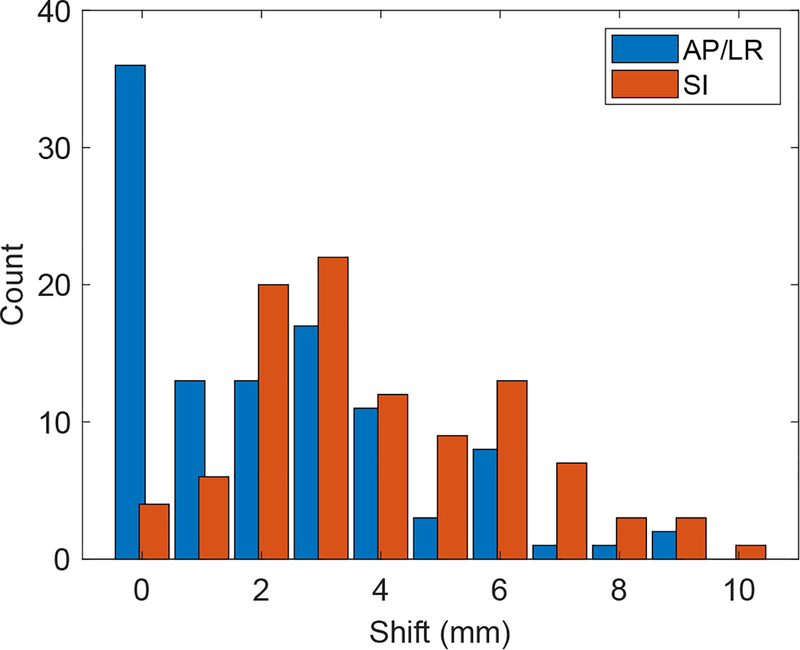
Treatment pauses that required patient realignment because of real-time tumor tracking occurred during 32% of all fractions. The median magnitude of realignment shifts was 5.2 mm (range, 2.1-18.9 mm). Forty-five percent of shifts resulted in dosimetric differences to the tumor; of these, the median point dose difference was 23% ± 22% of prescription dose (maximum, 94%). The number of pauses per fraction was significantly higher in patients treated with respiratory gating (vs abdominal compression) and in patients with greater treatment time.
Fiducial-based, real-time target tracking is clinically feasible for pancreatic SBRT treatment. Our data indicate that real-time tumor tracking leads to patient realignment in 32% of cases and results in significant benefits to target coverage. The increased accuracy of real-time target tracking may potentially enable safe dose escalation in pancreatic SBRT.
运动常常会妨碍胰腺肿瘤消融剂量的放射治疗的安全实施。实时肿瘤跟踪方法是提高传输精度的新兴技术。在这项研究中,我们报告了一组大型的、回顾性的胰腺患者队列,他们接受了实时、基于基准点的、立体定向体部放射治疗(SBRT)的千伏图像引导。本研究的目的是确定实时跟踪对治疗准确性、肿瘤剂量和临床工作流程的影响。
对 68 例接受胰腺 SBRT 治疗的患者的实时跟踪数据进行了分析。在治疗过程中,实时获取与治疗束正交的千伏图像,以显示植入基准点标记的位置。如果基准标记被观察到距离预期参考位置超过 3 毫米,则进行位置校正。我们记录了由于实时跟踪而导致的治疗干预的频率和性质,并得出了一个基于神经网络的剂量模型,以计算这些治疗中干预对靶剂量的影响。
由于实时肿瘤跟踪需要患者重新对准,导致 32%的所有分次治疗暂停。重新对准的中位数为 5.2 毫米(范围,2.1-18.9 毫米)。45%的移位导致肿瘤剂量差异;其中,中位数点剂量差异为处方剂量的 23%±22%(最大值为 94%)。与呼吸门控(与腹部压缩相比)和治疗时间较长的患者相比,每个分次的暂停次数显著增加。
基于基准点的实时靶标跟踪对于胰腺 SBRT 治疗是临床可行的。我们的数据表明,实时肿瘤跟踪导致 32%的病例需要患者重新对准,并显著提高了靶区覆盖率。实时靶标跟踪的准确性提高可能使胰腺 SBRT 的安全剂量升级成为可能。