Division of Geriatric Psychiatry, New York State Psychiatric Institute, College of Physicians and Surgeons, Columbia University, NY, USA.
Int J Geriatr Psychiatry. 2011 Sep;26(9):937-43. doi: 10.1002/gps.2630. Epub 2010 Dec 28.
In patients with Alzheimer's disease (AD) with psychosis or agitation that respond to haloperidol treatment, to evaluate the risk of relapse following discontinuation.
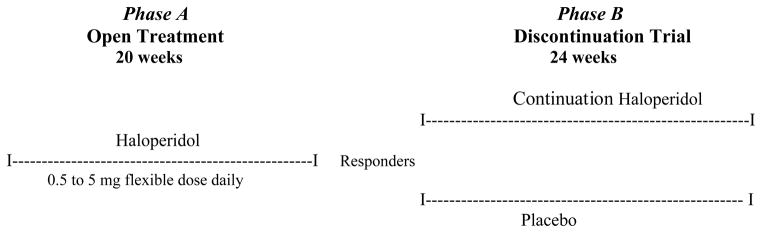
In outpatients with AD with symptoms of psychosis or agitation, responders to 20 weeks of haloperidol (0.5-5 mg daily) were randomized to a 24-week, double-blind pilot trial of discontinuation on placebo versus continuation haloperidol. Phase A response criteria were minimum 50% reduction in three target symptoms, and improvement on the Clinical Global Impression-Change (CGI-C) score for psychosis/agitation. Phase B relapse criteria required 50% worsening in target symptoms and on the CGI-C. α = 0.1 was the significance criterion in this pilot study.
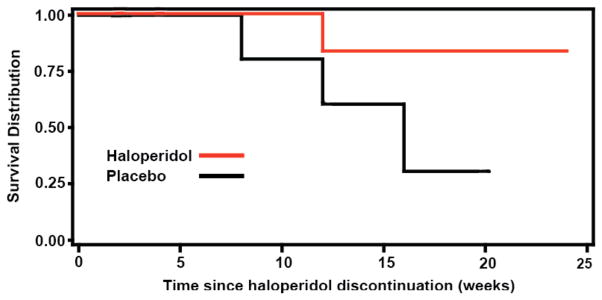
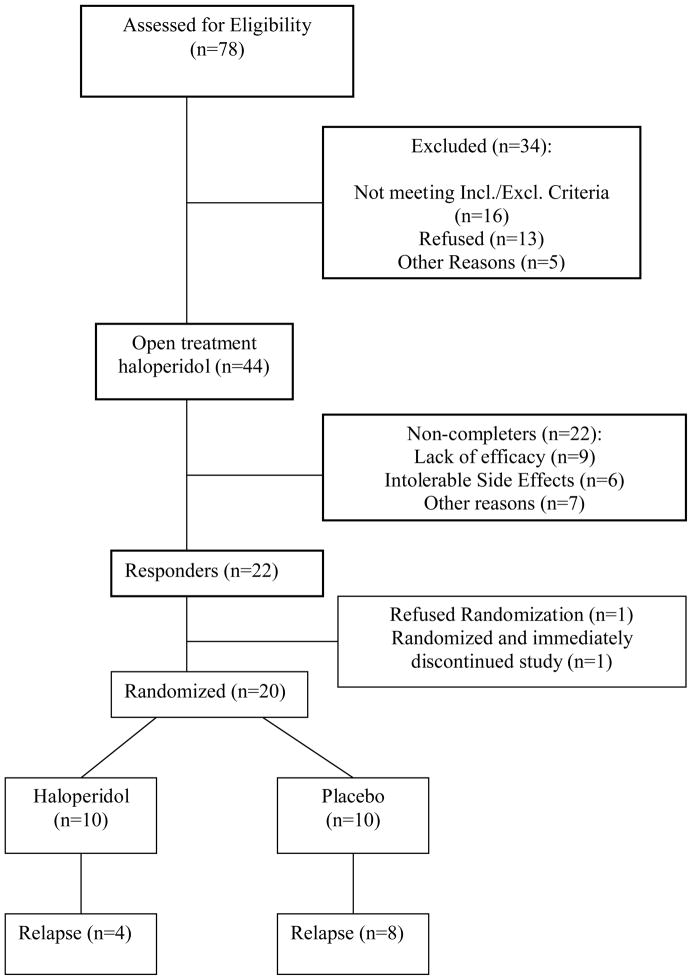
Of 44 patients, 22 patients responded in Phase A. The sum score of target symptoms, and Brief Psychiatric Rating Scale (BPRS) psychosis and hostile suspiciousness factor scores, decreased in Phase A (p's < 0.001). Extrapyramidal signs increased in Phase A (p < 0.01). Of 22 responders, 21 patients entered Phase B, and 20 had at least one follow-up visit. Four of 10 patients (40%) on continuation haloperidol relapsed compared to eight of 10 patients on placebo (80%, χ(2) = 3.3, p = 0.07). In survival analyses, time to relapse was shorter on placebo than haloperidol (χ(2) = 4.1, p = 0.04).
Haloperidol open treatment was efficacious, and relapse was greater on placebo than with haloperidol continuation. In patients with AD who have psychosis or agitation and respond to antipsychotic medication, the increased risk of relapse after discontinuation needs to be weighed against the side effects associated with continuing the medication.
在伴有精神病或激越症状且对氟哌啶醇治疗有反应的阿尔茨海默病(AD)患者中,评估停药后的复发风险。
在伴有精神病或激越症状的 AD 门诊患者中,对氟哌啶醇(0.5-5mg/天)治疗 20 周有反应的患者随机分为 24 周、双盲、安慰剂对照、停药与继续氟哌啶醇的试验。A 期反应标准是三个目标症状至少减少 50%,精神病/激越的临床总体印象-变化(CGI-C)评分改善。B 期复发标准需要目标症状和 CGI-C 的恶化达到 50%。在这项试验中,α=0.1 为显著性标准。
在 44 例患者中,有 22 例患者在 A 期有反应。A 期目标症状总和,简明精神病评定量表(BPRS)精神病和敌对猜疑因子评分降低(p 值均<0.001)。A 期锥体外系症状增加(p<0.01)。在 22 名有反应的患者中,21 名患者进入 B 期,20 名患者至少有一次随访。继续氟哌啶醇治疗的 10 例患者中有 4 例(40%)复发,安慰剂组的 10 例患者中有 8 例(80%)复发(χ(2) =3.3,p=0.07)。生存分析显示,安慰剂组的复发时间短于氟哌啶醇组(χ(2) =4.1,p=0.04)。
氟哌啶醇开放治疗有效,安慰剂组的复发率高于氟哌啶醇组。在有精神病或激越症状且对抗精神病药物有反应的 AD 患者中,停药后复发的风险增加需要与继续用药相关的副作用相权衡。