Division of General Internal Medicine and Center for Human Nutrition, University of Colorado School of Medicine, Address: Campus Box C-263, 13001 E, 17th Place, Aurora, Colorado 80045, USA.
BMC Health Serv Res. 2011 Aug 17;11:191. doi: 10.1186/1472-6963-11-191.
Overweight and obesity are associated with many conditions treated in primary care. Our objectives were: 1) to determine the frequency of weight-related conditions in a national sample of outpatient visits in the United States; 2) to establish the percentage of diagnosis codes and visit codes attributable to overweight and obesity; and 3) to estimate time spent to address these conditions, including time attributable to overweight and obesity itself.
We analyzed primary care visits from the 2005 and 2006 National Ambulatory Medical Care Survey (NAMCS) in the United States. Weight-related conditions included diabetes, hypertension, hyperlipidemia, obesity, cardiovascular disease, osteoarthritis, and low back pain. We used multivariable logistic regression to estimate an odds ratio for each weight-related condition, which we then converted to an attributable fraction (AF). The AF represents the percentage of diagnosis codes and visit codes attributable to excess weight for that condition. We then divided total visit time among all diagnoses and clinical items addressed at the primary care visit. Finally, to calculate the time attributable to overweight and obesity, we multiplied the AFs by the time spent on each weight-related condition.
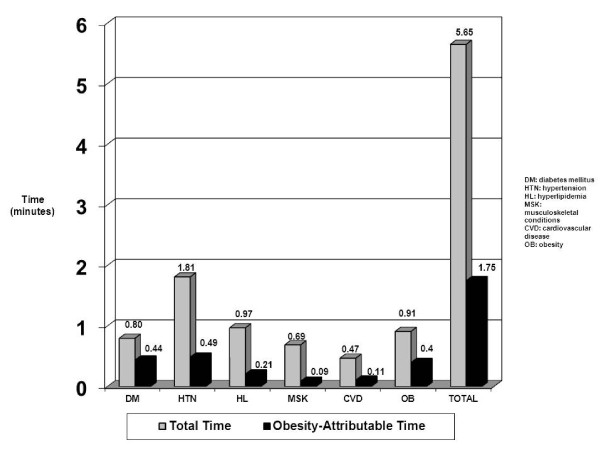
The total number of clinical items (diagnoses + medications + tests + counseling) was estimated to be 7.6 per patient, of which 2.2 were weight-related. Of a total visit time of 21.77 minutes, time spent addressing weight-related conditions was 5.65 minutes (30%), including 1.75 minutes (8.0%) attributable to overweight and obesity.
Approximately 8% of time from primary care visits is attributable to overweight and obesity. This estimate is conservative because the NAMCS only allows for coding of three diagnoses addressed per visit. Estimates of the time burden of overweight and obesity provide data to prioritize weight management for prevention and treatment.
超重和肥胖与许多在初级保健中治疗的疾病有关。我们的目标是:1)确定美国全国门诊就诊者中与体重相关的疾病的发生频率;2)确定超重和肥胖相关的诊断代码和就诊代码的百分比;3)估计解决这些疾病所花费的时间,包括归因于超重和肥胖本身的时间。
我们分析了美国 2005 年和 2006 年全国门诊医疗调查(NAMCS)中的初级保健就诊。与体重相关的疾病包括糖尿病、高血压、血脂异常、肥胖、心血管疾病、骨关节炎和下腰痛。我们使用多变量逻辑回归来估计每个与体重相关的疾病的优势比,然后将其转换为归因分数(AF)。AF 代表该疾病归因于超重的诊断代码和就诊代码的百分比。然后,我们将所有诊断和临床项目的总就诊时间除以初级保健就诊时所涉及的项目。最后,为了计算归因于超重和肥胖的时间,我们将 AF 乘以与每个与体重相关的疾病相关的时间。
每位患者的临床项目总数(诊断+药物+检查+咨询)估计为 7.6 个,其中 2.2 个与体重相关。就诊时间总计 21.77 分钟,用于解决与体重相关的疾病的时间为 5.65 分钟(30%),其中 1.75 分钟(8.0%)归因于超重和肥胖。
大约 8%的初级保健就诊时间归因于超重和肥胖。这个估计是保守的,因为 NAMCS 只允许每个就诊编码三个诊断。超重和肥胖的时间负担估计为预防和治疗体重管理提供了数据支持。