Department of Microbiology and Immunology, University of Nevada School of Medicine, Reno, Nevada, USA.
mBio. 2011 Aug 16;2(4). doi: 10.1128/mBio.00136-11. Print 2011.
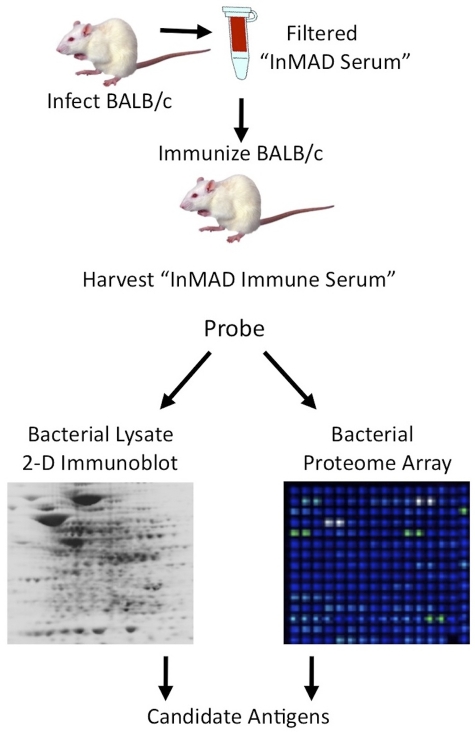
Detection of microbial antigens in clinical samples can lead to rapid diagnosis of an infection and administration of appropriate therapeutics. A major barrier in diagnostics development is determining which of the potentially hundreds or thousands of antigens produced by a microbe are actually present in patient samples in detectable amounts against a background of innumerable host proteins. In this report, we describe a strategy, termed in vivo microbial antigen discovery (InMAD), that we used to identify circulating bacterial antigens. This technique starts with "InMAD serum," which is filtered serum that has been harvested from BALB/c mice infected with a bacterial pathogen. The InMAD serum, which is free of whole bacterial cells, is used to immunize syngeneic BALB/c mice. The resulting "InMAD immune serum" contains antibodies specific for the soluble microbial antigens present in sera from the infected mice. The InMAD immune serum is then used to probe blots of bacterial lysates or bacterial proteome arrays. Bacterial antigens that are reactive with the InMAD immune serum are precisely the antigens to target in an antigen immunoassay. By employing InMAD, we identified multiple circulating antigens that are secreted or shed during infection using Burkholderia pseudomallei and Francisella tularensis as model organisms. Potential diagnostic targets identified by the InMAD approach included bacterial proteins, capsular polysaccharide, and lipopolysaccharide. The InMAD technique makes no assumptions other than immunogenicity and has the potential to be a broad discovery platform to identify diagnostic targets from microbial pathogens.
Effective treatment of microbial infection is critically dependent on early diagnosis and identification of the etiological agent. One means for rapid diagnosis is immunoassay for antigens that are shed into body fluids during infection. Immunoassays can be inexpensive, rapid, and adaptable to a point-of-care format. A major impediment to immunoassay for diagnosis of infectious disease is identification of appropriate antigen targets. This report describes a strategy that can be used for identification of microbial antigens that are shed into serum during infection by the biothreats Burkholderia pseudomallei and Francisella tularensis. Termed InMAD (in vivo microbial antigen discovery), the strategy has the potential for application to a broad spectrum of microbial pathogens.
在临床样本中检测微生物抗原可快速诊断感染并进行适当的治疗。诊断开发的一个主要障碍是确定数以百计或数千种微生物产生的潜在抗原中,哪些实际上以可检测的量存在于患者样本中,而背景是无数的宿主蛋白。在本报告中,我们描述了一种称为体内微生物抗原发现(InMAD)的策略,用于鉴定循环细菌抗原。该技术从“InMAD 血清”开始,即从感染细菌病原体的 BALB/c 小鼠中采集的过滤血清。InMAD 血清不含完整的细菌细胞,用于免疫同基因 BALB/c 小鼠。由此产生的“InMAD 免疫血清”包含针对感染小鼠血清中存在的可溶性微生物抗原的特异性抗体。然后,将“InMAD 免疫血清”用于探测细菌裂解物或细菌蛋白质组阵列的印迹。与“InMAD 免疫血清”反应的细菌抗原正是抗原免疫测定中要针对的抗原。通过采用 InMAD,我们使用 Burkholderia pseudomallei 和 Francisella tularensis 作为模型生物鉴定了在感染过程中分泌或脱落的多种循环抗原。InMAD 方法鉴定的潜在诊断靶标包括细菌蛋白、荚膜多糖和脂多糖。InMAD 技术除了免疫原性外没有其他假设,并且有可能成为一种广泛的发现平台,用于从微生物病原体中鉴定诊断靶标。
有效治疗微生物感染严重依赖于早期诊断和确定病原体。一种快速诊断方法是检测在感染期间释放到体液中的抗原的免疫测定。免疫测定可以是廉价、快速且适用于即时护理格式。免疫测定用于诊断传染病的主要障碍是鉴定适当的抗原靶标。本报告描述了一种可用于鉴定 Burkholderia pseudomallei 和 Francisella tularensis 等生物威胁感染期间释放到血清中的微生物抗原的策略。该策略称为 InMAD(体内微生物抗原发现),具有应用于广泛微生物病原体的潜力。