Department of Gastroenterology and Metabolism, Nagoya City University Graduate School of Medical Sciences, Nagoya, Japan.
Cancer Manag Res. 2011;3:267-72. doi: 10.2147/CMR.S22073. Epub 2011 Jul 28.
The purpose of this study was to clarify important risk factors for distant recurrence of hepatocellular carcinoma in patients positive for hepatitis C and without local recurrence.
A total of 212 patients (145 males and 67 females) underwent radiofrequency ablation and transcatheter arterial embolization or transcatheter arterial chemoembolization at initial development of hepatocellular carcinoma. All patients were positive for hepatitis C. Child-Pugh classification was A in 115 and B in 97. The indication for radiofrequency ablation was the presence of up to three tumors ≤ 3 cm. The distant recurrence rate was analyzed using the Kaplan-Meier method and tested by Wilcoxon's method.
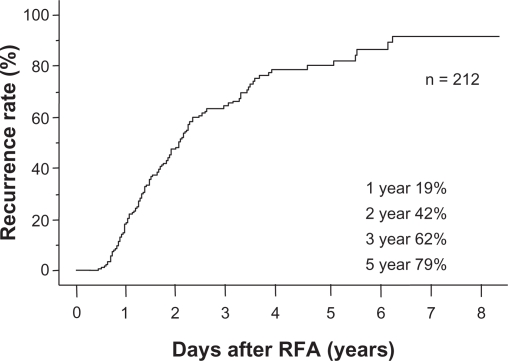
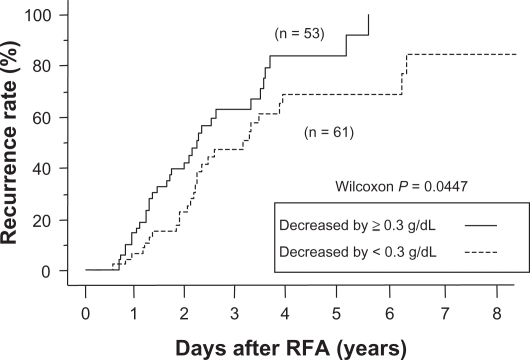
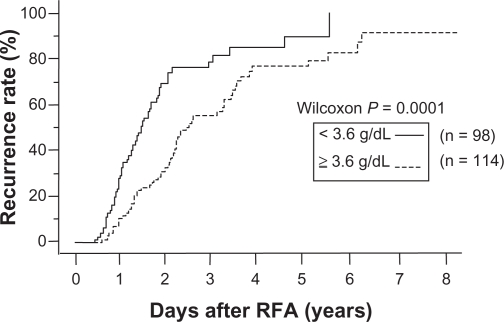
Cumulative distant recurrence rates at years 1, 3, and 5 were 19%, 62%, and 79%, respectively. On univariate analysis, a ≥ 3 cm tumor, ≥ 50 ng/mL α-fetoprotein level, and < 3.6 g/dL serum albumin level were significant risk factors for distant recurrence, but only a serum albumin level < 3.6 g/dL (P = 0.004) was identified as significant on multivariate analysis. In the group with a pretreatment albumin level ≥ 3.6 g/dL, the distant recurrence rate was compared between patients in whom the albumin level rose, remained unchanged, or decreased by < 0.3 g/dL, and those in whom the level decreased by ≥ 0.3 g/dL. The rate was significantly higher in the latter, with a one-year recurrence rate of 7% versus 15% (P = 0.04).
Distant recurrence was significantly decreased in patients with a high serum albumin level. Distant recurrence was more likely to occur in patients with a decreased albumin level, although the pretreatment level was high. Thus, strict follow-up after treatment for hepatocellular carcinoma is necessary in patients with low serum albumin levels.
本研究旨在明确丙型肝炎阳性且无局部复发的肝细胞癌患者远处复发的重要危险因素。
212 例(男 145 例,女 67 例)肝细胞癌初发时接受射频消融联合经导管动脉栓塞或经导管动脉化疗栓塞治疗。所有患者均为丙型肝炎阳性。Child-Pugh 分级 A 级 115 例,B 级 97 例。射频消融的适应证为存在 3 个最大直径≤3cm 的肿瘤。采用 Kaplan-Meier 法分析远处复发率,采用 Wilcoxon 法检验。
1、3、5 年累积远处复发率分别为 19%、62%和 79%。单因素分析显示,肿瘤≥3cm、α-胎蛋白水平≥50ng/ml 和血清白蛋白水平<3.6g/dl 是远处复发的显著危险因素,但仅血清白蛋白水平<3.6g/dl(P=0.004)在多因素分析中具有显著性。在治疗前白蛋白水平≥3.6g/dl 的患者中,将白蛋白水平升高、不变或下降<0.3g/dl 的患者与白蛋白水平下降≥0.3g/dl 的患者进行比较。后者远处复发率显著较高,1 年复发率分别为 7%和 15%(P=0.04)。
血清白蛋白水平升高显著降低了远处复发率。尽管治疗前白蛋白水平较高,但白蛋白水平下降的患者更易发生远处复发。因此,对于低血清白蛋白水平的肝细胞癌患者,治疗后需要进行严格的随访。