Cognitive Psychology Unit, Institute of Psychology, Leiden University, Wassenaarseweg 52, 2333 AK, Leiden, The Netherlands.
Psychopharmacology (Berl). 2012 Feb;219(4):971-9. doi: 10.1007/s00213-011-2426-x. Epub 2011 Aug 17.
Electrophysiological studies have identified a scalp potential, the late positive potential (LPP), which is modulated by the emotional intensity of observed stimuli. Previous work has shown that the LPP reflects the modulation of activity in extrastriate visual cortical structures, but little is known about the source of that modulation.
The present study investigated whether beta-adrenergic receptors are involved in the generation of the LPP.
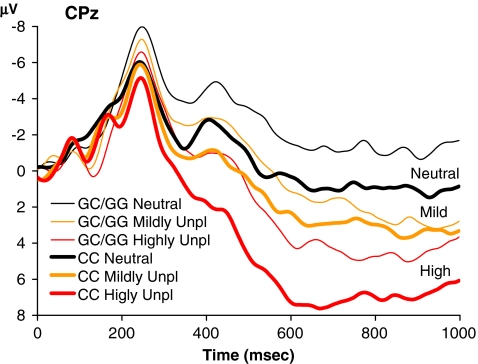
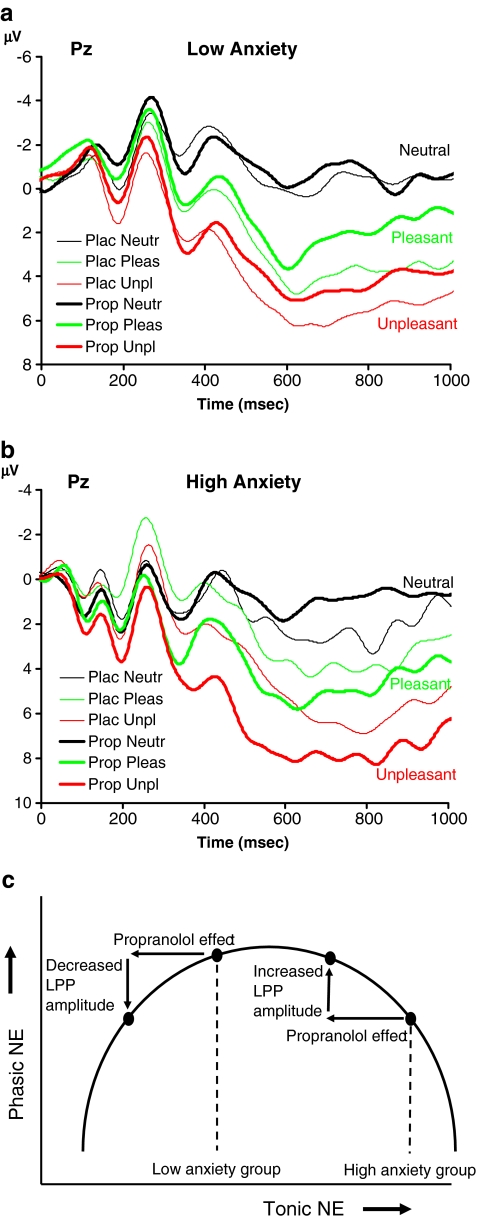
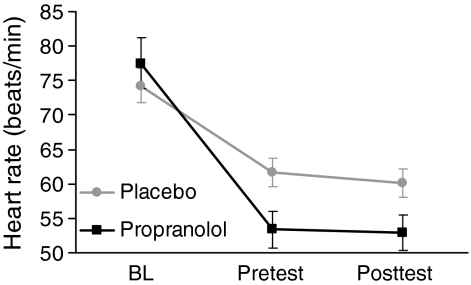
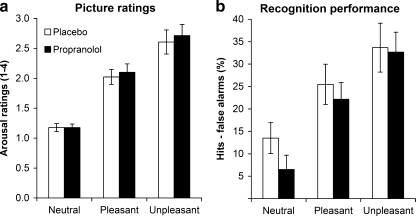
We used a genetic individual differences approach (experiment 1) and a pharmacological manipulation (experiment 2) to test the hypothesis that the LPP is modulated by the activation of β-adrenergic receptors.
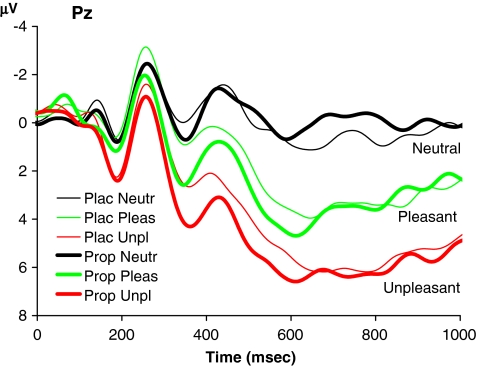
In experiment 1, we found that LPP amplitude depends on allelic variation in the β1-receptor gene polymorphism. In experiment 2, we found that LPP amplitude was modulated by the β-blocker propranolol in a direction dependent on subjects' level of trait anxiety: In participants with lower trait anxiety, propranolol led to a (nonsignificant) decrease in the LPP modulation; in participants with higher trait anxiety, propranolol increased the emotion-related LPP modulation.
These results provide initial support for the hypothesis that the LPP reflects the downstream effects, in visual cortical areas, of β-receptor-mediated activation of the amygdala.
电生理研究已经确定了一种头皮电位,即晚期正电位(LPP),它受到观察到的刺激的情绪强度的调节。以前的工作表明,LPP 反映了对大脑视觉皮层结构活动的调节,但对于这种调节的来源知之甚少。
本研究旨在探讨β-肾上腺素能受体是否参与了 LPP 的产生。
我们使用遗传个体差异方法(实验 1)和药物处理(实验 2)来检验这样一个假设,即 LPP 的调制取决于β-肾上腺素能受体的激活。
在实验 1 中,我们发现 LPP 幅度取决于β1-受体基因多态性的等位基因变异。在实验 2 中,我们发现 LPP 幅度被β-阻滞剂普萘洛尔调制,其方向取决于受试者特质焦虑的水平:在特质焦虑较低的参与者中,普萘洛尔导致 LPP 调制的(非显著)降低;在特质焦虑较高的参与者中,普萘洛尔增加了与情绪相关的 LPP 调制。
这些结果初步支持了这样一种假设,即 LPP 反映了杏仁核介导的β-受体激活对大脑视觉皮层区域的下游影响。