Department of Surgery, University of Vermont, Burlington, VT 05401, USA.
Breast Cancer Res Treat. 2012 Jan;131(1):255-65. doi: 10.1007/s10549-011-1726-5. Epub 2011 Aug 17.
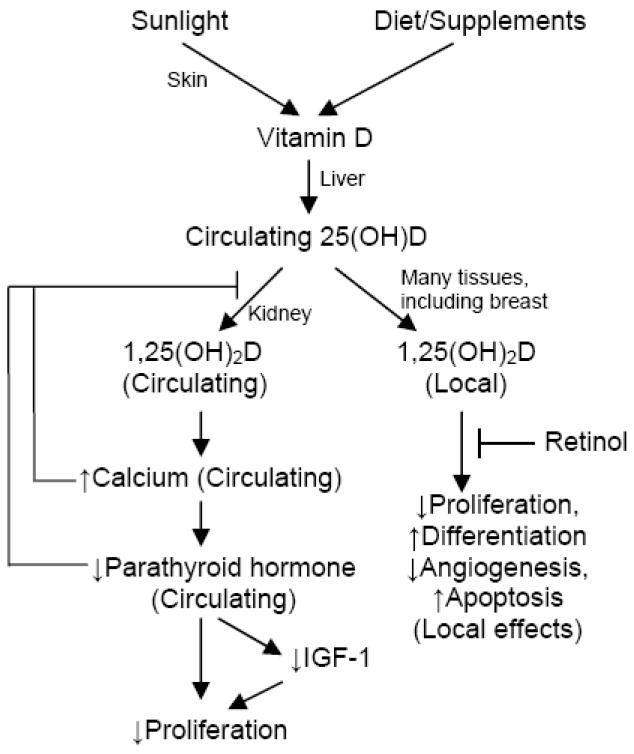
Laboratory studies have demonstrated that vitamin D has a number of chemopreventive properties, and that these properties may be mediated or modified by other molecules in the vitamin D pathway, such as parathyroid hormone (PTH) or calcium. However, there is little epidemiologic data exploring the effects of vitamin D on breast cancer risk in the context of these other molecules. We examined a panel of molecules in the vitamin D pathway in relation to mammographic breast density, a marker of breast cancer risk, in the Wisconsin Breast Density Study. A total of 238 postmenopausal women (ages 55-70, with no history of postmenopausal hormone use) were enrolled from mammography clinics in Madison, Wisconsin. Subjects provided blood samples that were analyzed for levels of 25-hydroxy vitamin D [25(OH)D], PTH, insulin-like growth factor-1 (IGF-1), IGF-binding protein 3 (IGFBP-3), retinol, and calcium. Percent breast density was measured using Cumulus software. In age-adjusted analyses there was a positive association between 25(OH)D and percent breast density (P = 0.05; mean percent density = 11.3% vs. 15.6% for 1st vs. 4th quartile of 25(OH)D). Breast density was inversely associated with PTH (P = 0.05; 16.0% vs. 11.4% for Q1 vs. Q4) and positively associated with the IGF-1:IGFBP-3 molar ratio (P = 0.02; 11.9% vs. 15.6% for Q1 vs. Q4). However, these associations were all null after further adjustment for body mass index (BMI; P > 0.25). The independent relation between 25(OH)D and breast density remained null among subgroups defined by BMI and serum levels of retinol, calcium, and estradiol. These results suggest no strong independent associations between the circulating molecules of the vitamin D pathway and mammographic breast density in postmenopausal women. While it remains possible that vitamin D could influence breast cancer risk, our results suggest that such an effect would be mediated through pathways other than breast density.
实验室研究表明,维生素 D 具有多种化学预防特性,这些特性可能由维生素 D 途径中的其他分子(如甲状旁腺激素 (PTH) 或钙)介导或调节。然而,几乎没有流行病学数据探讨维生素 D 对这些其他分子背景下乳腺癌风险的影响。我们在威斯康星州乳腺密度研究中检查了维生素 D 途径中的一组分子与乳腺 X 光密度的关系,乳腺 X 光密度是乳腺癌风险的标志物。共有 238 名绝经后妇女(年龄 55-70 岁,无绝经后激素使用史)从威斯康星州麦迪逊的乳房 X 光检查诊所招募。受试者提供血液样本,用于分析 25-羟维生素 D [25(OH)D]、甲状旁腺激素 (PTH)、胰岛素样生长因子-1 (IGF-1)、胰岛素样生长因子结合蛋白 3 (IGFBP-3)、视黄醇和钙的水平。使用 Cumulus 软件测量乳腺密度百分比。在年龄调整分析中,25(OH)D 与乳腺密度呈正相关(P = 0.05;第 1 四分位组的平均密度百分比为 11.3%,第 4 四分位组为 15.6%)。乳腺密度与 PTH 呈负相关(P = 0.05;第 1 四分位组为 16.0%,第 4 四分位组为 11.4%),与 IGF-1:IGFBP-3 摩尔比呈正相关(P = 0.02;第 1 四分位组为 11.9%,第 4 四分位组为 15.6%)。然而,在进一步调整体重指数 (BMI) 后,这些关联均变为无效(P > 0.25)。在根据 BMI 和视黄醇、钙和雌二醇的血清水平定义的亚组中,25(OH)D 与乳腺密度之间的独立关系仍然无效。这些结果表明,绝经后妇女循环的维生素 D 途径分子与乳腺 X 光密度之间没有很强的独立关联。虽然维生素 D 可能会影响乳腺癌风险,但我们的结果表明,这种影响可能通过乳腺密度以外的途径介导。