Hannover Medical School, Institute of Toxicology, Carl-Neuberg-Str, 1, D-30625 Hannover, Germany.
Proteome Sci. 2011 Aug 17;9:48. doi: 10.1186/1477-5956-9-48.
The anaerobe Clostridium difficile produces two major virulence factors toxin A and B that inactivate Rho proteins by glucosylation of a pivotal threonine residue. Purified toxins induce reorganization of the cytoskeleton and cell death in colonic cells. Whether all toxin effects on target cells depend on catalytic glucosyltransferase activity is unclear at present. Thus, we conducted a proteome approach to compare the protein profile of target cells treated either with wild type toxin A (rTcdA wt) or with a catalytically inactive mutant toxin A (mutant rTcdA). Relative protein quantification was feasible using isotope-coded protein labeling techniques (ICPL) and mass spectrometry (LC-MALDI).
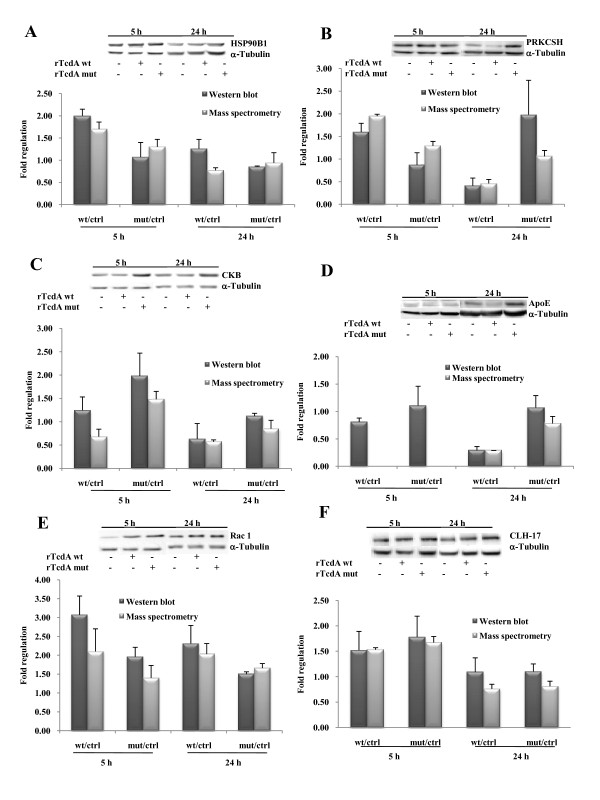
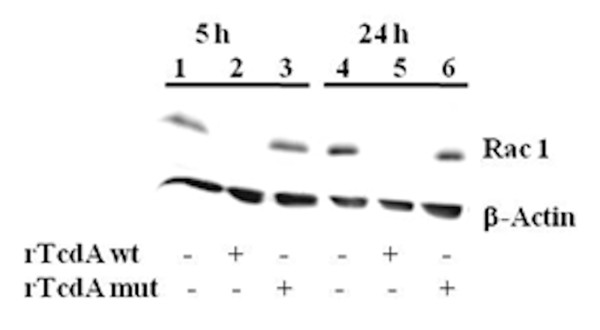
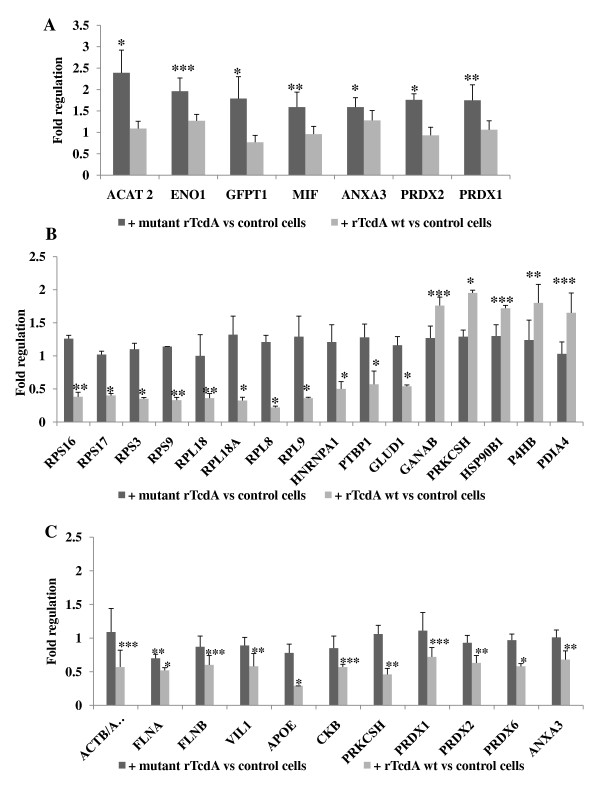
Altogether we found a significant differential expression of thirty proteins after treatment with rTcdA wt or mutant rTcdA. Mutant rTcdA caused up-regulation of seven proteins and sixteen proteins were responsive to rTcdA wt after 5 h. Long-term effect of rTcdA wt on protein expression was the down-regulation of eleven proteins. Up- or down-regulation of several proteins was verified by western blot analysis confirming the MS results.
Our results indicate incubation time-dependent effects of the clostridial glucosylating toxin A on colonic cells. The rTcdA wt impact more cellular functions than actin cytoskeleton reorganization and apoptosis. Furthermore, these data give insight into glucosyltransferase independent effects of clostridial glucosylating toxins on target cells after short incubation time. Additionally, our data reveal pro-inflammatory and proliferative effects of mutant rTcdA after short-term incubation.
厌氧菌艰难梭菌产生两种主要的毒力因子毒素 A 和 B,通过关键苏氨酸残基的葡糖基化使 Rho 蛋白失活。纯化的毒素诱导结肠细胞骨架的重排和细胞死亡。目前尚不清楚所有毒素对靶细胞的作用是否都依赖于催化葡糖基转移酶活性。因此,我们采用蛋白质组学方法比较了用野生型毒素 A(rTcdA wt)或催化失活突变体毒素 A(突变 rTcdA)处理的靶细胞的蛋白质谱。使用同位素编码蛋白质标记技术(ICPL)和液相色谱-基质辅助激光解吸电离飞行时间质谱(LC-MALDI)可实现相对蛋白质定量。
在用 rTcdA wt 或突变 rTcdA 处理后,我们总共发现 30 种蛋白质的表达有显著差异。突变 rTcdA 引起 7 种蛋白质上调,16 种蛋白质在 5 小时后对 rTcdA wt 有反应。rTcdA wt 对蛋白质表达的长期影响是 11 种蛋白质下调。通过 Western blot 分析验证了几个蛋白质的上调或下调,证实了 MS 结果。
我们的结果表明,梭菌葡糖基化毒素 A 对结肠细胞的作用随孵育时间而变化。rTcdA wt 对细胞的影响不仅仅是肌动蛋白细胞骨架重排和细胞凋亡,还涉及其他功能。此外,这些数据表明,在短孵育时间内,梭菌葡糖基化毒素的葡糖基转移酶非依赖性作用会影响靶细胞。此外,我们的数据还揭示了短时间孵育后突变 rTcdA 的促炎和促增殖作用。