Sociedad Argentina de Terapia Intensiva, The Registry of the Argentinian Society of Intensive Care, Niceto Vega 4617, C1414BEA Ciudad de Buenos Aires, Argentina.
Crit Care. 2011 Aug 17;15(4):R201. doi: 10.1186/cc10369.
Most cases of the 2009 influenza A (H1N1) infection are self-limited, but occasionally the disease evolves to a severe condition needing hospitalization. Here we describe the evolution of the respiratory compromise, ventilatory management and laboratory variables of patients with diffuse viral pneumonitis caused by pandemic 2009 influenza A (H1N1) admitted to the ICU.
This was a multicenter, prospective inception cohort study including adult patients with acute respiratory failure requiring mechanical ventilation (MV) admitted to 20 ICUs in Argentina between June and September of 2009 during the influenza A (H1N1) pandemic. In a standard case-report form, we collected epidemiological characteristics, results of real-time reverse-transcriptase--polymerase-chain-reaction viral diagnostic tests, oxygenation variables, acid-base status, respiratory mechanics, ventilation management and laboratory tests. Variables were recorded on ICU admission and at days 3, 7 and 10.
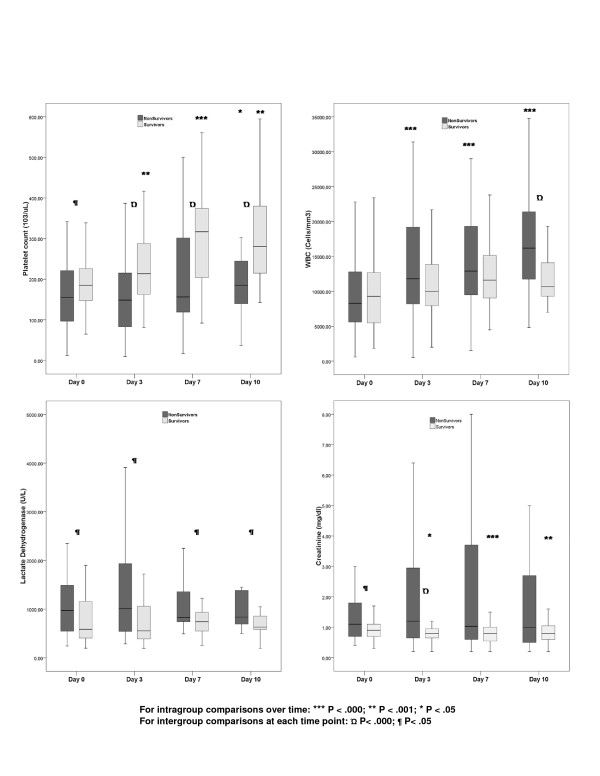
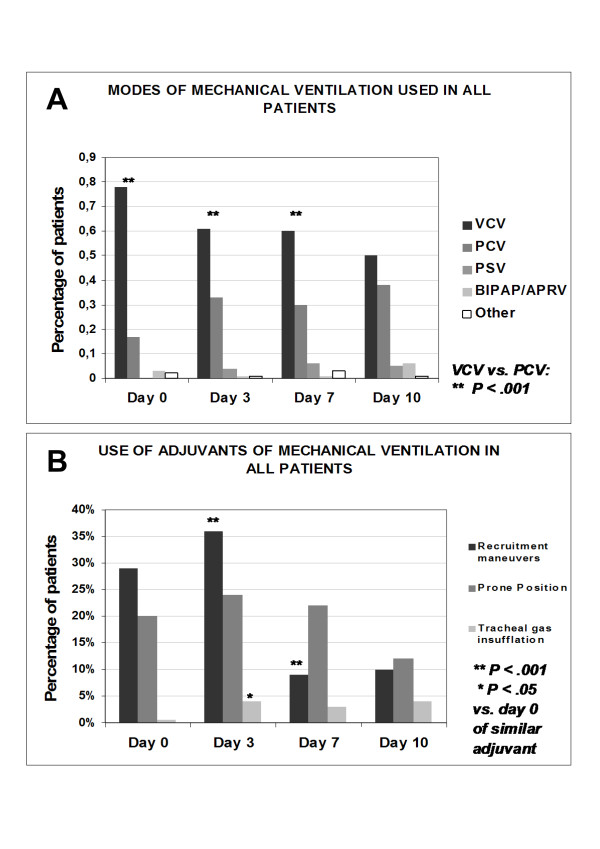
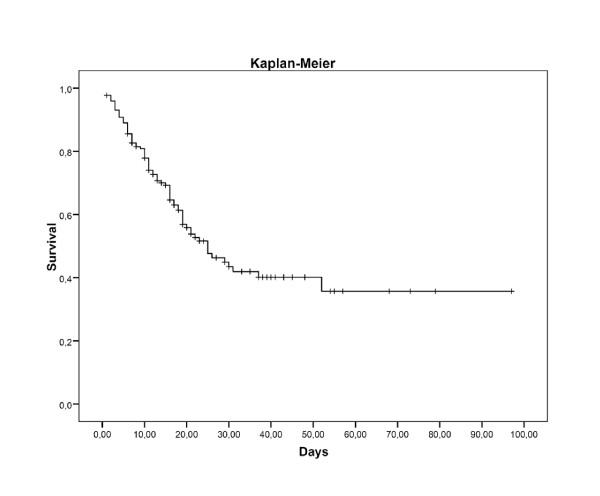
During the study period 178 patients with diffuse viral pneumonitis requiring MV were admitted. They were 44 ± 15 years of age, with Acute Physiology And Chronic Health Evaluation II (APACHE II) scores of 18 ± 7, and most frequent comorbidities were obesity (26%), previous respiratory disease (24%) and immunosuppression (16%). Non-invasive ventilation (NIV) was applied in 49 (28%) patients on admission, but 94% were later intubated.Acute respiratory distress syndrome (ARDS) was present throughout the entire ICU stay in the whole group (mean PaO2/FIO2 170 ± 25). Tidal-volumes used were 7.8 to 8.1 ml/kg (ideal body weight), plateau pressures always remained < 30 cmH2O, without differences between survivors and non-survivors; and mean positive end-expiratory pressure (PEEP) levels used were between 8 to 12 cm H2O. Rescue therapies, like recruitment maneuvers (8 to 35%), prone positioning (12 to 24%) and tracheal gas insufflation (3%) were frequently applied. At all time points, pH, platelet count, lactate dehydrogenase assay (LDH) and Sequential Organ Failure Assessment (SOFA) differed significantly between survivors and non-survivors. Lack of recovery of platelet count and persistence of leukocytosis were characteristic of non-survivors. Mortality was high (46%); and length of MV was 10 (6 to 17) days.
These patients had severe, hypoxemic respiratory failure compatible with ARDS that persisted over time, frequently requiring rescue therapies to support oxygenation. NIV use is not warranted, given its high failure rate. Death and evolution to prolonged mechanical ventilation were common outcomes. Persistence of thrombocytopenia, acidosis and leukocytosis, and high LDH levels found in non-survivors during the course of the disease might be novel prognostic findings.
大多数 2009 年甲型流感(H1N1)感染病例为自限性,但偶尔疾病会发展为需要住院的严重情况。在此,我们描述了由大流行 2009 年甲型流感(H1N1)引起的弥漫性病毒性肺炎患者在入住 ICU 后呼吸窘迫的演变、通气管理和实验室变量。
这是一项多中心、前瞻性的起始队列研究,纳入了 2009 年 6 月至 9 月期间阿根廷 20 家 ICU 中因急性呼吸衰竭需要机械通气(MV)的成年患者。在标准病例报告表中,我们收集了流行病学特征、实时逆转录-聚合酶链反应病毒诊断检测结果、氧合变量、酸碱状态、呼吸力学、通气管理和实验室检测结果。在 ICU 入院时和第 3、7、10 天记录变量。
在研究期间,178 例需要 MV 的弥漫性病毒性肺炎患者被纳入。他们的年龄为 44 ± 15 岁,急性生理学和慢性健康评估 II(APACHE II)评分为 18 ± 7,最常见的合并症是肥胖(26%)、既往呼吸疾病(24%)和免疫抑制(16%)。入院时 49 例(28%)患者应用了无创通气(NIV),但 94%的患者后来都进行了插管。整个 ICU 住院期间,所有患者均存在急性呼吸窘迫综合征(ARDS)(平均 PaO2/FIO2 为 170 ± 25)。潮气量为 7.8 至 8.1ml/kg(理想体重),平台压始终保持在<30cmH2O,幸存者和非幸存者之间无差异;平均呼气末正压(PEEP)水平在 8 至 12cmH2O 之间。经常应用复苏治疗,如肺复张手法(8 至 35%)、俯卧位(12 至 24%)和气管内充气(3%)。在所有时间点,幸存者和非幸存者之间的 pH 值、血小板计数、乳酸脱氢酶(LDH)和序贯器官衰竭评估(SOFA)均有显著差异。血小板计数无恢复和白细胞增多持续存在是非幸存者的特征。死亡率高(46%);MV 时间为 10(6 至 17)天。
这些患者有严重的低氧性呼吸衰竭,符合 ARDS,且随时间推移持续存在,常需要复苏治疗以支持氧合。由于其高失败率,不推荐使用 NIV。死亡和发展为长时间机械通气是常见的结局。非幸存者在疾病过程中发现血小板减少症、酸中毒和白细胞增多症以及高 LDH 水平可能是新的预后发现。