Li Naiyang, Wang Xiaoran, Wan Pengxia, Huang Minghai, Wu Zheng, Liang Xuanwei, Liu Ying, Ge Jian, Huang Junqi, Wang Zhichong
State Key Laboratory of Ophthalmology, Sun Yat-sen University, Guangzhou, P.R. China.
Mol Vis. 2011;17:1909-17. Epub 2011 Jul 15.
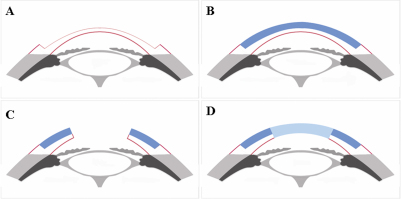
Tectonic lamellar keratoplasty (TLKP) is a primary surgical procedure to improve the condition of the recipient bed in high-risk corneal transplantation. It is usually performed for a secondary optical penetrating keratoplasty (PKP). The present study was undertaken to explore a new strategy for TLKP using acellular corneal stroma (ACS) prepared by decellularization.
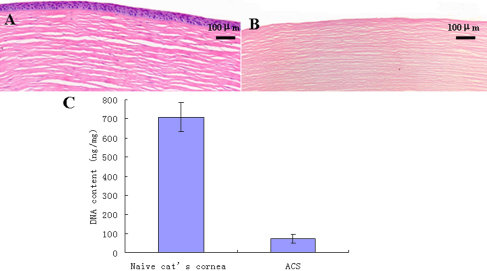
ACS for TLKP was prepared from cat cornea by decellularization. The efficiency of the decellularization was examined by hematoxylin and eosin (H&E) staining and through DNA content analysis. Twenty-eight New Zealand white rabbits, as recipients, were assigned to one of two groups that had different material for their TLKP. The TLKP was combined with a central optical PKP as a single-stage procedure. Either ACS or fresh cat corneal lamella, 11.25 mm in diameter, was used for the TLKP in these two groups. After TLKP, a 6.5-mm full-thickness cat cornea was placed in the central cornea of each recipient rabbit for PKP. Clinical outcomes and the histology of the transplants were compared post-operatively.
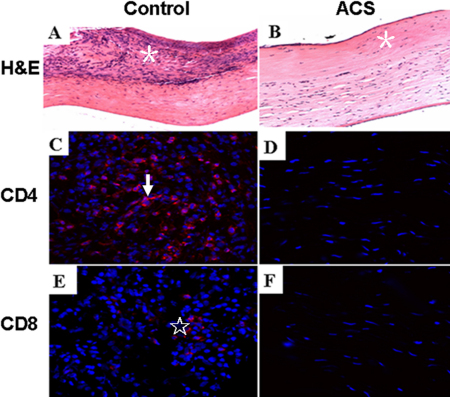
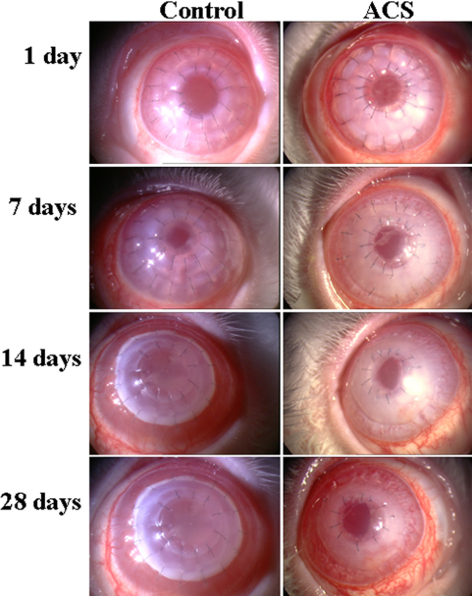
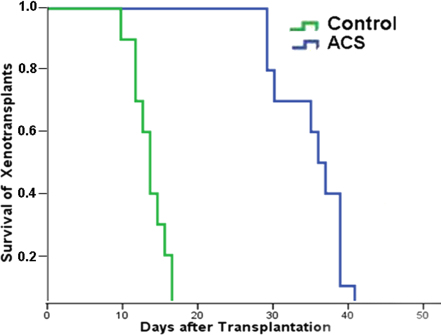
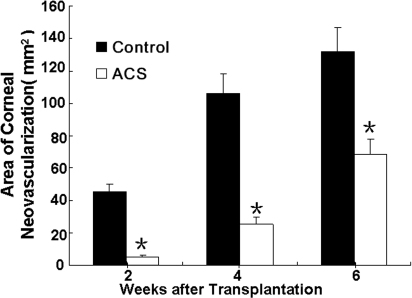
ACS for TLKP prolonged the survival of the transplants. The mean survival time of the transplants in the ACS group (36.4±4.3 days) was longer than for those in the control group (14.0±2.2 days, p<0.05). The ACS group showed a significantly smaller neovascularization area compared to the control group. The areas of corneal neovascularization were 5.3±1.1 mm² and 45.2±4.9 mm² (p<0.05), respectively, after two weeks, and 25.1±4.7 mm² and 105.3±12.4 mm² (p<0.05), respectively, after four weeks. Histology revealed that fewer inflammatory cells were infiltrating the transplants in the ACS group than those in the control group.
The use of ACS for TLKP prolonged the survival of corneal transplants, reduced corneal neovascularization, and prevented from infiltration of inflammatory cells. It is a feasible and effective strategy to prolong the survival of transplants in high-risk corneal transplantation.
结构性板层角膜移植术(TLKP)是改善高危角膜移植受床状况的一种主要手术方法。它通常用于二期光学穿透性角膜移植术(PKP)。本研究旨在探索一种使用去细胞化制备的脱细胞角膜基质(ACS)进行TLKP的新策略。
通过去细胞化从猫角膜制备用于TLKP的ACS。通过苏木精和伊红(H&E)染色及DNA含量分析检测去细胞化效率。28只新西兰白兔作为受体,被分为两组,两组进行TLKP时使用不同材料。TLKP与中央光学PKP作为一期手术联合进行。两组中TLKP均使用直径11.25mm的ACS或新鲜猫角膜板层。TLKP后,将6.5mm全层猫角膜置于每只受体兔的中央角膜处进行PKP。术后比较移植片的临床结果和组织学情况。
用于TLKP的ACS延长了移植片的存活时间。ACS组移植片的平均存活时间(36.4±4.3天)长于对照组(14.0±2.2天,p<0.05)。与对照组相比,ACS组的新生血管化区域明显更小。两周后,角膜新生血管化面积分别为5.3±1.1mm²和45.2±4.9mm²(p<0.05),四周后分别为25.1±4.7mm²和105.3±12.4mm²(p<0.05)。组织学显示,ACS组移植片中浸润的炎性细胞比对照组少。
在TLKP中使用ACS可延长角膜移植片的存活时间,减少角膜新生血管化,并防止炎性细胞浸润。这是延长高危角膜移植中移植片存活时间的一种可行且有效的策略。