Meire Françoise, Delpierre Isabelle, Brachet Cecile, Roulez Françoise, Van Nechel Christian, Depasse Fanny, Christophe Catherine, Menten Björn, De Baere Elfride
Department of Ophthalmology, Queen Fabiola Children's University Hospital, Brussels, Belgium.
Mol Vis. 2011;17:2072-9. Epub 2011 Aug 5.
Optic nerve aplasia (ONA, OMIM 165550) is a very rare unilateral or bilateral condition that leads to blindness in the affected eye, and is usually associated with other ocular abnormalities. Although bilateral ONA often occurs in association with severe congenital anomalies of the brain, nonsyndromic sporadic forms with bilateral ONA have been described. So far, no autosomal-dominant nonsyndromic ONA has been reported. The genetic basis of this condition remains largely unknown, as no developmental genes other than paired box gene 6 (PAX6) are known to be implicated in sporadic bilateral ONA.
The individuals reported underwent extensive ophthalmological, endocrinological, and neurologic evaluation, including neuroimaging of the visual pathways. In addition genomewide copy number screening was performed.
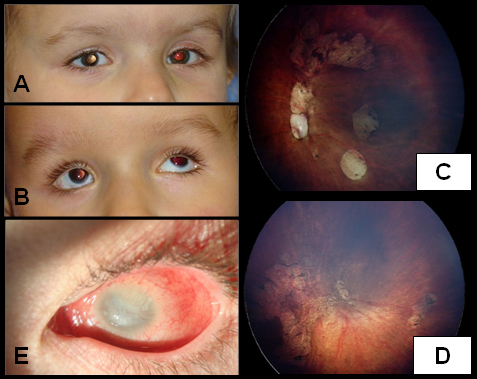
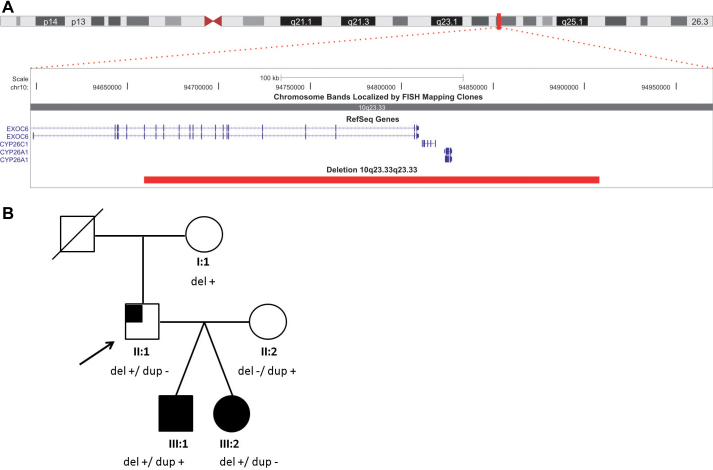
Here we report an autosomal-dominant form of nonsyndromic ONA in a Belgian pedigree, with unilateral microphthalmia and ONA in the second generation (II:1), and bilateral ONA in two sibs of the third generation (III:1; III:2). No PAX6 mutation was found. Genome wide copy number screening revealed a microdeletion of maximal 363 kb of chromosome 10q23.33q23.33 in all affected individuals (II:1, III:1; III:2) and in unaffected I:1, containing three genes: exocyst complex component 6 (EXOC6), cytochrome p450, subfamily XXVIA, polypeptide 1 (CYP26A1), and cytochrome p450, subfamily XXVIC, polypeptide 1 (CYP26C1). The latter two encode retinoic acid-degrading enzymes.
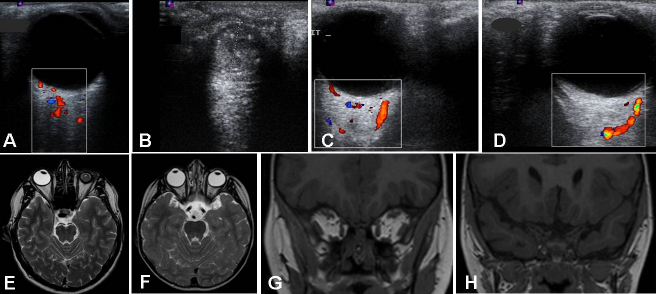
This is the first study reporting an autosomal-dominant form of nonsyndromic ONA. The diagnostic value of neuroimaging in uncovering ONA in microphthalmic patients is demonstrated. Although involvement of other genetic factors cannot be ruled out, our study might point to a role of CYP26A1 and CYP26C1 in the pathogenesis of nonsyndromic ONA.
视神经发育不全(ONA,OMIM 165550)是一种非常罕见的单侧或双侧疾病,可导致患眼失明,通常还伴有其他眼部异常。虽然双侧ONA常与严重的先天性脑部异常相关,但也有非综合征性散发性双侧ONA的报道。迄今为止,尚未有常染色体显性非综合征性ONA的报道。这种疾病的遗传基础在很大程度上仍不清楚,因为除了配对盒基因6(PAX6)外,尚无其他发育基因被认为与散发性双侧ONA有关。
所报道的个体接受了广泛的眼科、内分泌科和神经科评估,包括视觉通路的神经影像学检查。此外,还进行了全基因组拷贝数筛查。
我们在此报告一个比利时家系中的常染色体显性非综合征性ONA,第二代(II:1)中有单侧小眼畸形和ONA,第三代的两个同胞(III:1;III:2)中有双侧ONA。未发现PAX6突变。全基因组拷贝数筛查显示,所有受影响个体(II:1、III:1;III:2)以及未受影响的I:1中,10q23.33q23.33染色体上存在最大363 kb的微缺失,其中包含三个基因:外被体复合物成分6(EXOC6)、细胞色素P450 26A1亚家族多肽1(CYP26A1)和细胞色素P450 26C1亚家族多肽1(CYP26C1)。后两个基因编码视黄酸降解酶。
这是第一项报道常染色体显性非综合征性ONA的研究。证明了神经影像学在发现小眼畸形患者ONA方面的诊断价值。虽然不能排除其他遗传因素的参与,但我们的研究可能表明CYP26A1和CYP26C1在非综合征性ONA的发病机制中起作用。