Department of General Pediatrics, Münster University Children's Hospital, Albert-Schweitzer-Campus 1, D-48149 Münster, Germany.
Circ Res. 2011 Aug 19;109(5):578-92. doi: 10.1161/CIRCRESAHA.111.247965.
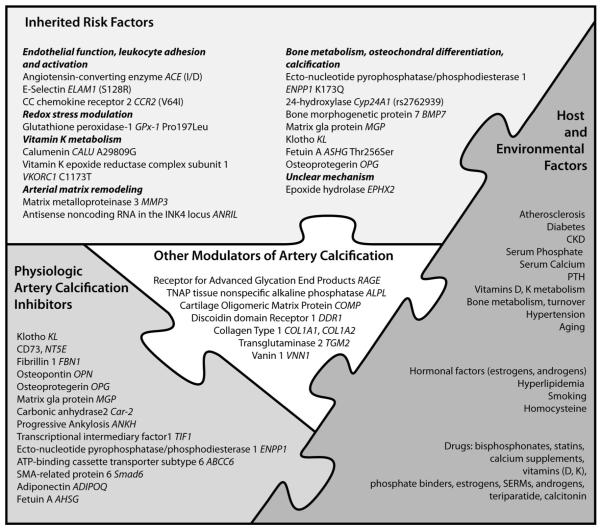
Artery calcification reflects an admixture of factors such as ectopic osteochondral differentiation with primary host pathological conditions. We review how genetic factors, as identified by human genome-wide association studies, and incomplete correlations with various mouse studies, including knockout and strain analyses, fit into "pieces of the puzzle" in intimal calcification in human atherosclerosis, and artery tunica media calcification in aging, diabetes mellitus, and chronic kidney disease. We also describe in sharp contrast how ENPP1, CD73, and ABCC6 serve as "cogs in a wheel" of arterial calcification. Specifically, each is a minor component in the function of a much larger network of factors that exert balanced effects to promote and suppress arterial calcification. For the network to normally suppress spontaneous arterial calcification, the "cogs" ENPP1, CD73, and ABCC6 must be present and in working order. Monogenic ENPP1, CD73, and ABCC6 deficiencies each drive a molecular pathophysiology of closely related but phenotypically different diseases (generalized arterial calcification of infancy (GACI), pseudoxanthoma elasticum (PXE) and arterial calcification caused by CD73 deficiency (ACDC)), in which premature onset arterial calcification is a prominent but not the sole feature.
动脉钙化反映了多种因素的混合,如异位骨软骨分化与主要宿主病理状况。我们回顾了遗传因素如何通过全基因组关联研究来确定,以及与各种小鼠研究(包括基因敲除和品系分析)的不完全相关性,这些研究如何融入人类动脉粥样硬化内膜钙化和衰老、糖尿病和慢性肾脏病中动脉中层钙化的“拼图碎片”。我们还鲜明地描述了 ENPP1、CD73 和 ABCC6 如何作为动脉钙化的“齿轮”。具体而言,每个都是一个更大的网络因素的功能中的一个次要组成部分,这些因素发挥着平衡的作用来促进和抑制动脉钙化。为了使网络正常抑制自发性动脉钙化,“齿轮”ENPP1、CD73 和 ABCC6 必须存在且正常运转。单基因 ENPP1、CD73 和 ABCC6 缺陷都会导致分子病理生理学上密切相关但表型不同的疾病(婴儿全身性动脉钙化(GACI)、弹性假黄瘤(PXE)和 CD73 缺乏引起的动脉钙化(ACDC)),其中动脉钙化过早发生是一个突出但不是唯一的特征。