Bozzi Yuri, Dunleavy Mark, Henshall David C
Laboratory of Molecular Neuropathology, Centre for Integrative Biology, University of Trento Trento, Italy.
Front Behav Neurosci. 2011 Aug 2;5:45. doi: 10.3389/fnbeh.2011.00045. eCollection 2011.
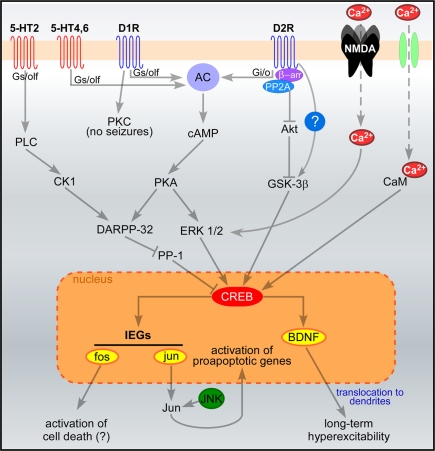
Epilepsy is a complex disease, characterized by the repeated occurrence of bursts of electrical activity (seizures) in specific brain areas. The behavioral outcome of seizure events strongly depends on the brain regions that are affected by overactivity. Here we review the intracellular signaling pathways involved in the generation of seizures in epileptogenic areas. Pathways activated by modulatory neurotransmitters (dopamine, norepinephrine, and serotonin), involving the activation of extracellular-regulated kinases and the induction of immediate early genes (IEGs) will be first discussed in relation to the occurrence of acute seizure events. Activation of IEGs has been proposed to lead to long-term molecular and behavioral responses induced by acute seizures. We also review deleterious consequences of seizure activity, focusing on the contribution of apoptosis-associated signaling pathways to the progression of the disease. A deep understanding of signaling pathways involved in both acute- and long-term responses to seizures continues to be crucial to unravel the origins of epileptic behaviors and ultimately identify novel therapeutic targets for the cure of epilepsy.
癫痫是一种复杂的疾病,其特征是特定脑区反复出现电活动突发(癫痫发作)。癫痫发作事件的行为结果很大程度上取决于受过度活动影响的脑区。在此,我们综述了癫痫源区癫痫发作产生过程中涉及的细胞内信号通路。首先将讨论由调节性神经递质(多巴胺、去甲肾上腺素和5-羟色胺)激活的信号通路,这些通路涉及细胞外调节激酶的激活和即刻早期基因(IEGs)的诱导,与急性癫痫发作事件的发生相关。有人提出,即刻早期基因的激活会导致急性癫痫发作诱导的长期分子和行为反应。我们还综述了癫痫发作活动的有害后果,重点关注凋亡相关信号通路对疾病进展的作用。深入了解癫痫发作的急性和长期反应所涉及的信号通路对于揭示癫痫行为的起源并最终确定治疗癫痫的新靶点仍然至关重要。