Dr. Margarete Fischer-Bosch Institute of Clinical Pharmacology, University of Tuebingen Stuttgart, Germany.
Front Pharmacol. 2011 Jul 27;2:41. doi: 10.3389/fphar.2011.00041. eCollection 2011.
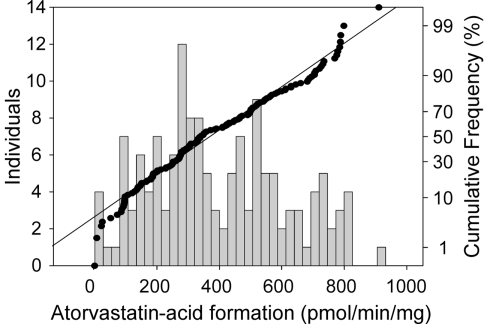
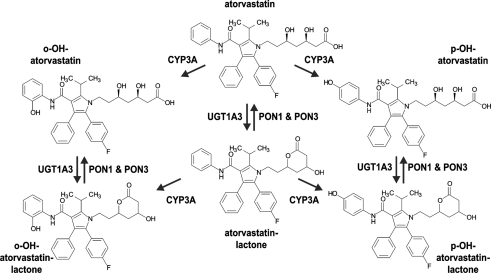
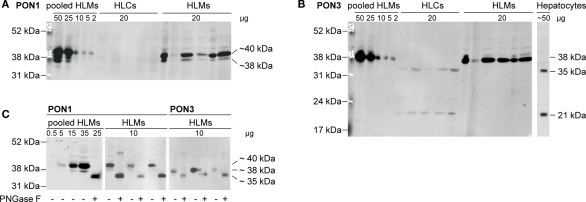
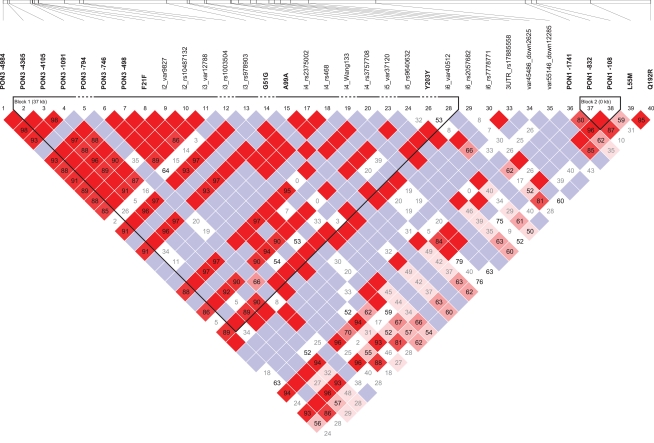
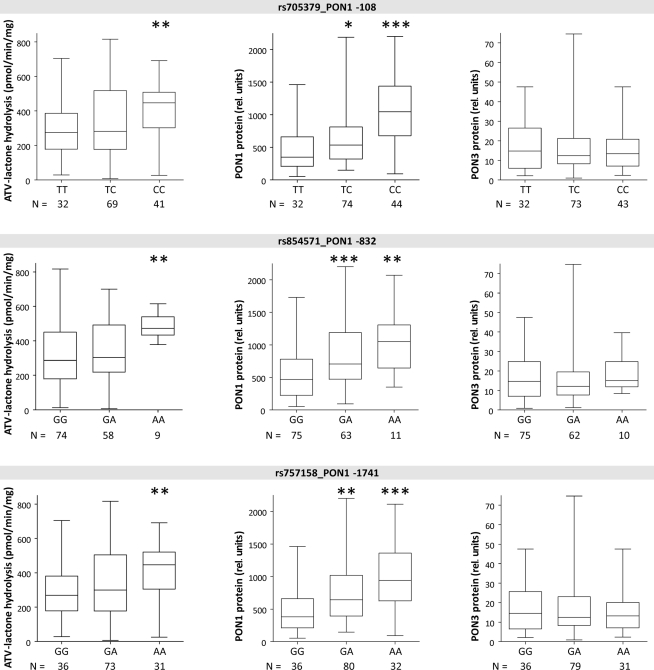
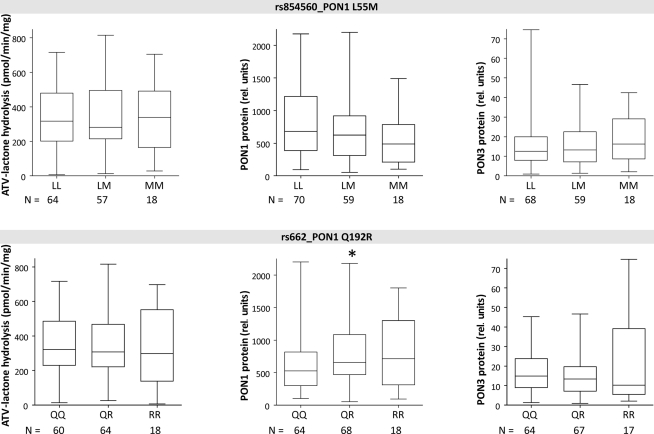
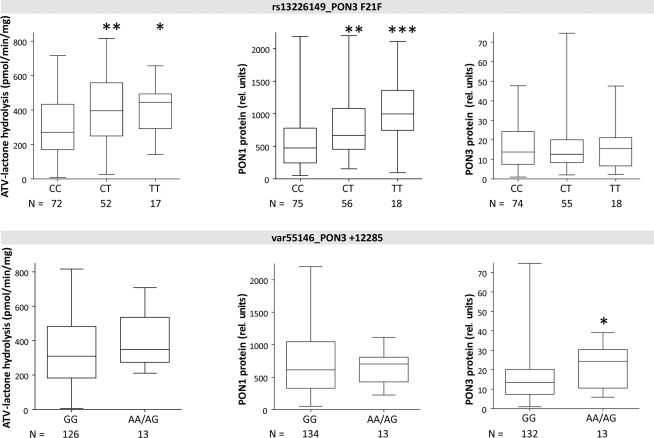
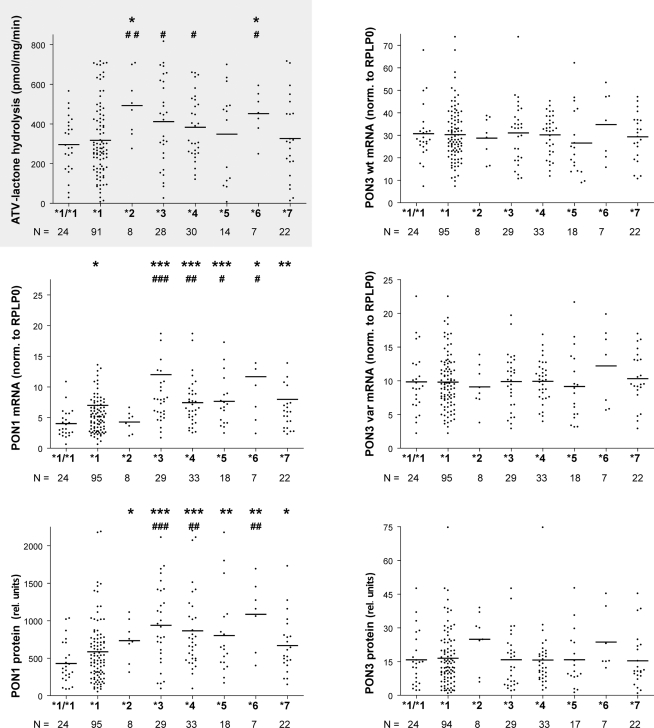
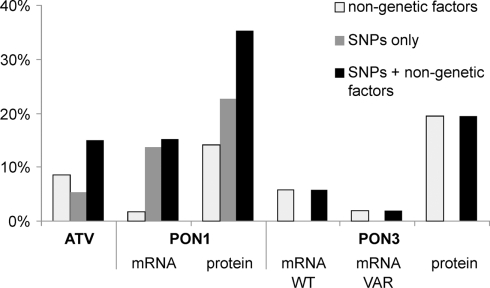
Atorvastatin δ-lactone, a major, pharmacologically inactive metabolite, has been associated with toxicity. In a previous study we showed that polymorphisms of UGT1A3 influence atorvastatin δ-lactone formation. Here we investigated the reverse reaction, atorvastatin δ-lactone hydrolysis, in a human liver bank. Screening of microarray data revealed paraoxonases PON1 and PON3 among 17 candidate esterases. Microsomal δ-lactone hydrolysis was significantly correlated to PON1 and PON3 protein (r(s) = 0.60; r(s) = 0.62, respectively; P < 0.0001). PON1 and PON3 were strongly correlated to each other (r(s) = 0.60) but PON1 was shown to be more extensively glycosylated than PON3. In addition a novel splice-variant of PON3 was identified. Genotyping of 40 polymorphisms within the PON-locus identified PON1 promoter polymorphisms (-108T > C, -832G > A, -1741G > A) and a tightly linked group of PON3 polymorphisms (-4984A > G, -4105G > A, -1091A > G, -746C > T, and F21F) to be associated with changes in atorvastatin δ-lactone hydrolysis and expression of PON1 but not PON3. However, carriers of the common PON1 polymorphisms L55M or Q192R showed no difference in δ-lactone hydrolysis or PON expression. Haplotype analysis revealed decreased δ-lactone hydrolysis in carriers of the most common haplotype *1 compared to carriers of haplotypes *2, *3, *4, and *7. Analysis of non-genetic factors showed association of hepatocellular and cholangiocellular carcinoma with decreased PON1 and PON3 expression, respectively. Increased C-reactive protein and γ-glutamyl transferase levels were associated with decreased protein expression of both enzymes, and increased bilirubin levels, cholestasis, and presurgical exposure to omeprazole or pantoprazole were related to decreased PON3 protein. In conclusion, PON-locus polymorphisms affect PON1 expression whereas non-genetic factors have an effect on PON1 and PON3 expression. This may influence response to therapy or adverse events in statin treatment.
阿托伐他汀 δ-内酯是一种主要的、无药理活性的代谢物,与毒性有关。在之前的研究中,我们表明 UGT1A3 的多态性影响阿托伐他汀 δ-内酯的形成。在这里,我们在人类肝脏库中研究了阿托伐他汀 δ-内酯的水解反应。微阵列数据的筛选显示,对氧磷酶 PON1 和 PON3 是 17 种候选酯酶之一。微粒体 δ-内酯水解与 PON1 和 PON3 蛋白呈显著相关(r(s)=0.60; r(s)=0.62,P<0.0001)。PON1 和 PON3 之间具有很强的相关性(r(s)=0.60),但 PON1 的糖基化程度明显高于 PON3。此外,还鉴定了 PON3 的一种新剪接变体。PON 基因座内 40 个多态性的基因分型鉴定出 PON1 启动子多态性(-108T>C、-832G>A、-1741G>A)和紧密连锁的 PON3 多态性群(-4984A>G、-4105G>A、-1091A>G、-746C>T 和 F21F)与阿托伐他汀 δ-内酯水解和 PON1 表达的变化相关,但与 PON3 无关。然而,PON1 常见多态性 L55M 或 Q192R 的携带者在 δ-内酯水解或 PON 表达方面没有差异。单体型分析显示,与单体型*2、3、4 和7 相比,最常见单体型1 的携带者 δ-内酯水解减少。非遗传因素分析显示,肝细胞癌和胆管细胞癌分别与 PON1 和 PON3 表达降低相关。C 反应蛋白和γ-谷氨酰转移酶水平升高与两种酶的蛋白表达降低有关,胆红素水平升高、胆汁淤积、术前接受奥美拉唑或泮托拉唑治疗与 PON3 蛋白表达降低有关。总之,PON 基因座多态性影响 PON1 表达,而非遗传因素影响 PON1 和 PON3 表达。这可能会影响他汀类药物治疗的反应或不良反应。