Department of Ecology and Evolutionary Biology, University of California Santa Cruz, Santa Cruz, California, United States of America.
PLoS One. 2011;6(8):e23166. doi: 10.1371/journal.pone.0023166. Epub 2011 Aug 10.
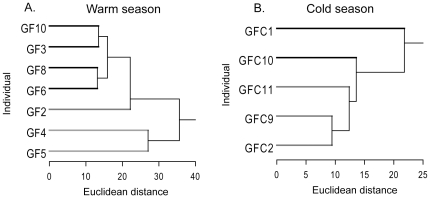
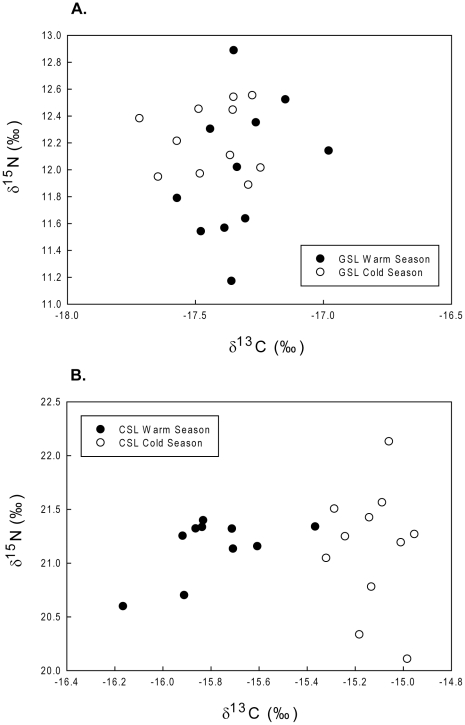
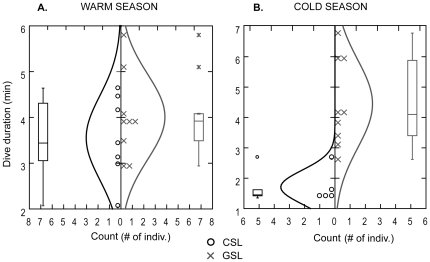
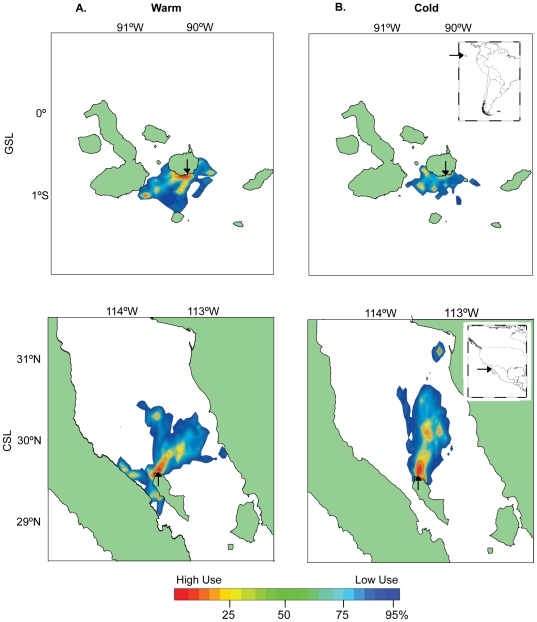
Non-migratory resident species should be capable of modifying their foraging behavior to accommodate changes in prey abundance and availability associated with a changing environment. Populations that are better adapted to change will have higher foraging success and greater potential for survival in the face of climate change. We studied two species of resident central place foragers from temperate and equatorial regions with differing population trends and prey availability associated to season, the California sea lion (Zalophus californianus) (CSL) whose population is increasing and the endangered Galapagos sea lion (Zalophus wollebaeki) (GSL) whose population is declining. To determine their response to environmental change, we studied and compared their diving behavior using time-depth recorders and satellite location tags and their diet by measuring C and N isotope ratios during a warm and a cold season. Based on latitudinal differences in oceanographic productivity, we hypothesized that the seasonal variation in foraging behavior would differ for these two species. CSL exhibited greater seasonal variability in their foraging behavior as seen in changes to their diving behavior, foraging areas and diet between seasons. Conversely, GSL did not change their diving behavior between seasons, presenting three foraging strategies (shallow, deep and bottom divers) during both. GSL exhibited greater dive and foraging effort than CSL. We suggest that during the warm and less productive season a greater range of foraging behaviors in CSL was associated with greater competition for prey, which relaxed during the cold season when resource availability was greater. GSL foraging specialization suggests that resources are limited throughout the year due to lower primary production and lower seasonal variation in productivity compared to CSL. These latitudinal differences influence their foraging success, pup survival and population growth reflected in contrasting population trends in which CSL are more successful and potentially more resilient to climate change.
非迁徙性居留物种应该能够改变其觅食行为,以适应与环境变化相关的猎物丰度和可获得性的变化。更适应变化的种群将在面对气候变化时具有更高的觅食成功率和更大的生存潜力。我们研究了来自温带和赤道地区的两种具有不同种群趋势和与季节相关的猎物可利用性的居留性中央觅食物种,即加利福尼亚海狮(Zalophus californianus)(CSL),其种群正在增加,而濒临灭绝的加拉帕戈斯海狮(Zalophus wollebaeki)(GSL),其种群正在减少。为了确定它们对环境变化的反应,我们使用时间深度记录器和卫星位置标记来研究和比较它们的潜水行为,并在温暖和寒冷季节通过测量 C 和 N 同位素比值来研究它们的饮食。基于海洋生产力的纬度差异,我们假设这两个物种的觅食行为季节性变化会有所不同。CSL 的觅食行为在季节性变化方面表现出更大的可变性,表现在潜水行为、觅食区域和饮食方面在季节之间的变化。相反,GSL 在季节之间没有改变它们的潜水行为,在两个季节都表现出三种觅食策略(浅潜水、深潜水和底栖潜水)。GSL 的潜水和觅食努力比 CSL 更大。我们认为,在温暖和生产力较低的季节,CSL 更广泛的觅食行为与对猎物的更大竞争有关,而在资源可用性更大的寒冷季节,这种竞争会放松。GSL 的觅食专业化表明,由于初级生产力较低,全年资源都受到限制,并且与 CSL 相比,生产力的季节性变化较小。这些纬度差异影响它们的觅食成功率、幼崽存活率和种群增长,反映在对比鲜明的种群趋势中,CSL 更成功,并且可能对气候变化更有弹性。