Departamento de Biología del Estrés y Patología Vegetal, Centro deEdafología y Biología Aplicada del Segura (CEBAS)-CSIC, 30100 Espinardo(Murcia), Spain.
BMC Genomics. 2011 Aug 20;12:424. doi: 10.1186/1471-2164-12-424.
The melon belongs to the Cucurbitaceae family, whose economic importance among vegetable crops is second only to Solanaceae. The melon has a small genome size (454 Mb), which makes it suitable for molecular and genetic studies. Despite similar nuclear and chloroplast genome sizes, cucurbits show great variation when their mitochondrial genomes are compared. The melon possesses the largest plant mitochondrial genome, as much as eight times larger than that of other cucurbits.
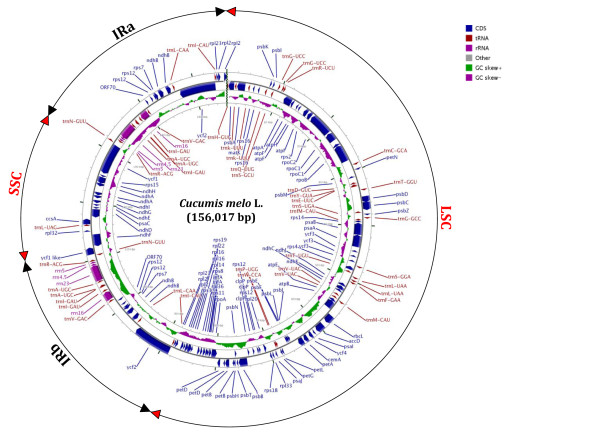
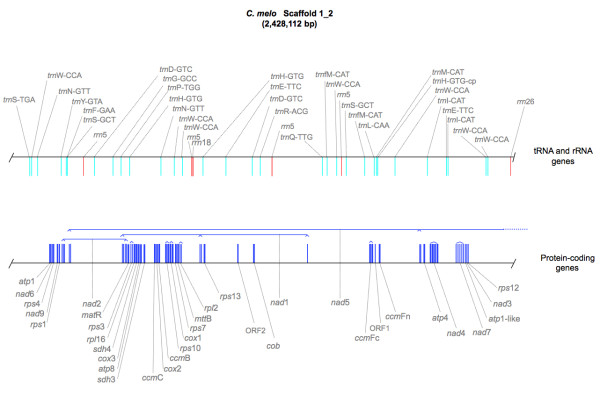
The nucleotide sequences of the melon chloroplast and mitochondrial genomes were determined. The chloroplast genome (156,017 bp) included 132 genes, with 98 single-copy genes dispersed between the small (SSC) and large (LSC) single-copy regions and 17 duplicated genes in the inverted repeat regions (IRa and IRb). A comparison of the cucumber and melon chloroplast genomes showed differences in only approximately 5% of nucleotides, mainly due to short indels and SNPs. Additionally, 2.74 Mb of mitochondrial sequence, accounting for 95% of the estimated mitochondrial genome size, were assembled into five scaffolds and four additional unscaffolded contigs. An 84% of the mitochondrial genome is contained in a single scaffold. The gene-coding region accounted for 1.7% (45,926 bp) of the total sequence, including 51 protein-coding genes, 4 conserved ORFs, 3 rRNA genes and 24 tRNA genes. Despite the differences observed in the mitochondrial genome sizes of cucurbit species, Citrullus lanatus (379 kb), Cucurbita pepo (983 kb) and Cucumis melo (2,740 kb) share 120 kb of sequence, including the predicted protein-coding regions. Nevertheless, melon contained a high number of repetitive sequences and a high content of DNA of nuclear origin, which represented 42% and 47% of the total sequence, respectively.
Whereas the size and gene organisation of chloroplast genomes are similar among the cucurbit species, mitochondrial genomes show a wide variety of sizes, with a non-conserved structure both in gene number and organisation, as well as in the features of the noncoding DNA. The transfer of nuclear DNA to the melon mitochondrial genome and the high proportion of repetitive DNA appear to explain the size of the largest mitochondrial genome reported so far.
瓜类属于葫芦科,其经济重要性在蔬菜作物中仅次于茄科。瓜类的基因组大小较小(454Mb),这使其适合进行分子和遗传研究。尽管核基因组和叶绿体基因组大小相似,但在比较其线粒体基因组时,葫芦科表现出很大的差异。瓜类拥有最大的植物线粒体基因组,比其他葫芦科植物大 8 倍之多。
测定了瓜类叶绿体和线粒体基因组的核苷酸序列。叶绿体基因组(156017bp)包含 132 个基因,其中 98 个为单拷贝基因分布在小(SSC)和大(LSC)单拷贝区之间,17 个为重复基因分布在反向重复区(IRa 和 IRb)。黄瓜和瓜类叶绿体基因组的比较显示,核苷酸的差异主要在 5%左右,主要是由于短插入缺失和单核苷酸多态性。此外,组装了 2.74Mb 的线粒体序列,占估计线粒体基因组大小的 95%,这些序列组装成了五个支架和四个额外未组装的连续体。线粒体基因组的 84%包含在一个支架中。基因编码区占总序列的 1.7%(45926bp),包括 51 个蛋白质编码基因、4 个保守 ORF、3 个 rRNA 基因和 24 个 tRNA 基因。尽管葫芦科物种的线粒体基因组大小存在差异,但甜瓜(379kb)、南瓜(983kb)和甜瓜(2740kb)共享 120kb 的序列,包括预测的蛋白质编码区。然而,甜瓜含有大量的重复序列和高比例的核起源 DNA,分别占总序列的 42%和 47%。
尽管瓜类物种的叶绿体基因组大小和基因组织相似,但线粒体基因组在大小、基因数量和组织以及非编码 DNA 的特征上表现出广泛的多样性。核 DNA 向甜瓜线粒体基因组的转移和重复 DNA 的高比例似乎解释了迄今为止报道的最大线粒体基因组的大小。