Division of Pharmaceutics and Biopharmaceutics, The University of British Columbia, Vancouver British Columbia, V6T 1Z3, Canada.
Lipids Health Dis. 2011 Aug 20;10:144. doi: 10.1186/1476-511X-10-144.
Invasive fungal infections such as candidiasis constitute an increasingly important medical problem. Drugs currently used for the treatment of candidiasis include polyenes (such as Amphotericin B) and azoles. Amphotericin B (AmpB) presents several limitations such as its nephrotoxicity and limited solubility. We have developed two novel lipid-based AmpB formulations which in vivo show less nephrotoxicity and enhanced solubility compared to Fungizone™ a commercial AmpB formulation. The purpose of this study was to determine the cytotoxicity of Fungizone™, Ambisome™ and two novel AmpB formulations (iCo-009 and iCo-010) against Candida albicans, human kidney (293T) cells and monocytic (THP1) cells.
Cell cytotoxicity to the AmpB formulations was evaluated by MTS and LDH assays. In vitro anti-Candida albicans activity was assessed after a 48 h drug incubation.
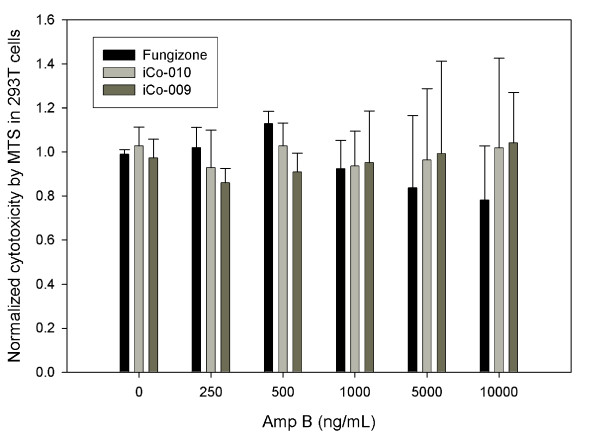
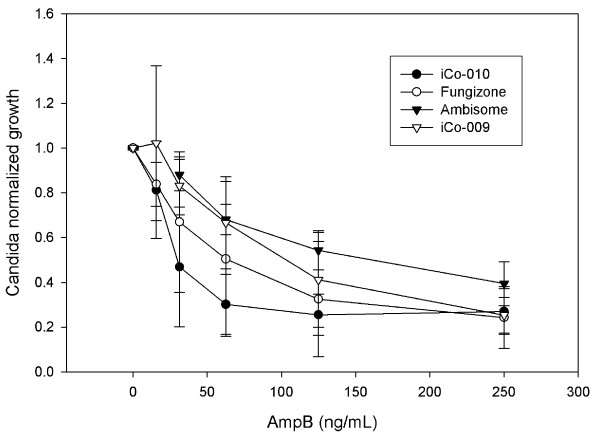
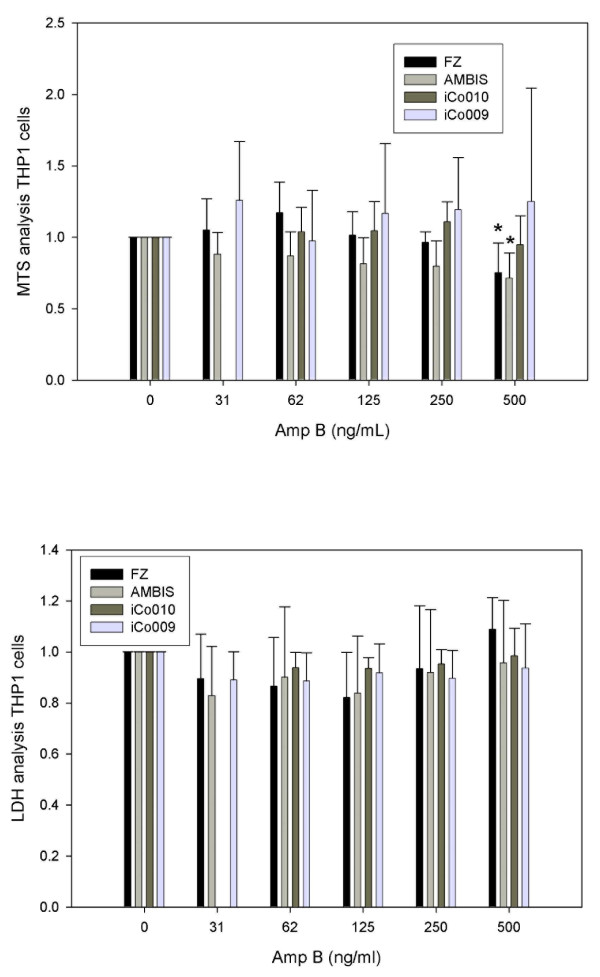
None of the AmpB formulations tested showed cytotoxicity against 293T cells. In the case of THP1 cells only Fungizone™ and Ambisome™ showed cytotoxicity at 500 μg/L (n = 4-10, p < 0.05).The calculated EC50 to Candida albicans for the different formulations was as follows: 26.8 ± 2.9 for iCo-010, 74.6 ± 8.9 for iCo-009, 109 ± 31 for Ambisome™ and 87.1 ± 22 for Fungizone™ (μg of AmpB/L, n = 6-12, p < 0.05).
The AmpB formulations analyzed were not cytotoxic to 293T cells. Cytotoxicity in THP1 cells was observed for Fungizone™ and Ambisome™, but not with the novel AmpB formulations. iCo-010 had higher efficacy compared to other three AmpB formulations in the Candida albicans model.The absence of cytotoxicity as well as its higher efficacy for the Candida model compared to Fungizone™ and Ambisome™ suggest that iCo-010 has potential in treating candidiasis.
侵袭性真菌感染,如念珠菌病,构成了一个日益重要的医学问题。目前用于治疗念珠菌病的药物包括多烯类(如两性霉素 B)和唑类。两性霉素 B(AmpB)存在一些局限性,如肾毒性和有限的溶解度。我们开发了两种新型的脂质两性霉素 B 制剂,与商业两性霉素 B 制剂 Fungizone™相比,这两种制剂在体内的肾毒性较低,溶解度更高。本研究的目的是确定 Fungizone™、Ambisome™和两种新型两性霉素 B 制剂(iCo-009 和 iCo-010)对白色念珠菌、人肾(293T)细胞和单核(THP1)细胞的细胞毒性。
通过 MTS 和 LDH 测定评估两性霉素 B 制剂对细胞的细胞毒性。在药物孵育 48 小时后,评估体外抗白色念珠菌活性。
在 293T 细胞中,没有一种两性霉素 B 制剂显示出细胞毒性。在 THP1 细胞中,只有 Fungizone™和 Ambisome™在 500μg/L 时显示出细胞毒性(n=4-10,p<0.05)。不同制剂对白色念珠菌的 EC50 计算如下:iCo-010 为 26.8±2.9,iCo-009 为 74.6±8.9,Ambisome™为 109±31,Fungizone™为 87.1±22(μg 两性霉素 B/L,n=6-12,p<0.05)。
分析的两性霉素 B 制剂对 293T 细胞没有细胞毒性。在 THP1 细胞中观察到 Fungizone™和 Ambisome™的细胞毒性,但新型两性霉素 B 制剂没有。在白色念珠菌模型中,iCo-010 比其他三种两性霉素 B 制剂具有更高的疗效。与 Fungizone™和 Ambisome™相比,iCo-010 不仅没有细胞毒性,而且对念珠菌模型的疗效更高,这表明它具有治疗念珠菌病的潜力。