Department of Oral and Maxillofacial Surgery, College of Stomatology, Ninth People's Hospital, Shanghai Jiao Tong University School of Medicine, Shanghai, People's Republic of China.
PLoS One. 2011;6(8):e23282. doi: 10.1371/journal.pone.0023282. Epub 2011 Aug 16.
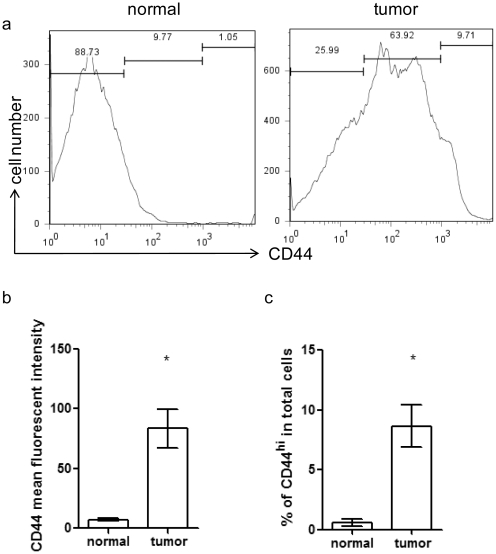
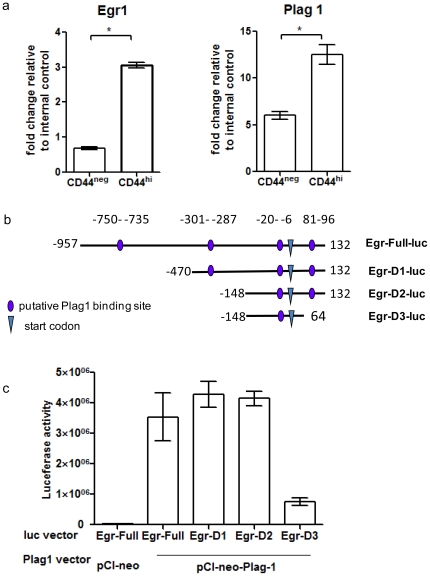
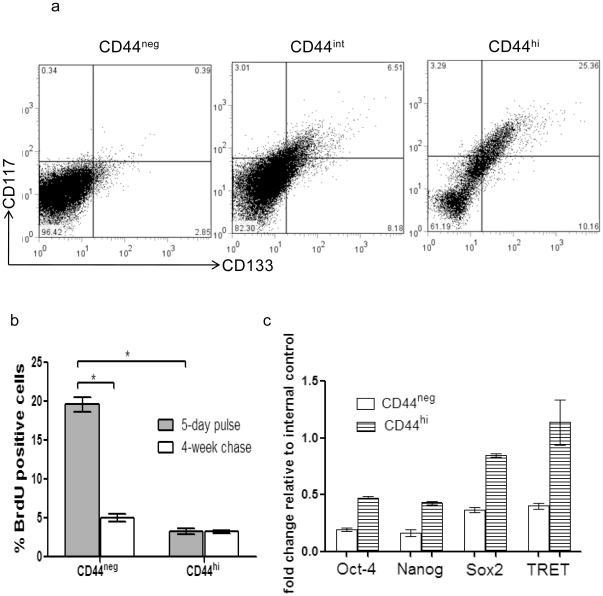
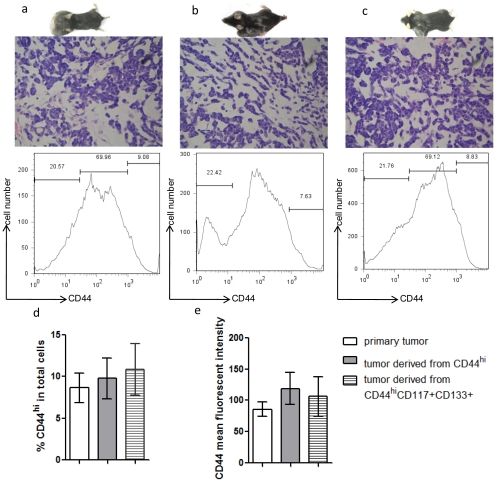
Tumor-initiating cells (T-ICs) discovered in various tumors have been widely reported. However, T-IC populations in salivary gland tumors have yet to be elucidated. Using the established Pleomorphic Adenoma Gene-1 (Plag1) transgenic mouse model of a salivary gland tumor, we identified CD44(high) (CD44(hi)) tumor cells, characterized by high levels of CD44 cell surface expression, as the T-ICs for pleomorphic adenomas. These CD44(hi) tumor cells incorporated 5-bromo-2-deoxyuridine (BrdU), at a lower rate than their CD44(negative) (CD44(neg)) counterparts, and also retained BrdU for a long period of time. Cell surface maker analysis revealed that 25% of the CD44(hi) tumor cells co-express other cancer stem cell markers such as CD133 and CD117. As few as 500 CD44(hi) tumor cells were sufficient to initiate pleomorphic adenomas in one third of the wildtype mice, whereas more than 1×10(4) CD44(neg) cells were needed for the same purpose. In NIH 3T3 cells, Plag1 was capable of activating the gene transcription of Egr1, a known upregulator for CD44. Furthermore, deletion of sequence 81-96 in the Egr1 promoter region abolished the effect of Plag1 on Egr1 upregulation. Our results establish the existence of T-ICs in murine salivary gland tumors, and suggest a potential molecular mechanism for CD44 upregulation.
已在各种肿瘤中广泛报道了肿瘤起始细胞(T-ICs)。然而,唾液腺肿瘤中的 T-IC 群体尚未阐明。使用已建立的唾液腺肿瘤 Pleomorphic Adenoma Gene-1(Plag1)转基因小鼠模型,我们鉴定出 CD44(高)(CD44(hi))肿瘤细胞,其特征是高水平的 CD44 细胞表面表达,作为多形性腺瘤的 T-ICs。这些 CD44(hi)肿瘤细胞掺入 5-溴-2-脱氧尿苷(BrdU)的速度低于其 CD44(阴性)(CD44(neg))对应物,并且还长时间保留 BrdU。细胞表面标志物分析表明,25%的 CD44(hi)肿瘤细胞共表达其他癌症干细胞标志物,如 CD133 和 CD117。只需 500 个 CD44(hi)肿瘤细胞就足以使三分之一的野生型小鼠引发多形性腺瘤,而需要超过 1×10(4)个 CD44(neg)细胞才能达到相同的目的。在 NIH 3T3 细胞中,Plag1 能够激活 Egr1 的基因转录,Egr1 是已知的 CD44 上调因子。此外,Egr1 启动子区域 81-96 序列缺失消除了 Plag1 对 Egr1 上调的影响。我们的结果确立了 T-ICs 在小鼠唾液腺肿瘤中的存在,并提出了 CD44 上调的潜在分子机制。