Department of Gastroenterology, Lithuanian University of Health Sciences, Eiveniu 2, 50009 Kaunas, Lithuania.
BMC Med Genet. 2011 Aug 24;12:112. doi: 10.1186/1471-2350-12-112.
Several polymorphisms of genes involved in the immunological recognition of Helicobacter pylori and regulating apoptosis and proliferation have been linked to gastric carcinogenesis, however reported data are partially conflicting. The aim of our study was to evaluate potential associations between the presence of gastric cancer (GC) and high risk atrophic gastritis (HRAG) and polymorphisms of genes encoding Angiotensin converting enzyme (ACE), Nod-like receptor 1 (NOD1), Toll-like receptor 4 (TLR4) and FAS/FASL.
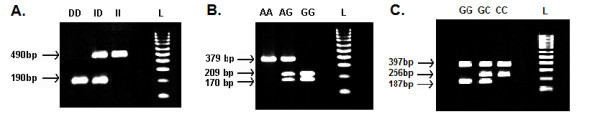
Gene polymorphisms were analyzed in 574 subjects (GC: n = 114; HRAG: n = 222, controls: n = 238) of Caucasian origin. ACE I/D (rs4646994), NOD1 796G>A (rs5743336), TLR4 3725G>C (rs11536889), FAS 1377G>A (rs2234767), FAS 670A>G (rs1800682) and FASL 844T>C (rs763110) were genotyped by different PCR approaches and restriction fragment length polymorphism analysis.
Frequencies of genotypes in our study are similar to the data reported on subjects of Caucasian ethnicity. There was a tendency for NOD1 796G/G genotype to be associated with increased risk of HRAG (62.4% vs. 54.5% in controls, p = 0.082). FAS 670G/G genotype was more frequent in HRAG when compared to controls, 23.9% and 17.2% respectively, however it failed to reach significance level (p = 0.077). We did not find any significant associations for all polymorphisms in relation to GC or HRAG. NOD1 796G>A and TLR4 3725G>C gene polymorphisms were also not associated with Helicobacter pylori infection.
ACE, NOD1, TRL4 and FAS/FASL gene polymorphisms are not linked with gastric carcinogenesis in Caucasians, and therefore they should not be considered as potential biomarkers for identifying individuals with higher risk for GC.
一些参与幽门螺杆菌免疫识别和调节细胞凋亡与增殖的基因的多态性与胃癌的发生有关,但报道的数据部分存在冲突。我们的研究旨在评估编码血管紧张素转换酶(ACE)、Nod 样受体 1(NOD1)、Toll 样受体 4(TLR4)和 FAS/FASL 的基因多态性与胃癌(GC)和高风险萎缩性胃炎(HRAG)之间的潜在相关性。
分析了 574 名白种人受试者(GC:n=114;HRAG:n=222,对照组:n=238)的基因多态性。ACE I/D(rs4646994)、NOD1 796G>A(rs5743336)、TLR4 3725G>C(rs11536889)、FAS 1377G>A(rs2234767)、FAS 670A>G(rs1800682)和 FASL 844T>C(rs763110)通过不同的 PCR 方法和限制性片段长度多态性分析进行基因分型。
本研究中的基因型频率与白种人受试者的报道数据相似。NOD1 796G/G 基因型与 HRAG 风险增加有一定的相关性(在对照组中分别为 62.4%和 54.5%,p=0.082)。与对照组相比,HRAG 中 FAS 670G/G 基因型更为常见,分别为 23.9%和 17.2%,但未达到显著水平(p=0.077)。我们没有发现所有多态性与 GC 或 HRAG 相关的任何显著关联。NOD1 796G>A 和 TLR4 3725G>C 基因多态性也与幽门螺杆菌感染无关。
ACE、NOD1、TLR4 和 FAS/FASL 基因多态性与白种人胃癌的发生无关,因此不应将其视为识别 GC 高危个体的潜在生物标志物。