Department of Pathology, University of Maryland School of Medicine, 10 S, Pine St, Baltimore, MD 21201, USA.
BMC Cancer. 2011 Aug 24;11:374. doi: 10.1186/1471-2407-11-374.
Making a definitive preoperative diagnosis of solitary pulmonary nodules (SPNs) found by CT has been a clinical challenge. We previously demonstrated that microRNAs (miRNAs) could be used as biomarkers for lung cancer diagnosis. Here we investigate whether plasma microRNAs are useful in identifying lung cancer among individuals with CT-detected SPNs.
By using quantitative reverse transcriptase PCR analysis, we first determine plasma expressions of five miRNAs in a training set of 32 patients with malignant SPNs, 33 subjects with benign SPNs, and 29 healthy smokers to define a panel of miRNAs that has high diagnostic efficiency for lung cancer. We then validate the miRNA panel in a testing set of 76 patients with malignant SPNs and 80 patients with benign SPNs.
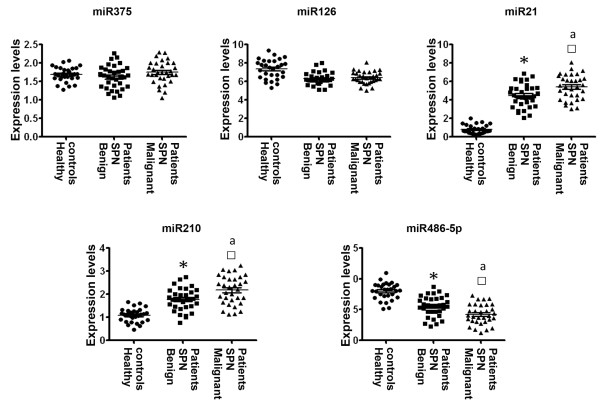
In the training set, miR-21 and miR-210 display higher plasma expression levels, whereas miR-486-5p has lower expression level in patients with malignant SPNs, as compared to subjects with benign SPNs and healthy controls (all P ≤ 0.001). A logistic regression model with the best prediction was built on the basis of miR-21, miR-210, and miR-486-5p. The three miRNAs used in combination produced the area under receiver operating characteristic curve at 0.86 in distinguishing lung tumors from benign SPNs with 75.00% sensitivity and 84.95% specificity. Validation of the miRNA panel in the testing set confirms their diagnostic value that yields significant improvement over any single one.
The plasma miRNAs provide potential circulating biomarkers for noninvasively diagnosing lung cancer among individuals with SPNs, and could be further evaluated in clinical trials.
通过 CT 发现的孤立性肺结节(SPN)术前明确诊断一直是临床面临的挑战。我们之前证明,微小 RNA(miRNA)可用作肺癌诊断的生物标志物。在这里,我们研究了血浆 miRNA 是否可用于识别 CT 检测到的 SPN 个体中的肺癌。
通过使用定量逆转录酶 PCR 分析,我们首先确定了 32 例恶性 SPN 患者、33 例良性 SPN 患者和 29 例健康吸烟者的训练组中五种 miRNA 的血浆表达,以确定具有高效肺癌诊断效率的 miRNA 组合。然后,我们在 76 例恶性 SPN 患者和 80 例良性 SPN 患者的测试组中验证了 miRNA 组合。
在训练组中,与良性 SPN 患者和健康对照者相比,恶性 SPN 患者的血浆 miR-21 和 miR-210 表达水平较高,而 miR-486-5p 表达水平较低(均 P ≤ 0.001)。基于 miR-21、miR-210 和 miR-486-5p,建立了最佳预测的逻辑回归模型。三个 miRNA 联合使用,在区分肺癌与良性 SPN 方面,ROC 曲线下面积为 0.86,灵敏度为 75.00%,特异性为 84.95%。在测试组中对 miRNA 组合的验证证实了其诊断价值,与任何单一 miRNA 相比均有显著提高。
血浆 miRNA 为 SPN 个体的非侵入性肺癌诊断提供了潜在的循环生物标志物,可进一步在临床试验中进行评估。