Hematology-Oncology Division, Department of Medicine, Beth Israel Deaconess Medical Center, Harvard Medical School, Boston, Massachusetts, USA.
Cancer Res. 2011 Oct 15;71(20):6503-13. doi: 10.1158/0008-5472.CAN-11-0532. Epub 2011 Aug 25.
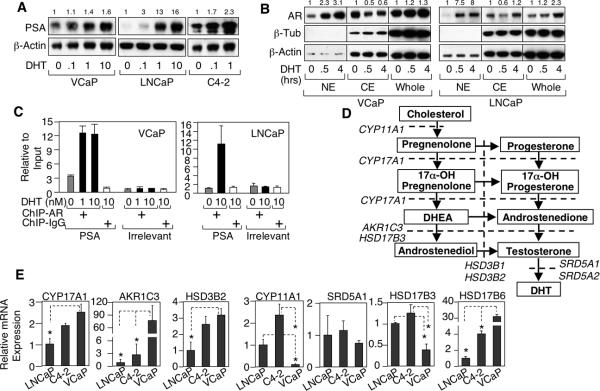
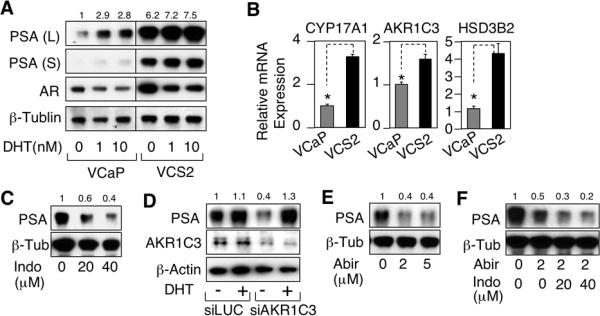
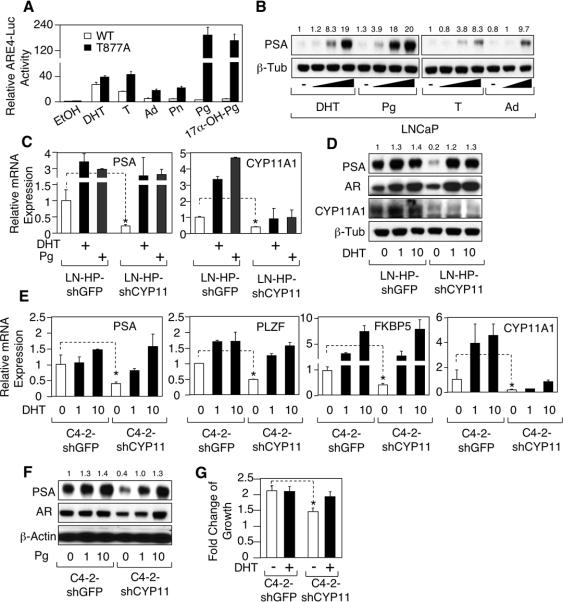
Relapse of castration-resistant prostate cancer (CRPC) that occurs after androgen deprivation therapy of primary prostate cancer can be mediated by reactivation of the androgen receptor (AR). One important mechanism mediating this AR reactivation is intratumoral conversion of the weak adrenal androgens DHEA and androstenedione into the AR ligands testosterone and dihydrotestosterone. DHEA and androstenedione are synthesized by the adrenals through the sequential actions of the cytochrome P450 enzymes CYP11A1 and CYP17A1, so that CYP17A1 inhibitors such as abiraterone are effective therapies for CRPC. However, the significance of intratumoral CYP17A1 and de novo androgen synthesis from cholesterol in CRPC, and the mechanisms contributing to CYP17A1 inhibitor resistance/relapse, remain to be determined. We report that AR activity in castration-resistant VCaP tumor xenografts can be restored through CYP17A1-dependent de novo androgen synthesis, and that abiraterone treatment of these xenografts imposes selective pressure for increased intratumoral expression of CYP17A1, thereby generating a mechanism for development of resistance to CYP17A1 inhibitors. Supporting the clinical relevance of this mechanism, we found that intratumoral expression of CYP17A1 was markedly increased in tumor biopsies from CRPC patients after CYP17A1 inhibitor therapy. We further show that CRPC cells expressing a progesterone responsive T877A mutant AR are not CYP17A1 dependent, but that AR activity in these cells is still steroid dependent and mediated by upstream CYP11A1-dependent intraturmoral pregnenolone/progesterone synthesis. Together, our results indicate that CRPCs resistant to CYP17A1 inhibition may remain steroid dependent and therefore responsive to therapies that can further suppress de novo intratumoral steroid synthesis.
去势抵抗性前列腺癌(CRPC)在原发性前列腺癌的雄激素剥夺治疗后发生的复发,可以通过雄激素受体(AR)的重新激活来介导。介导这种 AR 重新激活的一个重要机制是肿瘤内弱肾上腺雄激素 DHEA 和雄烯二酮转化为 AR 配体睾酮和二氢睾酮。DHEA 和雄烯二酮通过细胞色素 P450 酶 CYP11A1 和 CYP17A1 的顺序作用由肾上腺合成,因此 CYP17A1 抑制剂如阿比特龙是治疗 CRPC 的有效疗法。然而,肿瘤内 CYP17A1 和胆固醇从头合成雄激素在 CRPC 中的意义,以及导致 CYP17A1 抑制剂耐药/复发的机制,仍有待确定。我们报告说,在去势抵抗的 VCaP 肿瘤异种移植中,AR 活性可以通过 CYP17A1 依赖性从头合成雄激素来恢复,并且阿比特龙治疗这些异种移植会对肿瘤内 CYP17A1 表达的增加施加选择性压力,从而产生对 CYP17A1 抑制剂产生耐药性的机制。支持这种机制的临床相关性,我们发现,在 CYP17A1 抑制剂治疗后,来自 CRPC 患者的肿瘤活检中 CYP17A1 的表达明显增加。我们进一步表明,表达孕激素反应性 T877A 突变 AR 的 CRPC 细胞不依赖于 CYP17A1,但这些细胞中的 AR 活性仍然是类固醇依赖性的,并由上游 CYP11A1 依赖性肿瘤内孕烯醇酮/孕酮合成介导。总之,我们的结果表明,对 CYP17A1 抑制耐药的 CRPC 可能仍然对类固醇有依赖性,因此对可以进一步抑制肿瘤内从头合成类固醇的治疗有反应。