Department of Internal Medicine, VU University Medical Center, Amsterdam, the Netherlands.
Diabetes Care. 2011 Sep;34(9):2041-7. doi: 10.2337/dc11-0291.
We previously showed that exenatide (EXE) enhanced insulin secretion after 1 year of treatment, relative to insulin glargine (GLAR), with a similar glucose-lowering action. These effects were not sustained after a 4-week off-drug period. This article reports the results after additional 2 years of exposure.
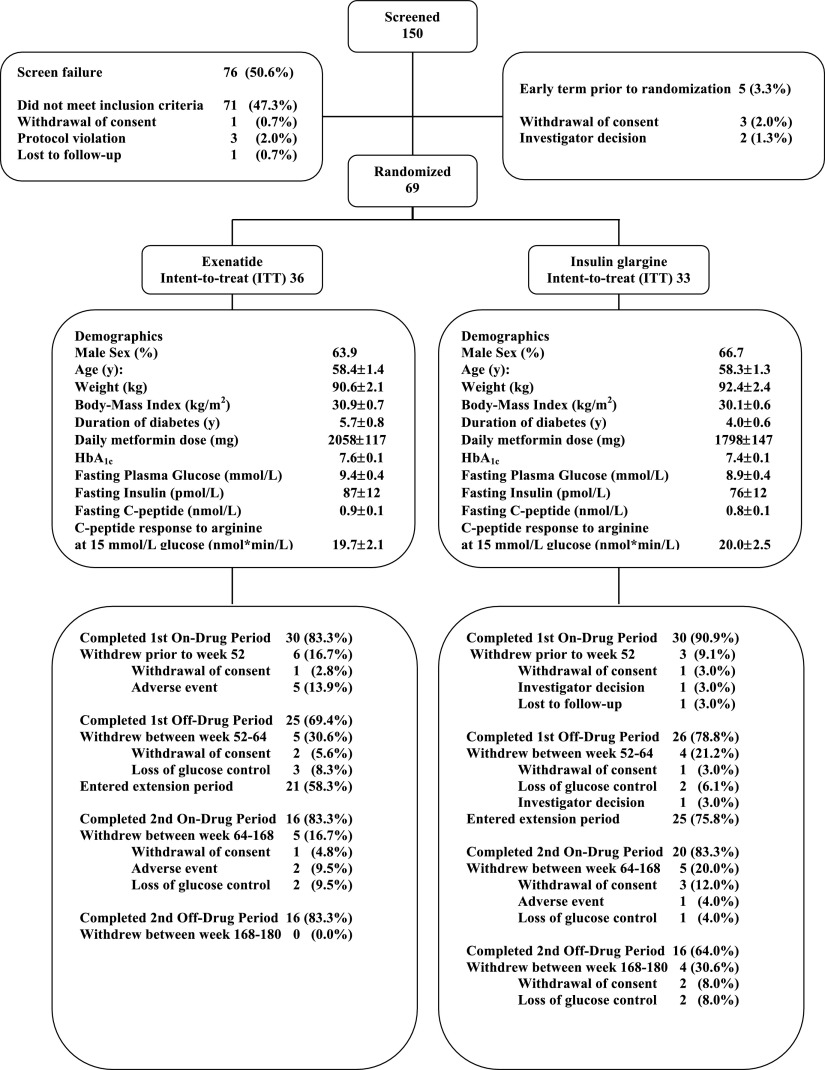
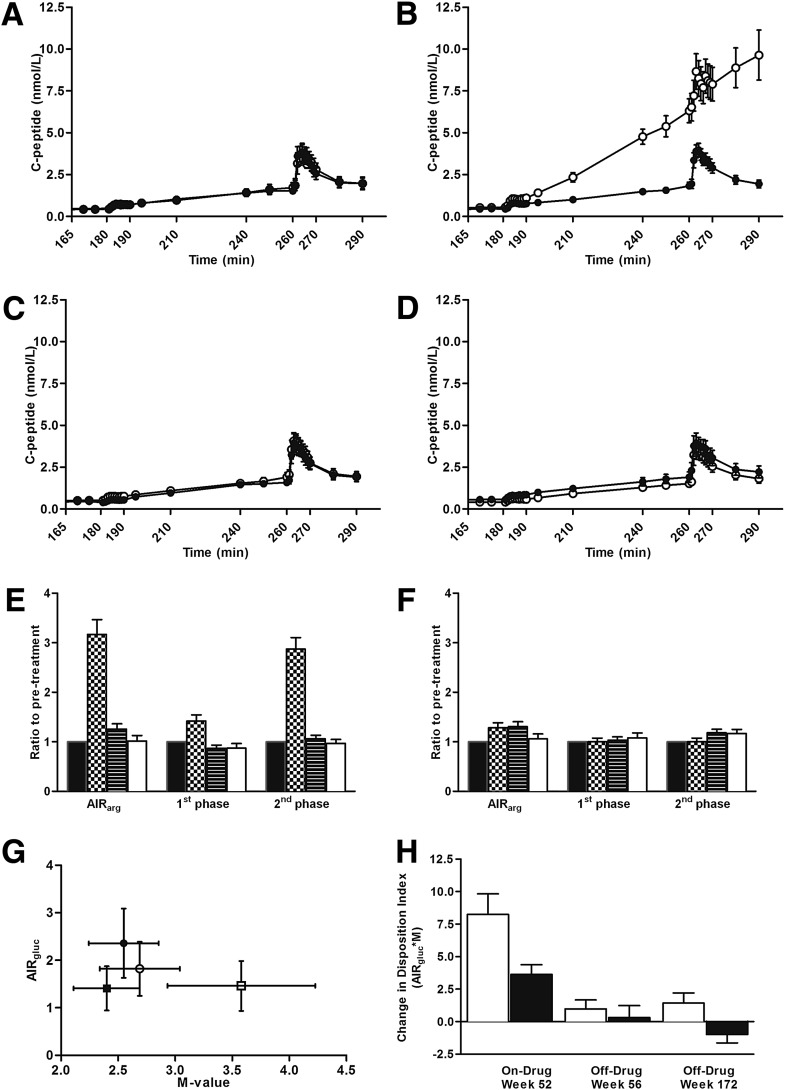
Sixty-nine metformin-treated patients with type 2 diabetes were randomized to EXE or GLAR. Forty-six patients entered the 2-year extension study in which they continued their allocated therapy. Thirty-six completed (EXE: n = 16; GLAR: n = 20) the 3-year exposure period. Insulin sensitivity (M value) and β-cell function were measured by euglycemic hyperinsulinemic clamp followed by hyperglycemic clamp with arginine stimulation at pretreatment (week 52) and 4 weeks after discontinuation of study medication (week 56 and week 172). First-phase glucose stimulated C-peptide secretion was adjusted for M value and calculated as the disposition index (DI).
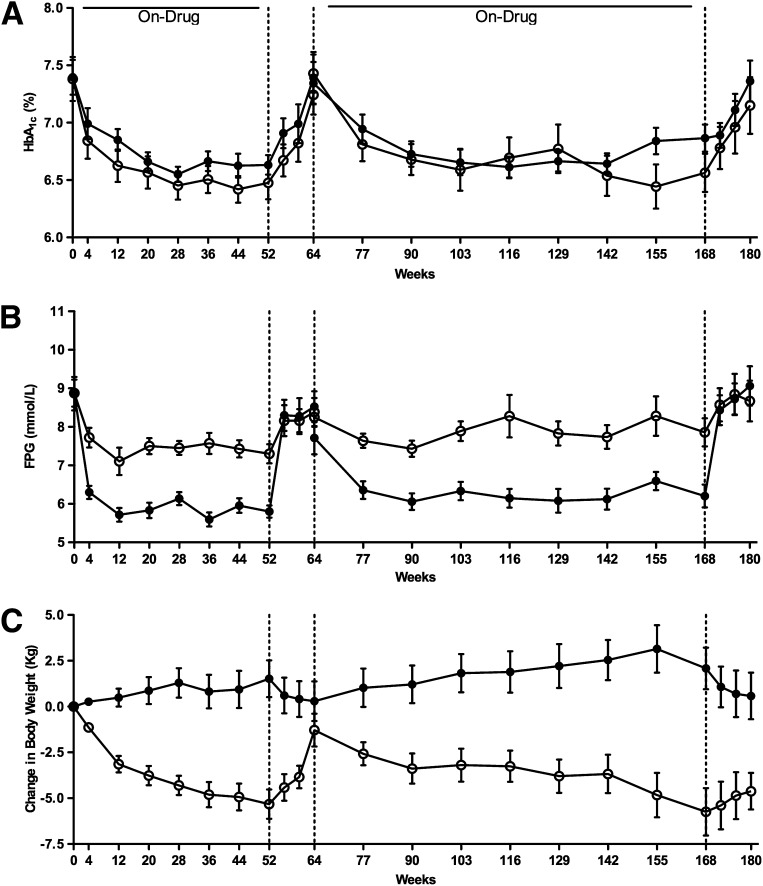
At 3 years, EXE and GLAR resulted in similar levels of glycemic control: 6.6 ± 0.2% and 6.9 ± 0.2%, respectively (P = 0.186). EXE compared with GLAR significantly reduced body weight (-7.9 ± 1.8 kg; P < 0.001). After the 4-week off-drug period, EXE increased the M value by 39% (P = 0.006) while GLAR had no effect (P = 0.647). Following the 4-week off-drug period, the DI, compared with pretreatment, increased with EXE, but decreased with GLAR (1.43 ± 0.78 and -0.99 ± 0.65, respectively; P = 0.028).
EXE and GLAR sustained HbA(1c) over the 3-year treatment period, while EXE reduced body weight and GLAR increased body weight. Following the 3-year treatment with EXE, the DI was sustained after a 4-week off-drug period. These findings suggest a beneficial effect on β-cell health.
我们之前的研究表明,与甘精胰岛素(GLAR)相比,艾塞那肽(EXE)在治疗 1 年后可增强胰岛素分泌,且具有相似的降血糖作用。但停药 4 周后这些效果不能持续。本文报道了额外 2 年暴露后的结果。
69 例接受二甲双胍治疗的 2 型糖尿病患者被随机分为 EXE 或 GLAR 组。46 例患者进入为期 2 年的扩展研究,继续接受分配的治疗。36 例患者(EXE:n = 16;GLAR:n = 20)完成了 3 年的暴露期。在治疗前(第 52 周)和停药后 4 周(第 56 周和第 172 周)进行了正常血糖高胰岛素夹心法和精氨酸刺激高血糖钳夹法以测量胰岛素敏感性(M 值)和β细胞功能。将第一时相葡萄糖刺激的 C 肽分泌量根据 M 值进行校正,并计算为处置指数(DI)。
3 年后,EXE 和 GLAR 分别使血糖控制水平达到相似水平:6.6 ± 0.2%和 6.9 ± 0.2%(P = 0.186)。与 GLAR 相比,EXE 显著降低体重(-7.9 ± 1.8 kg;P < 0.001)。停药 4 周后,EXE 使 M 值增加 39%(P = 0.006),而 GLAR 则没有效果(P = 0.647)。停药 4 周后,与治疗前相比,EXE 使 DI 增加,但 GLAR 则减少(分别为 1.43 ± 0.78 和-0.99 ± 0.65,P = 0.028)。
EXE 和 GLAR 在 3 年的治疗期间均能维持 HbA1c,而 EXE 可降低体重,GLAR 则增加体重。EXE 治疗 3 年后停药 4 周,DI 仍能维持。这些发现表明对β细胞健康有有益作用。