Bunck Mathijs C, Diamant Michaela, Cornér Anja, Eliasson Bjorn, Malloy Jaret L, Shaginian Rimma M, Deng Wei, Kendall David M, Taskinen Marja-Riitta, Smith Ulf, Yki-Järvinen Hannele, Heine Robert J
Department of Endocrinology, Diabetes Center, VU University Medical Center, Amsterdam, the Netherlands.
Diabetes Care. 2009 May;32(5):762-8. doi: 10.2337/dc08-1797. Epub 2009 Feb 5.
Traditional blood glucose-lowering agents do not sustain adequate glycemic control in most type 2 diabetic patients. Preclinical studies with exenatide have suggested sustained improvements in beta-cell function. We investigated the effects of 52 weeks of treatment with exenatide or insulin glargine followed by an off-drug period on hyperglycemic clamp-derived measures of beta-cell function, glycemic control, and body weight.
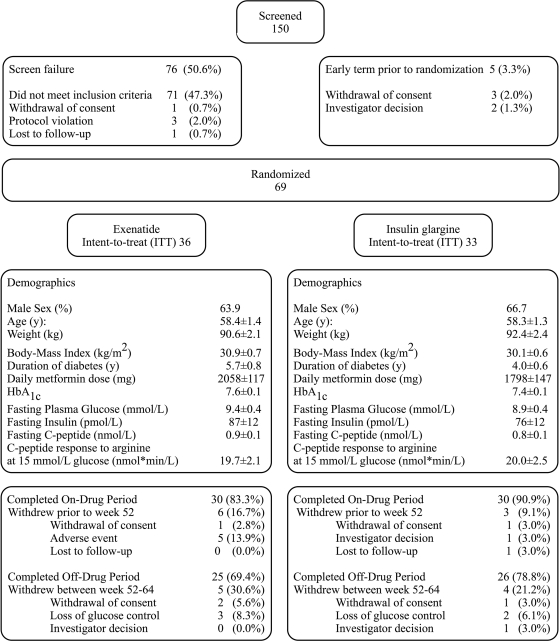
Sixty-nine metformin-treated patients with type 2 diabetes were randomly assigned to exenatide (n = 36) or insulin glargine (n = 33). beta-Cell function was measured during an arginine-stimulated hyperglycemic clamp at week 0, at week 52, and after a 4-week off-drug period. Additional end points included effects on glycemic control, body weight, and safety.
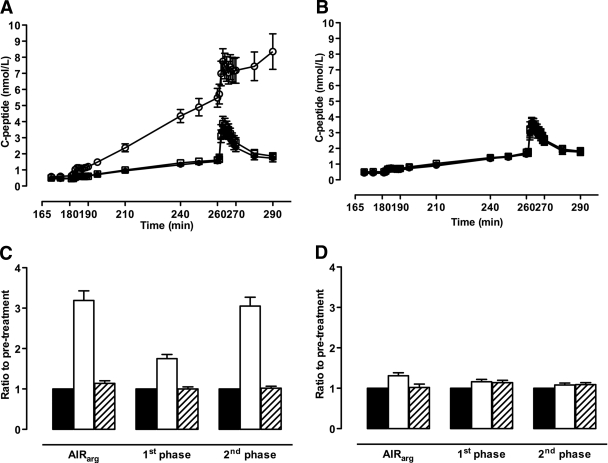
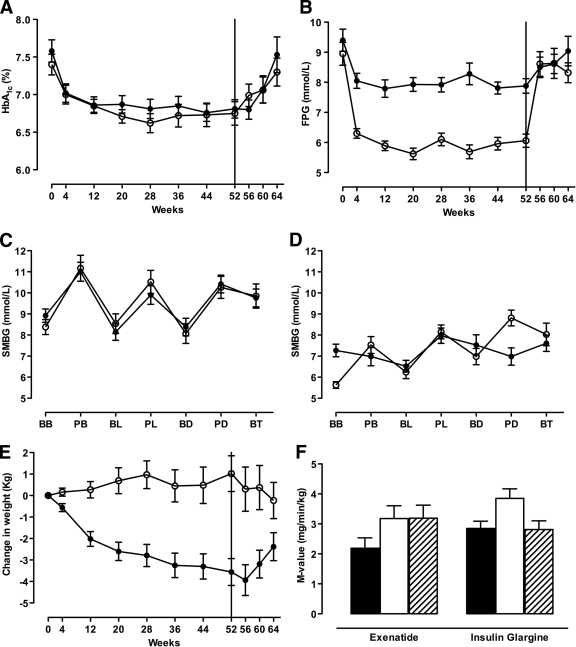
Treatment-induced change in combined glucose- and arginine-stimulated C-peptide secretion was 2.46-fold (95% CI 2.09-2.90, P < 0.0001) greater after a 52-week exenatide treatment compared with insulin glargine treatment. Both exenatide and insulin glargine reduced A1C similarly: -0.8 +/- 0.1 and -0.7 +/- 0.2%, respectively (P = 0.55). Exenatide reduced body weight compared with insulin glargine (difference -4.6 kg, P < 0.0001). beta-Cell function measures returned to pretreatment values in both groups after a 4-week off-drug period. A1C and body weight rose to pretreatment values 12 weeks after discontinuation of either exenatide or insulin glargine therapy.
Exenatide significantly improves beta-cell function during 1 year of treatment compared with titrated insulin glargine. After cessation of both exenatide and insulin glargine therapy, beta-cell function and glycemic control returned to pretreatment values, suggesting that ongoing treatment is necessary to maintain the beneficial effects of either therapy.
大多数2型糖尿病患者使用传统降糖药物无法维持充分的血糖控制。艾塞那肽的临床前研究表明其可使β细胞功能持续改善。我们研究了52周的艾塞那肽或甘精胰岛素治疗及随后的停药期对高血糖钳夹衍生的β细胞功能、血糖控制和体重指标的影响。
69例接受二甲双胍治疗的2型糖尿病患者被随机分配至艾塞那肽组(n = 36)或甘精胰岛素组(n = 33)。在第0周、第52周以及4周停药期后,通过精氨酸刺激的高血糖钳夹测量β细胞功能。其他终点指标包括对血糖控制、体重和安全性的影响。
与甘精胰岛素治疗相比,52周的艾塞那肽治疗后,葡萄糖和精氨酸刺激的C肽分泌联合治疗诱导变化大2.46倍(95%CI 2.09 - 2.90,P < 0.0001)。艾塞那肽和甘精胰岛素降低糖化血红蛋白(A1C)的效果相似:分别为-0.8±0.1%和-0.7±0.2%(P = 0.55)。与甘精胰岛素相比,艾塞那肽可降低体重(差异为-4.6 kg,P < 0.0001)。4周停药期后,两组的β细胞功能指标均恢复至治疗前水平。停用艾塞那肽或甘精胰岛素治疗12周后,A1C和体重升至治疗前水平。
与滴定的甘精胰岛素相比,艾塞那肽在1年治疗期间可显著改善β细胞功能。停用艾塞那肽和甘精胰岛素治疗后,β细胞功能和血糖控制均恢复至治疗前水平,提示持续治疗对于维持任一治疗的有益效果均有必要。