Department of Obstetrics and Gynecology, Taipei Medical University Hospital, Taipei, Taiwan.
Evid Based Complement Alternat Med. 2012;2012:740813. doi: 10.1155/2012/740813. Epub 2011 Aug 18.
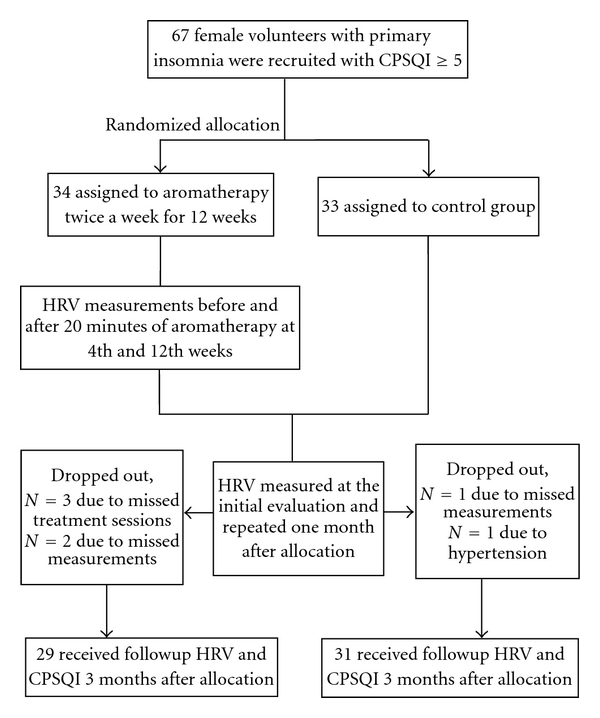
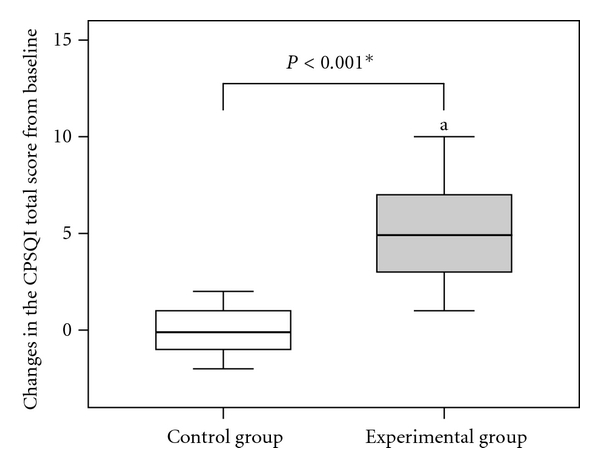
The objective of this study is to determine the effects of 12 weeks of lavender aromatherapy on self-reported sleep and heart rate variability (HRV) in the midlife women with insomnia. Sixty-seven women aged 45-55 years, with a CPSQI (Chinese version of Pittsburgh Sleep Quality Index) greater than 5, were recruited from communities in Taiwan. The experimental group (n = 34) received lavender inhalation, 20 min each time, twice per week, for 12 weeks, with a total of 24 times. The control group (n = 33) received health education program for sleep hygiene with no intervention. The study of HRV was analyzed by time- and frequency-domain methods. Significant decrease in mean heart rate (HR) and increases in SDNN (standard deviation of the normal-to-normal (NN) intervals), RMSDD (square root of the mean squared differences of successive NN intervals), and HF (high frequency) of spectral powers analysis after lavender inhalation were observed in the 4th and 12th weeks of aromatherapy. The total CPSQI score of study subjects was significantly decreased in the experimental group (P < 0.001), while no significant difference was observed across the same time period (P = 0.776) in the control group. Resting HR and HRV measurements at baseline 1 month and 3 months after allocation showed no significant difference between the experimental and control groups. The study demonstrated that lavender inhalation may have a persistent short-term effect on HRV with an increase in parasympathetic modulation. Women receiving aromatherapy experienced a significant improvement in sleep quality after intervention. However, lavender aromatherapy does not appear to confer benefit on HRV in the long-term followup.
本研究旨在探讨 12 周薰衣草芳香疗法对中年失眠女性的睡眠和心率变异性(HRV)的影响。从台湾社区招募了 67 名年龄在 45-55 岁之间、匹兹堡睡眠质量指数(Chinese version of Pittsburgh Sleep Quality Index,CPSQI)评分大于 5 的女性。实验组(n = 34)接受薰衣草吸入治疗,每次 20 分钟,每周两次,共 24 次。对照组(n = 33)接受睡眠卫生健康教育计划,无干预。HRV 的研究采用时频域方法分析。在芳香疗法的第 4 周和第 12 周观察到平均心率(HR)显著降低,SDNN(正常到正常(NN)间隔的标准差)、RMSDD(NN 间隔均方根差的平方根)和 HF(高频)频谱功率分析增加。在实验组中,研究对象的总 CPSQI 评分显著降低(P < 0.001),而对照组在同一时间段内(P = 0.776)无显著差异。在分配后 1 个月和 3 个月时的静息 HR 和 HRV 测量显示实验组和对照组之间没有显著差异。研究表明,薰衣草吸入可能对 HRV 具有持续的短期影响,增加副交感神经调节。接受芳香疗法的女性在干预后睡眠质量显著改善。然而,在长期随访中,薰衣草芳香疗法似乎对 HRV 没有益处。