Research Centre Adolescent Development, Faculty of Social Sciences, Utrecht University, Heidelberglaan 1, P.O. Box 80140, 3508 TC, Utrecht, The Netherlands.
J Abnorm Child Psychol. 2012 Feb;40(2):211-23. doi: 10.1007/s10802-011-9557-8.
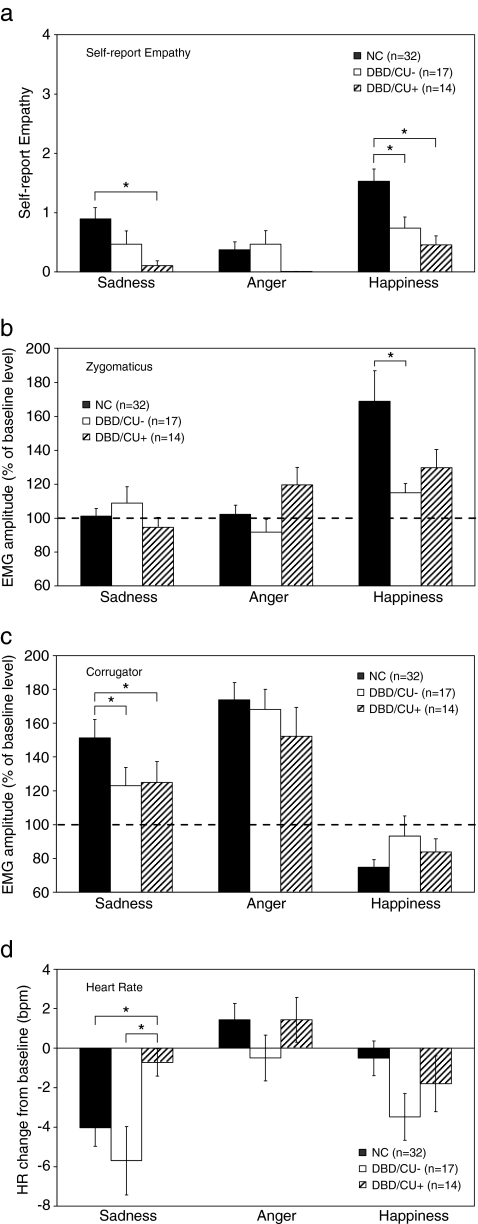
This study examined empathy-related responding in male adolescents with disruptive behavior disorder (DBD), high or low on callous-unemotional (CU) traits. Facial electromyographic (EMG) and heart rate (HR) responses were monitored during exposure to empathy-inducing film clips portraying sadness, anger or happiness. Self-reports were assessed afterward. In agreement with expectations, DBD adolescents with high CU traits showed significantly lower levels of empathic sadness than healthy controls across all response systems. Between DBD subgroups significant differences emerged at the level of autonomic (not verbal or facial) reactions to sadness, with high CU respondents showing less HR change from baseline than low CU respondents. The study also examined basal patterns of autonomic function. Resting HR was not different between groups, but resting respiratory sinus arrhythmia (RSA) was significantly lower in DBD adolescents with high CU traits compared to controls. Results support the notion that CU traits designate a distinct subgroup of DBD individuals.
本研究考察了具有破坏性行为障碍(DBD)的男性青少年在同理心相关反应方面的表现,这些青少年在冷酷无情(CU)特征方面表现为高或低。在观看引发同理心的悲伤、愤怒或快乐情绪的电影片段时,监测面部肌电图(EMG)和心率(HR)的反应。之后评估自我报告。与预期一致,在所有反应系统中,具有高 CU 特征的 DBD 青少年的同理心悲伤水平明显低于健康对照组。在 DBD 亚组之间,在对悲伤的自主(非言语或面部)反应水平上出现了显著差异,高 CU 受访者的 HR 变化比低 CU 受访者的 HR 变化更小。该研究还检查了自主功能的基础模式。静息心率在组间没有差异,但具有高 CU 特征的 DBD 青少年的静息呼吸窦性心律失常(RSA)明显低于对照组。研究结果支持这样一种观点,即 CU 特征指定了 DBD 个体的一个独特亚组。