• 文献检索
  • 文档翻译
  • 深度研究
  • 学术资讯
  • Suppr Zotero 插件Zotero 插件
  • 邀请有礼
  • 套餐&价格
  • 历史记录
应用&插件
Suppr Zotero 插件Zotero 插件浏览器插件Mac 客户端Windows 客户端微信小程序
定价
高级版会员购买积分包购买API积分包
服务
文献检索文档翻译深度研究API 文档MCP 服务
关于我们
关于 Suppr公司介绍联系我们用户协议隐私条款
关注我们

Suppr 超能文献

核心技术专利:CN118964589B侵权必究
粤ICP备2023148730 号-1Suppr @ 2026

文献检索

告别复杂PubMed语法,用中文像聊天一样搜索,搜遍4000万医学文献。AI智能推荐,让科研检索更轻松。

立即免费搜索

文件翻译

保留排版,准确专业,支持PDF/Word/PPT等文件格式,支持 12+语言互译。

免费翻译文档

深度研究

AI帮你快速写综述,25分钟生成高质量综述,智能提取关键信息,辅助科研写作。

立即免费体验

共生和非共生豆蚜之间对宿主的偏好,由蚜茧蜂,Lysiphlebus ambiguus 决定。

Host preference between symbiotic and aposymbiotic Aphis fabae, by the aphid parasitoid, Lysiphlebus ambiguus.

机构信息

Department of Entomology, Nanjing Agriculture University, Nanjing 210095, China.

出版信息

J Insect Sci. 2011;11:81. doi: 10.1673/031.011.8101.

DOI:10.1673/031.011.8101
PMID:21870967
原文链接:https://pmc.ncbi.nlm.nih.gov/articles/PMC3281486/
Abstract

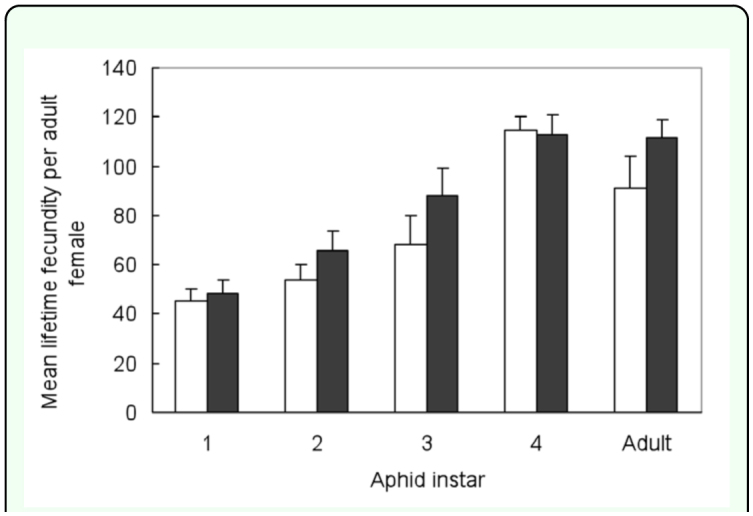
Few empirical studies have directly explored the association between Buchnera aphidicola (Enterobacteriales: Enterobacteriaceae), the primary endosymbiont of aphids, and the life history strategies of aphid parasitoids. A series of paired-choice experiments were conducted to explore the preference of the parasitoid Lysiphlebus ambiguus Halliday (Hymenoptera: Aphididae) for symbiotic and aposymbiotic Aphis fabae Scopoli (Hemiptera: Aphididae) and the suitability of these hosts for parasitoid development. When given a choice between symbiotic and aposymbiotic aphids of the same instar, the parasitoid significantly preferred symbiotic over aposymbiotic aphids only during the later instars (L(4) and adult). The suitability of aposymbiotic aphids for parasitoid development was equal to that of symbiotic aphids in terms of survivorship and sex ratio, but was significantly lower than that of symbiotic aphids for L(4) and adult instars in development rate and/or female adult size. When given a choice between similar-sized symbiotic L(2) and aposymbiotic L(4) aphids, the parasitoid preferred the former. No significant differences in preference or host suitability were demonstrated when the parasitoid was given a choice between different instars of aposymbiotic aphids. While parasitoid lifetime fecundity increased with aphid instar at the time of oviposition, there was no significant influence of previous development from symbiotic versus aposymbiotic aphids. These results suggest that while L. ambiguus can discriminate between symbiotic and aposymbiotic A. fabae during later instars and when the aphids are of a similar size, the primary endosymbiont is not needed for successful parasitoid development; and its absence only compromises parasitoid growth reared from later instar aposymbiotic host.

摘要

很少有实证研究直接探讨 Buchnera aphidicola(肠杆菌目:肠杆菌科),即蚜虫的主要内共生体,与蚜虫的生活史策略之间的关系。我们进行了一系列配对选择实验,以探究寄生蜂 Lysiphlebus ambiguus Halliday(膜翅目:蚜科)对共生和非共生的豆蚜 Aphis fabae Scopoli(半翅目:蚜科)的偏好,以及这些宿主对寄生蜂发育的适宜性。当给予同一龄期的共生和非共生蚜虫供选择时,寄生蜂仅在后期龄期(L(4)和成虫)显著偏爱共生蚜虫而非非共生蚜虫。从生存率和性别比例来看,非共生蚜虫对寄生蜂发育的适宜性与共生蚜虫相等,但在发育速度和/或雌性成虫大小方面,非共生蚜虫显著低于共生蚜虫。当给予相似大小的共生 L(2)和非共生 L(4)蚜虫供选择时,寄生蜂更喜欢前者。当给予非共生蚜虫不同龄期供选择时,寄生蜂既没有表现出偏好差异,也没有表现出宿主适宜性差异。尽管寄生蜂的一生总产卵量随蚜虫龄期的增加而增加,但以前由共生蚜虫或非共生蚜虫发育对其无显著影响。这些结果表明,虽然 L. ambiguus 可以在后期龄期和当蚜虫大小相同时区分共生和非共生的 A. fabae,但内共生体并不是成功寄生发育所必需的;而且它的缺失仅会影响从后期龄期非共生宿主中饲养的寄生蜂的生长。
https://cdn.ncbi.nlm.nih.gov/pmc/blobs/8dfd/3281486/7fcb954c03a7/f01_01.jpg

相似文献

1
Host preference between symbiotic and aposymbiotic Aphis fabae, by the aphid parasitoid, Lysiphlebus ambiguus.共生和非共生豆蚜之间对宿主的偏好,由蚜茧蜂,Lysiphlebus ambiguus 决定。
J Insect Sci. 2011;11:81. doi: 10.1673/031.011.8101.
2
Effects of aposymbiotic and symbiotic aphids on parasitoid progeny development and adult oviposition behavior within aphid instars.无共生蚜虫和共生蚜虫对寄生蜂后代发育及蚜虫龄期内成虫产卵行为的影响。
Environ Entomol. 2010 Apr;39(2):389-95. doi: 10.1603/EN08312.
3
Cornicle secretions by Aphis fabae (Hemiptera: Aphididae) result in age-dependent costs and improved host suitability for Lysiphlebus fabarum (Marshall) (Hymenoptera: Braconidae).豆蚜(半翅目:蚜科)分泌的蜡丝会导致随年龄增长的代价,并提高豌豆蚜茧蜂(马歇尔)(膜翅目:茧蜂科)对寄主的适应性。
Bull Entomol Res. 2018 Oct;108(5):685-693. doi: 10.1017/S0007485317001225. Epub 2017 Dec 4.
4
Host Preference and Fitness of Lysiphlebus testaceipes (Hymenoptera: Braconidae) in Different Instars of the Aphid Schizaphis graminum.淡足侧沟茧蜂(膜翅目:茧蜂科)对麦二叉蚜不同龄期的寄主偏好及适合度
Neotrop Entomol. 2019 Jun;48(3):391-398. doi: 10.1007/s13744-018-0662-z. Epub 2019 Jan 7.
5
Influence of host size variation on the development of a koinobiont aphid parasitoid, Lysiphlebus ambiguus Haliday (Braconidae, Hymenoptera).寄主大小变化对一种兼性寄生蚜茧蜂——暧昧蚜茧蜂(哈利迪,茧蜂科,膜翅目)发育的影响
Bull Entomol Res. 2008 Aug;98(4):389-95. doi: 10.1017/S0007485308005683. Epub 2008 Feb 25.
6
Are aphid parasitoids locally adapted to the prevalence of defensive symbionts in their hosts?蚜虫寄生蜂是否在当地适应了其宿主中防御性共生体的流行情况?
BMC Evol Biol. 2016 Dec 12;16(1):271. doi: 10.1186/s12862-016-0811-0.
7
The transgenerational consequences of maternal parasitism for aphid life history and suitability for subsequent parasitism.母体寄生对蚜虫生活史和适合后续寄生的跨代影响。
Bull Entomol Res. 2022 Feb;112(1):51-57. doi: 10.1017/S0007485321000547. Epub 2021 Jul 12.
8
Ant mimicry by an aphid parasitoid, Lysiphlebus fabarum.蚜茧蜂的拟态行为,Lysiphlebus fabarum。
J Insect Sci. 2010;10:126. doi: 10.1673/031.010.12601.
9
Parasitoid gene expression changes after adaptation to symbiont-protected hosts.寄生蜂适应共生菌保护的宿主后基因表达的变化。
Evolution. 2017 Nov;71(11):2599-2617. doi: 10.1111/evo.13333. Epub 2017 Sep 20.
10
Genotypic variation and the role of defensive endosymbionts in an all-parthenogenetic host-parasitoid interaction.全孤雌生殖宿主 - 寄生蜂相互作用中的基因型变异及防御性内共生菌的作用
Evolution. 2009 Jun;63(6):1439-50. doi: 10.1111/j.1558-5646.2009.00660.x. Epub 2009 Feb 18.

引用本文的文献

1
Functional insights from the GC-poor genomes of two aphid parasitoids, Aphidius ervi and Lysiphlebus fabarum.两种蚜虫寄生蜂,Aphidius ervi 和 Lysiphlebus fabarum 的低 GC 基因组的功能见解。
BMC Genomics. 2020 May 29;21(1):376. doi: 10.1186/s12864-020-6764-0.

本文引用的文献

1
Effects of aposymbiotic and symbiotic aphids on parasitoid progeny development and adult oviposition behavior within aphid instars.无共生蚜虫和共生蚜虫对寄生蜂后代发育及蚜虫龄期内成虫产卵行为的影响。
Environ Entomol. 2010 Apr;39(2):389-95. doi: 10.1603/EN08312.
2
Systemic analysis of the symbiotic function of Buchnera aphidicola, the primary endosymbiont of the pea aphid Acyrthosiphon pisum.豌豆蚜的主要内共生菌 Buchnera aphidicola 的共生功能的系统分析。
C R Biol. 2009 Nov;332(11):1034-49. doi: 10.1016/j.crvi.2009.09.007. Epub 2009 Oct 14.
3
Impact of host developmental age on the transcriptome of the symbiotic bacterium Buchnera aphidicola in the pea aphid (Acyrthosiphon pisum).
宿主发育年龄对豌豆蚜(Acyrthosiphon pisum)共生菌 Buchnera aphidicola 转录组的影响。
Appl Environ Microbiol. 2009 Nov;75(22):7294-7. doi: 10.1128/AEM.01472-09. Epub 2009 Sep 25.
4
Bacteriophages encode factors required for protection in a symbiotic mutualism.噬菌体编码共生互利关系中保护所需的因子。
Science. 2009 Aug 21;325(5943):992-4. doi: 10.1126/science.1174463.
5
Optimal egg distribution among host patches for parasitoids subject to attack by hyperparasitoids.在遭受重寄生蜂攻击的情况下,寄生蜂在寄主斑块间的最优卵分配
Am Nat. 1993 Jan;141(1):120-38. doi: 10.1086/285464.
6
Symbiotic bacteria enable insect to use a nutritionally inadequate diet.共生细菌使昆虫能够利用营养不足的食物。
Proc Biol Sci. 2009 Mar 7;276(1658):987-91. doi: 10.1098/rspb.2008.1476.
7
Influence of host size variation on the development of a koinobiont aphid parasitoid, Lysiphlebus ambiguus Haliday (Braconidae, Hymenoptera).寄主大小变化对一种兼性寄生蚜茧蜂——暧昧蚜茧蜂(哈利迪,茧蜂科,膜翅目)发育的影响
Bull Entomol Res. 2008 Aug;98(4):389-95. doi: 10.1017/S0007485308005683. Epub 2008 Feb 25.
8
Impact of plant nutrients on the relationship between a herbivorous insect and its symbiotic bacteria.植物养分对植食性昆虫与其共生细菌之间关系的影响。
Proc Biol Sci. 2008 Mar 7;275(1634):565-70. doi: 10.1098/rspb.2007.1478.
9
Aphid thermal tolerance is governed by a point mutation in bacterial symbionts.蚜虫的耐热性由细菌共生体中的一个点突变决定。
PLoS Biol. 2007 May;5(5):e96. doi: 10.1371/journal.pbio.0050096.
10
Selective elimination of aphid endosymbionts: effects of antibiotic dose and host genotype, and fitness consequences.蚜虫内共生菌的选择性消除:抗生素剂量和宿主基因型的影响以及适合度后果
FEMS Microbiol Ecol. 2007 May;60(2):229-39. doi: 10.1111/j.1574-6941.2007.00284.x. Epub 2007 Feb 22.