Institut für Humangenetik, Universitätsklinikum Essen, Hufelandstr, 55, 45157 Essen, Germany.
BMC Cancer. 2011 Aug 26;11:380. doi: 10.1186/1471-2407-11-380.
Uveal melanoma (UM) is a rare eye tumor. There are two classes of UM, which can be discriminated by the chromosome 3 status or global mRNA expression profile. Metastatic progression is predominantly originated from class II tumors or from tumors showing loss of an entire chromosome 3 (monosomy 3). We performed detailed EFS (embryonal Fyn-associated substrate) methylation analyses in UM, cultured uveal melanocytes and normal tissues, to explore the role of the differentially methylated EFS promoter region CpG island in tumor classification and metastatic progression.
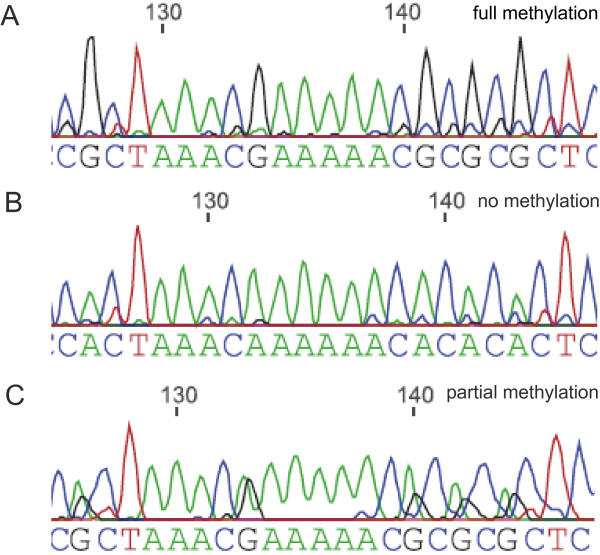
EFS methylation was determined by direct sequencing of PCR products from bisulfite-treated DNA or by sequence analysis of individual cloned PCR products. The results were associated with clinical features of tumors and tumor-related death of patients.
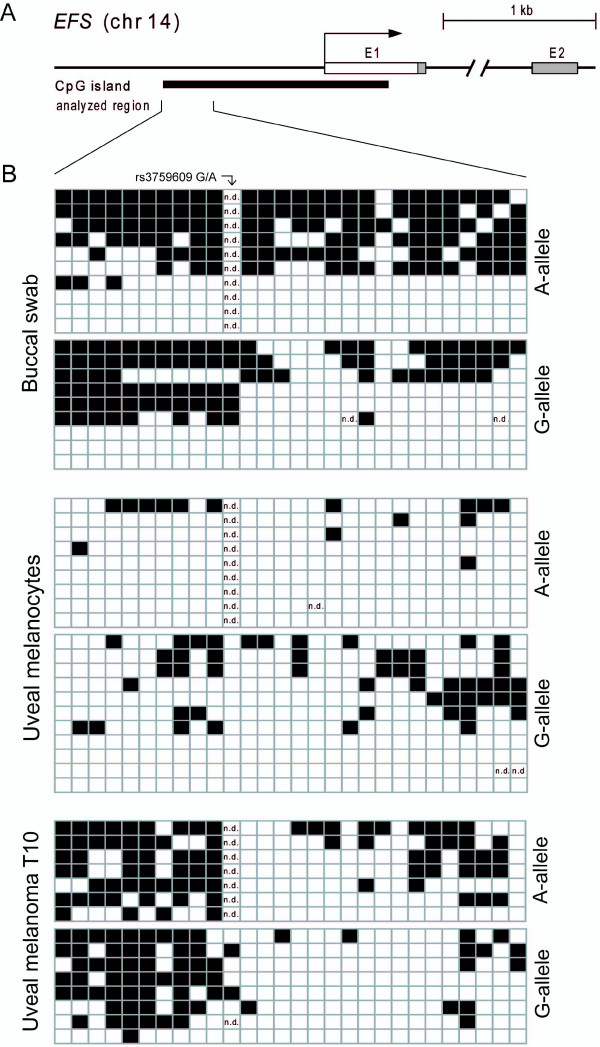
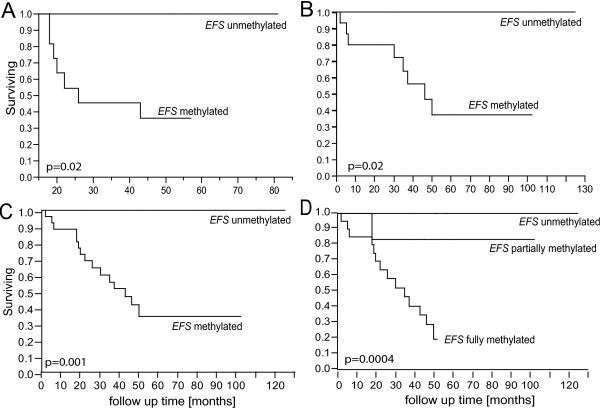
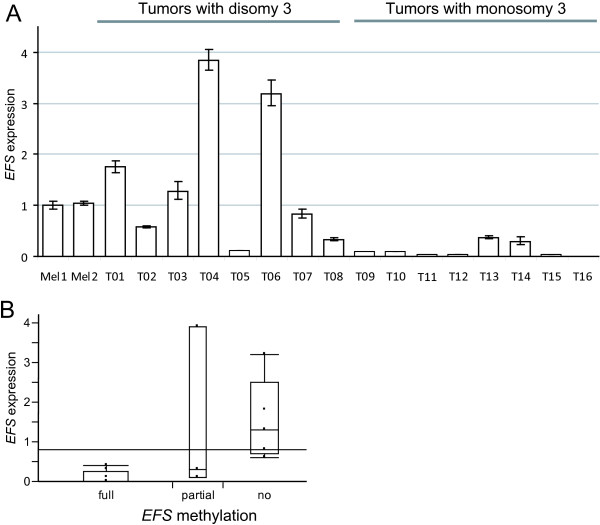
Analysis of 16 UM showed full methylation of the EFS CpG island in 8 (50%), no methylation in 5 (31%) and partial methylation in 3 (19%) tumors. Kaplan-Meier analysis revealed a higher risk of metastatic progression for tumors with EFS methylation (p = 0.02). This correlation was confirmed in an independent set of 24 randomly chosen tumors. Notably, only UM with EFS methylation gave rise to metastases. Real-time quantitative RT-PCR expression analysis revealed a significant inverse correlation of EFS mRNA expression with EFS methylation in UM. We further found that EFS methylation is tissue-specific with full methylation in peripheral blood cells, and no methylation in sperm, cultured primary fibroblasts and fetal muscle, kidney and brain. Adult brain samples, cultured melanocytes from the uveal tract, fetal liver and 3 of 4 buccal swab samples showed partial methylation. EFS methylation always affects both alleles in normal and tumor samples.
Biallelic EFS methylation is likely to be the result of a site-directed methylation mechanism. Based on partial methylation as observed in cultured melanocytes we hypothesize that there might be methylated and unmethylated precursor cells located in the uveal tract. The EFS methylation of a UM may depend on which type of precursor cell the tumor originated from.
葡萄膜黑色素瘤(UM)是一种罕见的眼部肿瘤。UM 有两类,可通过染色体 3 状态或全 mRNA 表达谱来区分。转移进展主要起源于 II 类肿瘤或整个染色体 3 缺失(单体性 3)的肿瘤。我们对 UM、培养的葡萄膜黑色素细胞和正常组织进行了详细的 EFS(胚胎 Fyn 相关底物)甲基化分析,以探讨差异甲基化的 EFS 启动子区 CpG 岛在肿瘤分类和转移进展中的作用。
通过对亚硫酸氢盐处理的 DNA 的 PCR 产物进行直接测序或对单个克隆的 PCR 产物进行序列分析来确定 EFS 甲基化。将结果与肿瘤的临床特征和患者的肿瘤相关死亡相关联。
对 16 例 UM 的分析显示,8 例(50%)UM 的 EFS CpG 岛完全甲基化,5 例(31%)UM 无甲基化,3 例(19%)UM 部分甲基化。Kaplan-Meier 分析显示 EFS 甲基化的肿瘤转移进展风险更高(p=0.02)。这一相关性在 24 例随机选择的肿瘤的独立组中得到了证实。值得注意的是,只有 EFS 甲基化的 UM 才会发生转移。实时定量 RT-PCR 表达分析显示,UM 中 EFS mRNA 表达与 EFS 甲基化呈显著负相关。我们进一步发现,EFS 甲基化具有组织特异性,外周血细胞完全甲基化,精子、培养的原代成纤维细胞和胎儿肌肉、肾脏和大脑均无甲基化。成人脑组织样本、眼葡萄膜培养的黑色素细胞、胎儿肝脏和 4 例口腔拭子样本中的 3 例均显示部分甲基化。EFS 甲基化在正常和肿瘤样本中总是影响两个等位基因。
EFS 双等位基因甲基化可能是一种靶向甲基化机制的结果。基于在培养的黑色素细胞中观察到的部分甲基化,我们假设在葡萄膜中可能存在甲基化和非甲基化的前体细胞。UM 的 EFS 甲基化可能取决于肿瘤起源的前体细胞类型。