J Transl Med. 2011 Aug 26;9:143. doi: 10.1186/1479-5876-9-143.
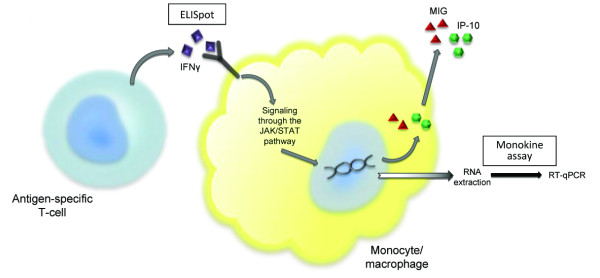
The ability to measure T-cell responses to antigens is proving critical in the field of vaccine development and for understanding immunity to pathogens, allergens and self-antigens. Although a variety of technologies exist for this purpose IFNγ-ELISpot assays are widely used because of their sensitivity and simplicity. However, ELISpots cannot be performed on whole blood, and require relatively large volumes of blood to yield sufficient numbers of peripheral blood mononuclear cells. To address these deficiencies, we describe an assay that measures antigen-specific T cell responses through changes in monokine gene transcription. The biological amplification of the IFNγ signal generated by this assay provides sensitivity comparable to ELISpot, but with the advantage that responses can be quantified using small volumes of whole blood.
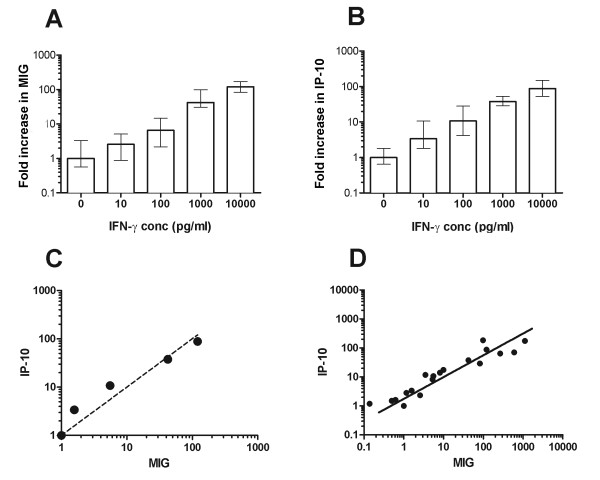
Whole blood or peripheral blood mononuclear cells (PBMCs) from healthy controls and immunosuppressed recipients of solid organ transplants were incubated with peptide pools covering viral and control antigens or mitogen for 20 hours. Total RNA was extracted and reverse transcribed before amplification in a TaqMan qPCR reaction using primers and probes specific for MIG (CXCL9), IP-10 (CXCL10) and HPRT. The induction of MIG and IP-10 in response to stimuli was analysed and the results were compared with those obtained by ELISpot.
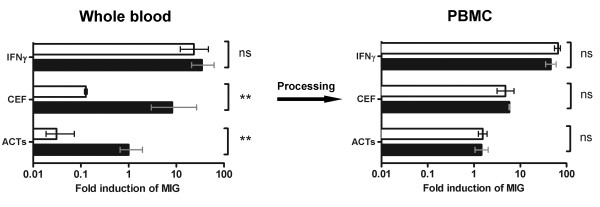
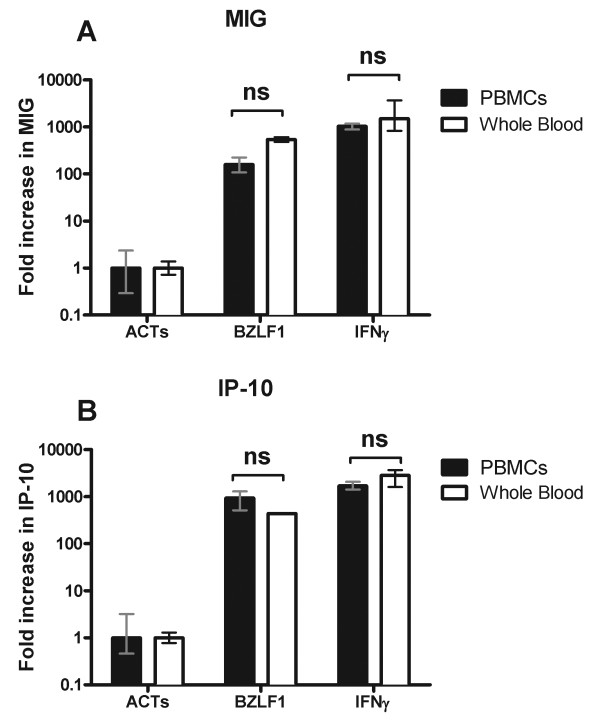
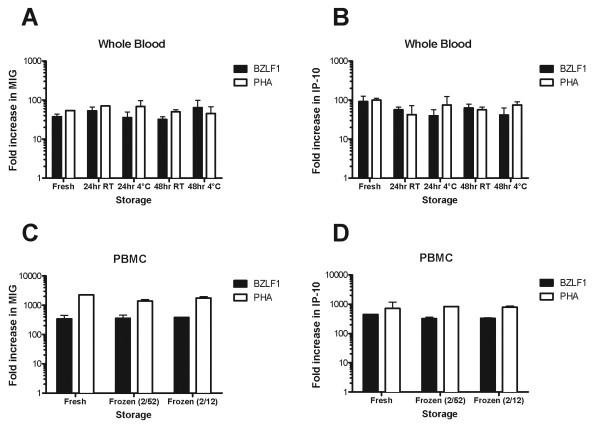
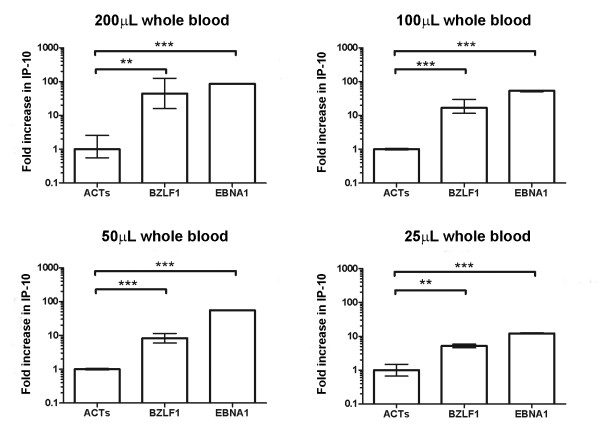
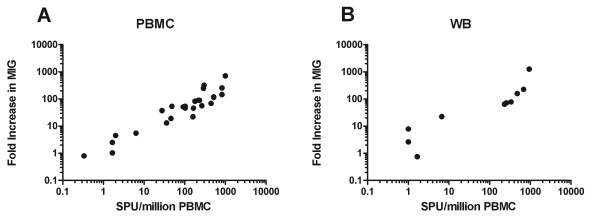
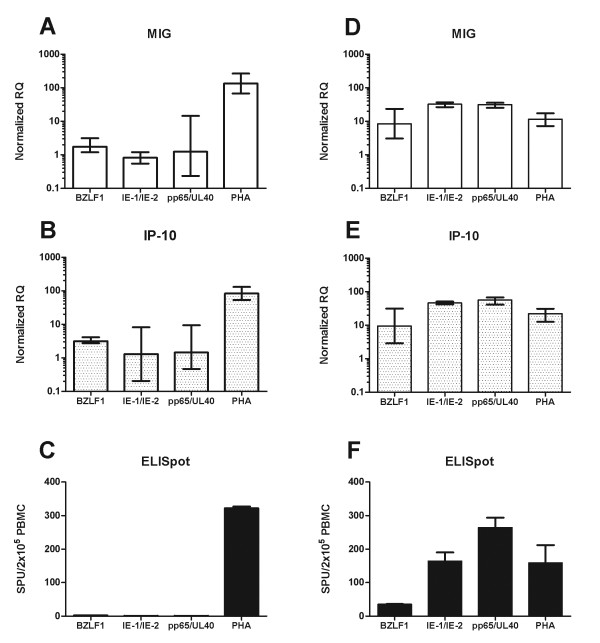
Antigen-specific T cell responses can be measured through the induction of MIG or IP-10 gene expression in PBMCs or whole blood with results comparable to those achieved in ELISpot assays. The biological amplification generated by IFNγ-R signaling allows responses to be detected in as little as 25 uL of whole blood and enables the assay to retain sensitivity despite storage of samples for up to 48 hours prior to processing.
A monokine-based reporter assay provides a sensitive measure of antigen-specific T cell activation. Assays can be performed on small volumes of whole blood and remain accurate despite delays in processing. This assay may be a useful tool for studying T cell responses, particularly when samples are limited in quantity or when storage or transportation are required before processing.
能够测量 T 细胞对抗原的反应在疫苗开发领域和理解病原体、过敏原和自身抗原的免疫方面证明是至关重要的。尽管存在多种用于此目的的技术,但 IFNγ-ELISpot 测定因其敏感性和简单性而被广泛使用。然而,ELISpots 不能在全血上进行,并且需要相对大量的血液才能产生足够数量的外周血单核细胞。为了解决这些缺陷,我们描述了一种通过单因基因转录变化来测量抗原特异性 T 细胞反应的测定法。该测定法产生的 IFNγ 信号的生物学扩增提供了与 ELISpot 相当的灵敏度,但具有使用小体积全血定量测定的优点。
来自健康对照者和实体器官移植受者的全血或外周血单核细胞(PBMCs)与覆盖病毒和对照抗原或有丝分裂原的肽池孵育 20 小时。提取总 RNA,然后在 TaqMan qPCR 反应中进行逆转录,使用针对 MIG(CXCL9)、IP-10(CXCL10)和 HPRT 的引物和探针进行扩增。分析刺激物引起的 MIG 和 IP-10 的诱导,并将结果与通过 ELISpot 获得的结果进行比较。
通过 PBMC 或全血中 MIG 或 IP-10 基因表达的诱导,可以测量抗原特异性 T 细胞反应,结果与 ELISpot 测定法相当。IFNγ-R 信号产生的生物学扩增允许在仅 25 μL 的全血中检测到反应,并使测定法能够在处理前样品储存长达 48 小时的情况下保持灵敏度。
基于单因的报告测定法提供了一种灵敏的抗原特异性 T 细胞激活测量方法。可以在小体积的全血上进行测定,并且即使处理延迟也保持准确性。该测定法可能是研究 T 细胞反应的有用工具,特别是在样品数量有限或在处理之前需要储存或运输的情况下。