Laboratory of Immunovirology, Infectious Diseases Service, Instituto Ramón y Cajal de Investigaciones Cientificas (IRYCIS), Hospital Universitario Ramón y Cajal, Madrid, Spain.
Virol J. 2011 Aug 26;8:416. doi: 10.1186/1743-422X-8-416.
Most of the non-B HIV-1 subtypes are predominant in Sub-Saharan Africa and India although they have been found worldwide. In the last decade, immigration from these areas has increased considerably in Spain. The objective of this study was to evaluate the prevalence of non-B subtypes circulating in a cohort of HIV-1-infected immigrants in Seville, Southern Spain and to identify drug resistance-associated mutations.
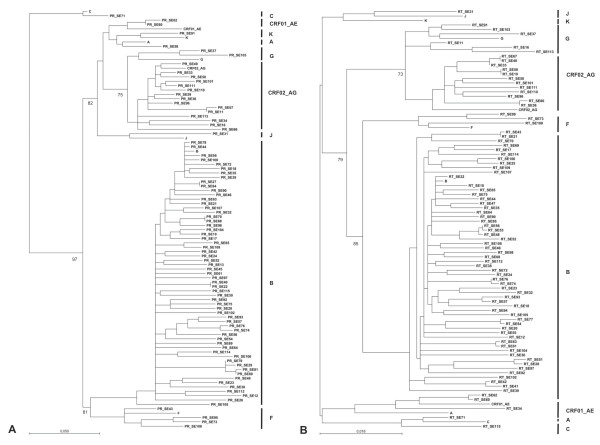
Complete protease and first 220 codons of the reverse transcriptase coding regions were amplified and sequenced by population sequencing. HIV-1 subtypes were determined using Stanford University Drug Resistance Database, and phylogenetic analysis was performed comparing multiple reported sequences. Drug resistance mutations were defined according to the International AIDS Society-USA.
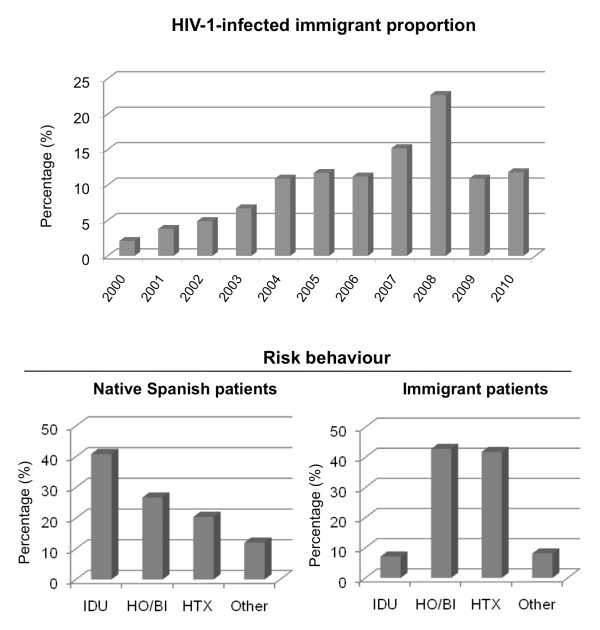
From 2000 to 2010 a total of 1,089 newly diagnosed HIV-1-infected patients were enrolled in our cohort. Of these, 121 were immigrants, of which 98 had ethical approval and informed consent to include in our study. Twenty-nine immigrants (29/98, 29.6%) were infected with non-B subtypes, of which 15/29 (51.7%) were CRF02-AG, mostly from Sub-Saharan Africa, and 2/29 (6.9%) were CRF01-AE from Eastern Europe. A, C, F, J and G subtypes from Eastern Europe, Central-South America and Sub-Saharan Africa were also present. Some others harboured recombinant forms CRF02-AG/CRF01-AE, CRF2-AG/G and F/B, B/C, and K/G, in PR and RT-coding regions. Patients infected with non-B subtypes showed a high frequency of minor protease inhibitor resistance mutations, M36I, L63P, and K20R/I. Only one patient, CRF02_AG, showed major resistance mutation L90M. Major RT inhibitor resistance mutations K70R and A98G were present in one patient with subtype G, L100I in one patient with CRF01_AE, and K103N in another patient with CRF01_AE. Three patients had other mutations such as V118I, E138A and V90I.
The circulation of non-B subtypes has significantly increased in Southern Spain during the last decade, with 29.6% prevalence, in association with demographic changes among immigrants. This could be an issue in the treatment and management of these patients. Resistance mutations have been detected in these patients with a prevalence of 7% among treatment-naïve patients compared with the 21% detected among patients under HAART or during treatment interruption.
尽管非 B 型 HIV-1 亚型已在全球范围内发现,但主要还是存在于撒哈拉以南非洲和印度。在过去十年中,来自这些地区的移民数量大大增加。本研究的目的是评估在西班牙南部塞维利亚的 HIV-1 感染移民队列中循环的非 B 亚型的流行情况,并鉴定与耐药相关的突变。
通过群体测序扩增并测序全长蛋白酶和逆转录酶编码区的前 220 个密码子。使用斯坦福大学耐药数据库确定 HIV-1 亚型,并通过比较多个报道序列进行系统进化分析。根据国际艾滋病协会-美国的定义,确定耐药突变。
2000 年至 2010 年,我们的队列共纳入了 1089 例新诊断的 HIV-1 感染患者。其中,121 例为移民,其中 98 例获得了道德批准并同意纳入我们的研究。29 例移民(29/98,29.6%)感染了非 B 亚型,其中 15 例(51.7%)为 CRF02-AG,主要来自撒哈拉以南非洲,2 例(6.9%)为东欧的 CRF01-AE。还存在来自东欧、中-南美洲和撒哈拉以南非洲的 A、C、F、J 和 G 亚型。其他一些患者在 PR 和 RT 编码区还携带重组形式 CRF02-AG/CRF01-AE、CRF2-AG/G 和 F/B、B/C 和 K/G。感染非 B 亚型的患者显示出较低的蛋白酶抑制剂耐药突变(M36I、L63P 和 K20R/I)的高频。只有一名患者(CRF02_AG)表现出主要耐药突变 L90M。在一名 G 型患者中发现了主要逆转录酶抑制剂耐药突变 K70R 和 A98G,在一名 CRF01_AE 患者中发现了 L100I,在另一名 CRF01_AE 患者中发现了 K103N。三名患者有其他突变,如 V118I、E138A 和 V90I。
在过去十年中,西班牙南部的非 B 型亚型的传播显著增加,流行率为 29.6%,这与移民中的人口变化有关。这可能是这些患者治疗和管理中的一个问题。在未接受治疗的患者中,耐药突变的发生率为 7%,而在接受 HAART 或治疗中断的患者中,耐药突变的发生率为 21%。