Department of Biological Sciences, California State University, Long Beach, Long Beach, CA 90840-9502, USA.
Horm Behav. 2011 Nov;60(5):540-8. doi: 10.1016/j.yhbeh.2011.08.002. Epub 2011 Aug 18.
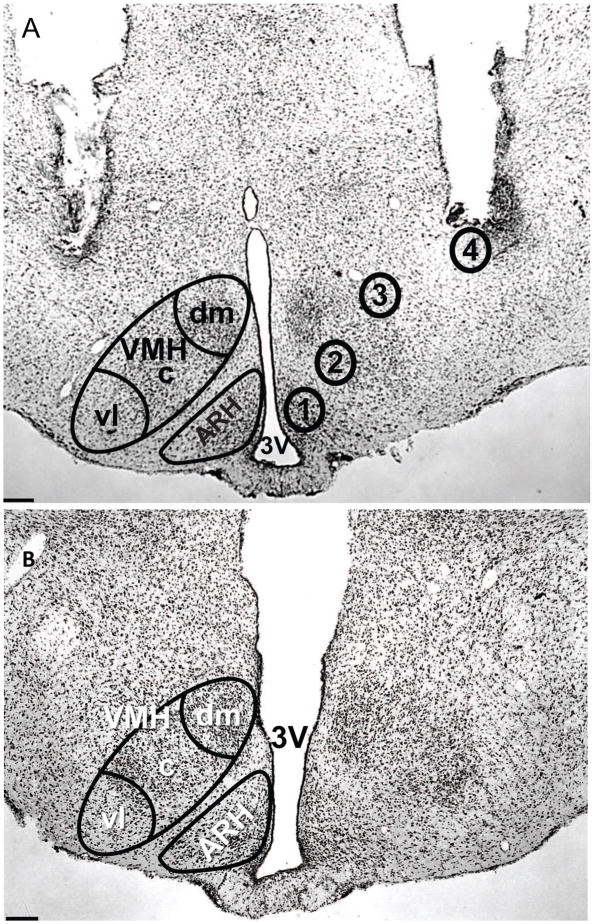
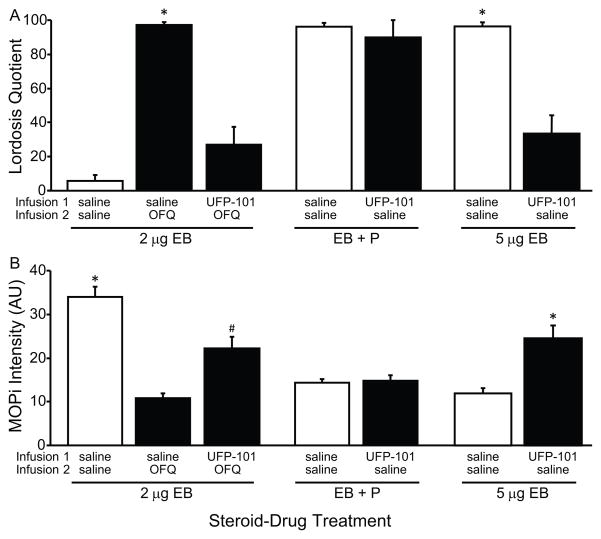
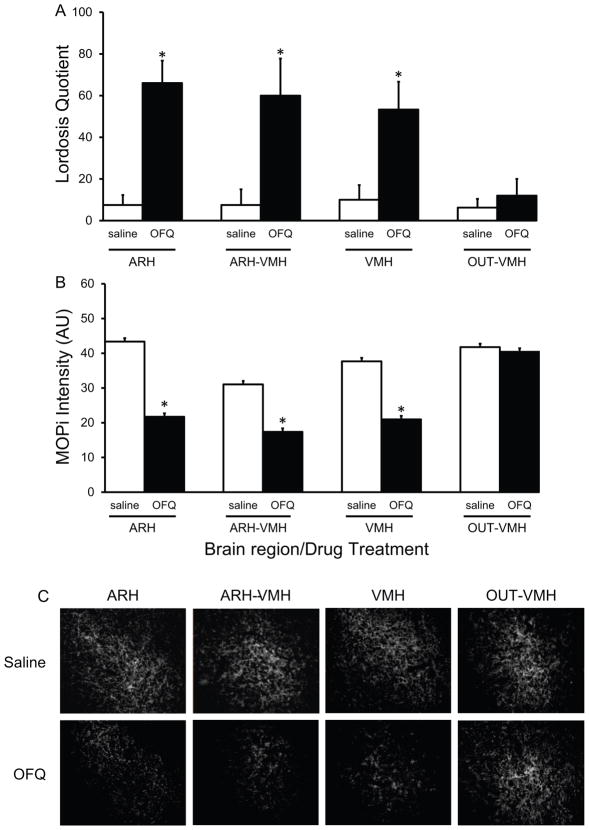
Sexual receptivity, lordosis, can be induced by sequential estradiol and progesterone or extended exposure to high levels of estradiol in the female rat. In both cases estradiol initially inhibits lordosis through activation of β-endorphin (β-END) neurons of the arcuate nucleus of the hypothalamus (ARH) that activate μ-opioid receptors (MOP) in the medial preoptic nucleus (MPN). Subsequent progesterone or extended estradiol exposure deactivates MPN MOP to facilitate lordosis. Opioid receptor-like receptor-1 (ORL-1) is expressed in ARH and ventromedial hypothalamus (VMH). Infusions of its endogenous ligand, orphanin FQ (OFQ/N, aka nociceptin), into VMH-ARH region facilitate lordosis. Whether OFQ/N acts in ARH and/or VMH and whether OFQ/N is necessary for steroid facilitation of lordosis are unclear. In Exp I, OFQ/N infusions in VMH and ARH that facilitated lordosis also deactivated MPN MOP indicating that OFQ/N facilitation of lordosis requires deactivation of ascending ARH-MPN projections by directly inhibiting ARH β-END neurons and/or through inhibition of excitatory VMH-ARH pathways to proopiomelanocortin neurons. It is unclear whether OFQ/N activates the VMH output motor pathways directly or via the deactivation of MPN MOP. In Exp II we tested whether ORL-1 activation is necessary for estradiol-only or estradiol+progesterone lordosis facilitation. Blocking ORL-1 with UFP-101 inhibited estradiol-only lordosis and MPN MOP deactivation but had no effect on estradiol+progesterone facilitation of lordosis and MOP deactivation. In conclusion, steroid facilitation of lordosis inhibits ARH β-END neurons to deactivate MPN MOP, but estradiol-only and estradiol+progesterone treatments appear to use different neurotransmitter systems to inhibit ARH-MPN signaling.
性接受能力,即发情,可通过雌二醇和孕酮的序贯作用或雌性大鼠中高水平雌二醇的持续暴露来诱导。在这两种情况下,雌二醇最初通过激活下丘脑弓状核(ARH)的β-内啡肽(β-END)神经元来抑制发情,从而激活中脑前脑核(MPN)中的μ-阿片受体(MOP)。随后,孕酮或持续的雌二醇暴露使 MPN MOP 失活,从而促进发情。阿片受体样受体 1(ORL-1)在 ARH 和腹内侧下丘脑(VMH)中表达。其内源性配体孤啡肽 FQ(OFQ/N,又名诺西肽)注入 VMH-ARH 区域可促进发情。OFQ/N 是否在 ARH 和/或 VMH 中起作用,以及 OFQ/N 是否是类固醇促进发情所必需的,目前尚不清楚。在实验 I 中,促进发情的 VMH 和 ARH 中的 OFQ/N 输注也使 MPN MOP 失活,表明 OFQ/N 促进发情需要通过直接抑制 ARH β-END 神经元和/或通过抑制兴奋性 VMH-ARH 通路到促阿黑皮素原神经元来使 ARH-MPN 投射失活。目前尚不清楚 OFQ/N 是否直接激活 VMH 输出运动通路,还是通过 MPN MOP 的失活。在实验 II 中,我们测试了 ORL-1 激活是否是雌二醇仅或雌二醇+孕酮发情促进所必需的。用 UFP-101 阻断 ORL-1 抑制了雌二醇仅发情和 MPN MOP 失活,但对雌二醇+孕酮促进发情和 MOP 失活没有影响。总之,发情的类固醇促进作用抑制 ARH β-END 神经元,使 MPN MOP 失活,但雌二醇仅和雌二醇+孕酮处理似乎使用不同的神经递质系统来抑制 ARH-MPN 信号。