Department of Radiation Oncology, University of Washington Medical Center, Seattle, WA 98195, USA.
Radiother Oncol. 2011 Dec;101(3):369-75. doi: 10.1016/j.radonc.2011.07.029. Epub 2011 Aug 27.
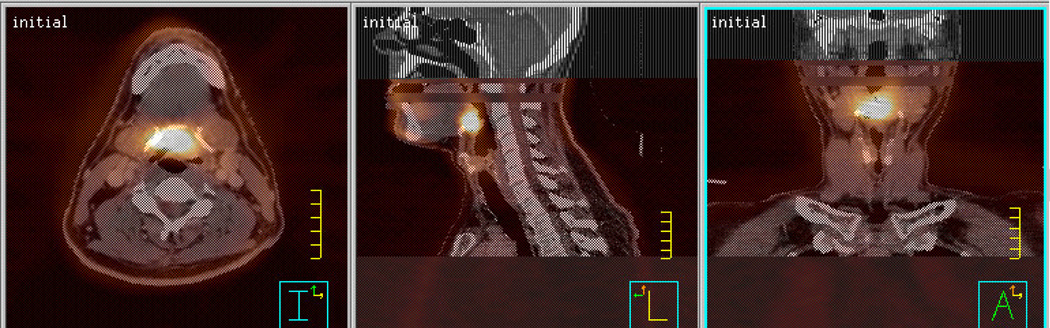
Positron emission tomography (PET) imaging with [F-18] fluoromisonidazole (FMISO) has been validated as a hypoxic tracer. Head and neck cancer exhibits hypoxia, inducing aggressive biologic traits that impart resistance to treatment. Delivery of modestly higher radiation doses to tumors with stable areas of chronic hypoxia can improve tumor control. Advanced radiation treatment planning (RTP) and delivery techniques such as intensity modulated radiation therapy (IMRT) can deliver higher doses to a small volume without increasing morbidity. We investigated the utility of co-registered FMISO-PET and CT images to develop clinically feasible RTPs with higher tumor control probabilities (TCP).
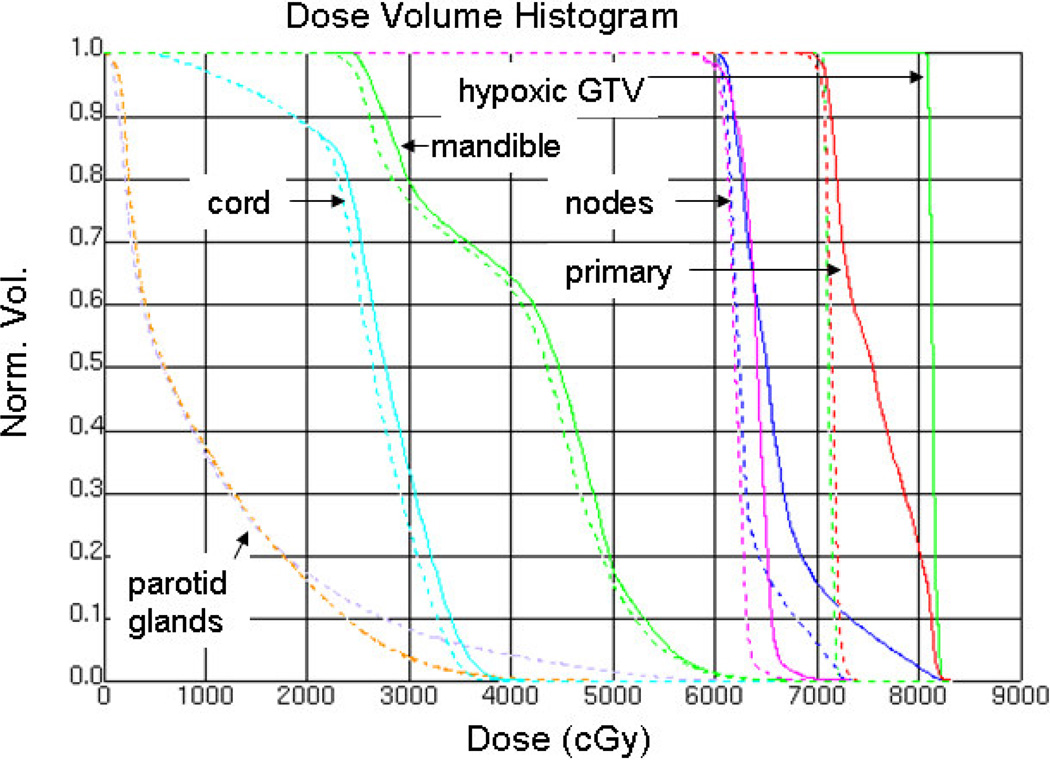
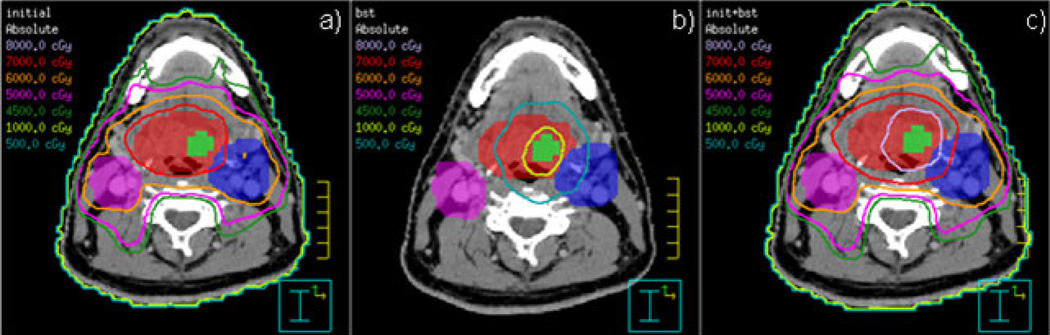
FMISO-PET images were used to determine hypoxic sub-volumes for boost planning. Example plans were generated for 10 of the patients in the study who exhibited significant hypoxia. We created an IMRT plan for each patient with a simultaneous integrated boost (SIB) to the hypoxic sub-volumes. We also varied the boost for two patients.
A significant (mean 17%, median 15%) improvement in TCP is predicted when the modest additional boost dose to the hypoxic sub-volume is included.
Combined FMISO-PET imaging and IMRT planning permit delivery of higher doses to hypoxic regions, increasing the predicted TCP (mean 17%) without increasing expected complications.
正电子发射断层扫描(PET)成像使用[F-18]氟米索硝唑(FMISO)作为缺氧示踪剂已得到验证。头颈部癌症存在缺氧,诱导侵袭性生物特征,从而对治疗产生抵抗力。向具有慢性缺氧稳定区域的肿瘤提供适度较高的辐射剂量可以改善肿瘤控制。先进的放射治疗计划(RTP)和输送技术,如强度调制放射治疗(IMRT),可以在不增加发病率的情况下将更高的剂量输送到小体积。我们研究了共配准 FMISO-PET 和 CT 图像的效用,以开发具有更高肿瘤控制概率(TCP)的临床可行的 RTP。
FMISO-PET 图像用于确定用于增强计划的缺氧亚体积。对研究中表现出明显缺氧的 10 名患者进行了示例计划的生成。我们为每个患者创建了一个具有同步综合增强(SIB)的 IMRT 计划,以增强缺氧亚体积。我们还为两名患者改变了增强剂量。
当将适度增加的剂量施用于缺氧亚体积时,预测 TCP 会显著提高(平均 17%,中位数 15%)。
结合 FMISO-PET 成像和 IMRT 计划可以向缺氧区域提供更高的剂量,从而提高预测的 TCP(平均 17%),而不会增加预期的并发症。