Department of Medical Genetics, Juvenile Diabetes Research Foundation/Wellcome Trust Diabetes and Inflammation Laboratory, Cambridge Institute for Medical Research, University of Cambridge, Cambridge, U.K.
Diabetes. 2011 Oct;60(10):2645-53. doi: 10.2337/db11-0364. Epub 2011 Aug 26.
In contrast with childhood-onset type 1 diabetes, the genetics of autoimmune diabetes in adults are not well understood. We have therefore investigated the genetics of diabetes diagnosed in adults positive for autoantibodies.
GAD autoantibodies (GADAs), insulinoma-associated antigen-2 antibodies (IA-2As), and islet cell autoantibodies were measured at time of diagnosis. Autoantibody-positive diabetic subjects (n = 1,384) and population-based control subjects (n = 2,235) were genotyped at 20 childhood-onset type 1 diabetes loci and FCRL3, GAD2, TCF7L2, and FTO.
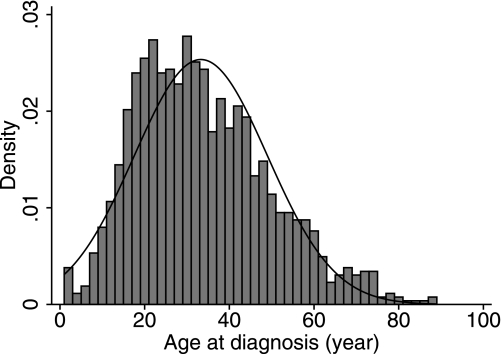
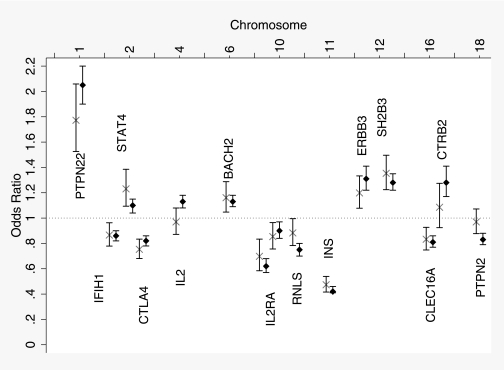
PTPN22 (1p13.2), STAT4 (2q32.2), CTLA4 (2q33.2), HLA (6p21), IL2RA (10p15.1), INS (11p15.5), ERBB3 (12q13.2), SH2B3 (12q24.12), and CLEC16A (16p13.13) were convincingly associated with autoimmune diabetes in adults (P ≤ 0.002), with consistent directions of effect as reported for pediatric type 1 diabetes. No evidence of an HLA-DRB103/HLA-DRB104 (DR3/4) genotype effect was obtained (P = 0.55), but it remained highly predisposing (odds ratio 26.22). DR3/4 was associated with a lower age at diagnosis of disease, as was DR4 (P = 4.67 × 10(-6)) but not DR3. DR3 was associated with GADA positivity (P = 6.03 × 10(-6)) but absence of IA-2A (P = 3.22 × 10(-7)). DR4 was associated with IA-2A positivity (P = 5.45 × 10(-6)).
Our results are consistent with the hypothesis that the genetics of autoimmune diabetes in adults and children are differentiated by only relatively few age-dependent genetic effects. The slower progression toward autoimmune insulin deficiency in adults is probably due to a lower genetic load overall combined with subtle variation in the HLA class II gene associations and autoreactivity.
与儿童发病的 1 型糖尿病相比,成人自身免疫性糖尿病的遗传学尚不清楚。因此,我们研究了在自身抗体阳性的成人中诊断为糖尿病的遗传学。
在诊断时测量谷氨酸脱羧酶自身抗体(GADAs)、胰岛素瘤相关抗原-2 抗体(IA-2As)和胰岛细胞自身抗体。自身抗体阳性的糖尿病患者(n=1384)和基于人群的对照受试者(n=2235)在 20 个儿童发病 1 型糖尿病基因座和 FCRL3、GAD2、TCF7L2 和 FTO 上进行基因分型。
PTPN22(1p13.2)、STAT4(2q32.2)、CTLA4(2q33.2)、HLA(6p21)、IL2RA(10p15.1)、INS(11p15.5)、ERBB3(12q13.2)、SH2B3(12q24.12)和 CLEC16A(16p13.13)与成人自身免疫性糖尿病有明显关联(P≤0.002),其作用方向与儿科 1 型糖尿病报道一致。未获得 HLA-DRB103/HLA-DRB104(DR3/4)基因型效应的证据(P=0.55),但它仍然高度易感(优势比 26.22)。DR3/4 与疾病诊断年龄较小相关,DR4 也与疾病诊断年龄较小相关(P=4.67×10(-6)),但 DR3 无关。DR3 与 GADA 阳性相关(P=6.03×10(-6)),但与 IA-2A 阴性相关(P=3.22×10(-7))。DR4 与 IA-2A 阳性相关(P=5.45×10(-6))。
我们的结果与以下假设一致,即成人和儿童自身免疫性糖尿病的遗传学仅通过少数相对年龄依赖性遗传效应来区分。成人向自身免疫性胰岛素缺乏的进展较慢,可能是由于整体遗传负荷较低,以及 HLA 类 II 基因相关性和自身反应性的细微变化。