Department of Dermatology, University of Wisconsin School of Medicine and Public Health, Madison, Wisconsin, United States of America.
PLoS One. 2011;6(8):e23747. doi: 10.1371/journal.pone.0023747. Epub 2011 Aug 18.
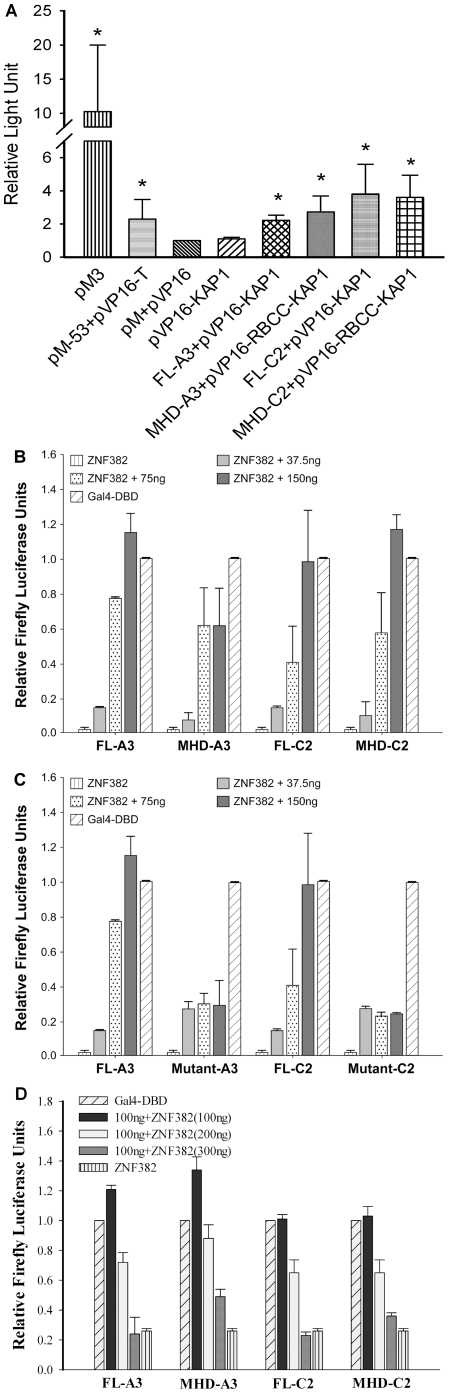
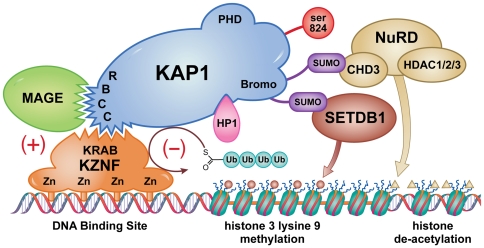
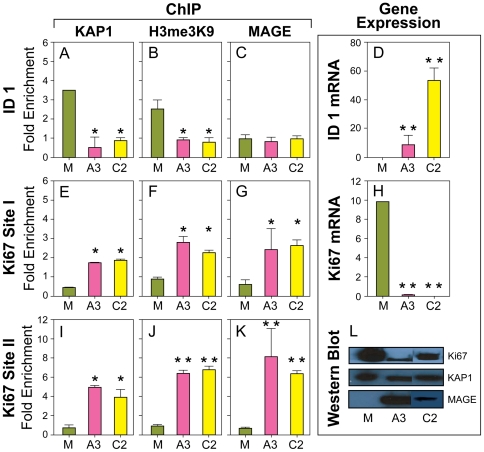
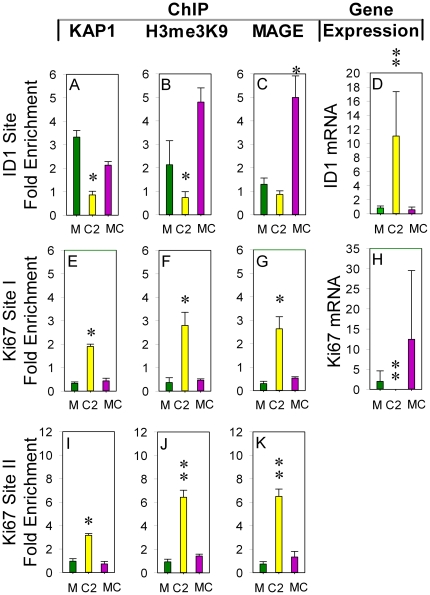
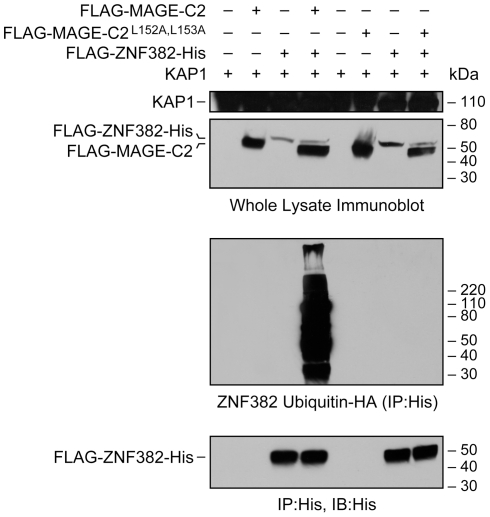
Class I MAGE proteins (MAGE I) are normally expressed only in developing germ cells but are aberrantly expressed in many cancers. They have been shown to promote tumor survival, aggressive growth, and chemoresistance but the underlying mechanisms and MAGE I functions have not been fully elucidated. KRAB domain zinc finger transcription factors (KZNFs) are the largest group of vertebrate transcription factors and regulate neoplastic transformation, tumor suppression, cellular proliferation, and apoptosis. KZNFs bind the KAP1 protein and direct KAP1 to specific DNA sequences where it suppresses gene expression by inducing localized heterochromatin characterized by histone 3 lysine 9 trimethylation (H3me3K9). Discovery that MAGE I proteins also bind to KAP1 prompted us to investigate whether MAGE I can affect KZNF and KAP1 mediated gene regulation. We found that expression of MAGE I proteins, MAGE-A3 or MAGE-C2, relieved repression of a reporter gene by ZNF382, a KZNF with tumor suppressor activity. ChIP of MAGE I (-) HEK293T cells showed KAP1 and H3me3K9 are normally bound to the ID1 gene, a target of ZNF382, but that binding is greatly reduced in the presence of MAGE I proteins. MAGE I expression relieved KAP1 mediated ID1 repression, causing increased expression of ID1 mRNA and ID1 chromatin relaxation characterized by loss of H3me3K9. MAGE I binding to KAP1 also induced ZNF382 poly-ubiquitination and degradation, consistent with loss of ZNF382 leading to decreased KAP1 binding to ID1. In contrast, MAGE I expression caused increased KAP1 binding to Ki67, another KAP1 target gene, with increased H3me3K9 and decreased Ki67 mRNA expression. Since KZNFs are required to direct KAP1 to specific genes, these results show that MAGE I proteins can differentially regulate members of the KZNF family and KAP1 mediated gene repression.
I 类黑色素瘤相关抗原蛋白(MAGE I)通常仅在发育中的生殖细胞中表达,但在许多癌症中异常表达。已经表明它们促进肿瘤存活、侵袭性生长和化疗耐药性,但潜在机制和 MAGE I 功能尚未完全阐明。Krab 结构域锌指转录因子(KZNFs)是脊椎动物转录因子中最大的一组,调节肿瘤转化、肿瘤抑制、细胞增殖和细胞凋亡。KZNFs 与 KAP1 蛋白结合,并指导 KAP1 到特定的 DNA 序列,在那里它通过诱导局部异染色质来抑制基因表达,其特征是组蛋白 3 赖氨酸 9 三甲基化(H3me3K9)。发现 MAGE I 蛋白也与 KAP1 结合,促使我们研究 MAGE I 是否可以影响 KZNF 和 KAP1 介导的基因调控。我们发现,MAGE I 蛋白(MAGE-A3 或 MAGE-C2)的表达可缓解具有肿瘤抑制活性的 KZNF ZNF382 对报告基因的抑制。MAGE I(-)HEK293T 细胞的 ChIP 显示,KAP1 和 H3me3K9 通常与 ID1 基因结合,ID1 基因是 ZNF382 的靶标,但在存在 MAGE I 蛋白时,结合大大减少。MAGE I 表达缓解了 KAP1 介导的 ID1 抑制,导致 ID1 mRNA 表达增加和 ID1 染色质松弛,其特征是 H3me3K9 丢失。MAGE I 与 KAP1 的结合也诱导 ZNF382 多泛素化和降解,与 ZNF382 缺失导致 KAP1 与 ID1 结合减少一致。相反,MAGE I 表达导致 KAP1 与另一个 KAP1 靶基因 Ki67 的结合增加,导致 H3me3K9 增加和 Ki67 mRNA 表达减少。由于 KZNFs 需要将 KAP1 引导到特定基因,因此这些结果表明 MAGE I 蛋白可以差异调节 KZNF 家族成员和 KAP1 介导的基因抑制。