Divisão de Pneumologia, Instituto do Coração, Faculdade de Medicina, Universidade de São Paulo, Brazil.
Clinics (Sao Paulo). 2011;66(7):1157-63. doi: 10.1590/s1807-59322011000700006.
Respiratory pressure-volume curves fitted to exponential equations have been used to assess disease severity and prognosis in spontaneously breathing patients with idiopathic pulmonary fibrosis. Sigmoidal equations have been used to fit pressure-volume curves for mechanically ventilated patients but not for idiopathic pulmonary fibrosis patients. We compared a sigmoidal model and an exponential model to fit pressure-volume curves from mechanically ventilated patients with idiopathic pulmonary fibrosis.
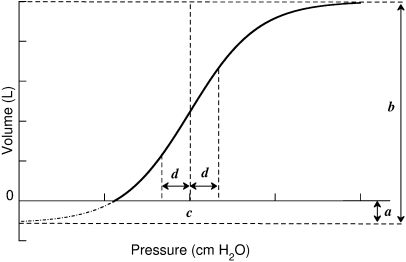
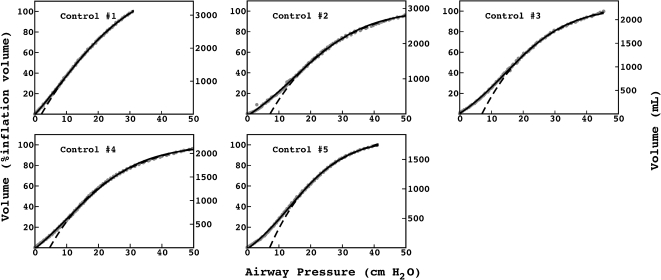
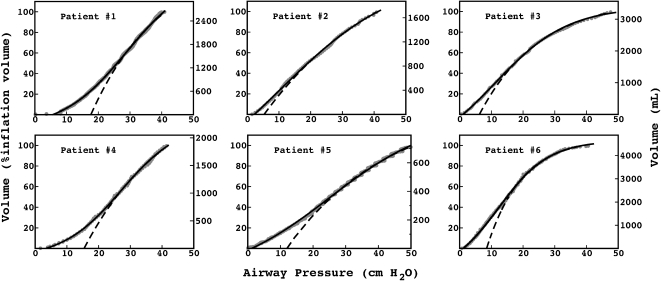
Six idiopathic pulmonary fibrosis patients and five controls underwent inflation pressure-volume curves using the constant-flow technique during general anesthesia prior to open lung biopsy or thymectomy. We identified the lower and upper inflection points and fit the curves with an exponential equation, V = A-B.e-k.P, and a sigmoid equation, V = a+b/(1+e-(P-c)/d).
The mean lower inflection point for idiopathic pulmonary fibrosis patients was significantly higher (10.5 ± 5.7 cm H2O) than that of controls (3.6 ± 2.4 cm H₂O). The sigmoidal equation fit the pressure-volume curves of the fibrotic and control patients well, but the exponential equation fit the data well only when points below 50% of the inspiratory capacity were excluded.
The elevated lower inflection point and the sigmoidal shape of the pressure-volume curves suggest that respiratory system compliance is decreased close to end-expiratory lung volume in idiopathic pulmonary fibrosis patients under general anesthesia and mechanical ventilation. The sigmoidal fit was superior to the exponential fit for inflation pressure-volume curves of anesthetized patients with idiopathic pulmonary fibrosis and could be useful for guiding mechanical ventilation during general anesthesia in this condition.
呼吸压力-容积曲线拟合指数方程已被用于评估特发性肺纤维化患者自主呼吸疾病严重程度和预后。在机械通气患者中使用了Sigmoidal 方程来拟合压力-容积曲线,但未用于特发性肺纤维化患者。我们比较了 Sigmoidal 模型和指数模型,以拟合特发性肺纤维化机械通气患者的压力-容积曲线。
在开胸肺活检或胸腺切除术之前,6 例特发性肺纤维化患者和 5 例对照者在全身麻醉下使用恒流技术进行充气压力-容积曲线。我们确定了下拐点和上拐点,并使用指数方程 V = A-B.e-k.P 和 Sigmoidal 方程 V = a+b/(1+e-(P-c)/d)拟合曲线。
特发性肺纤维化患者的平均下拐点明显高于对照组(10.5 ± 5.7 cm H2O)(3.6 ± 2.4 cm H₂O)。Sigmoidal 方程很好地拟合了纤维化和对照组患者的压力-容积曲线,但指数方程仅在排除吸气量 50%以下的数据时拟合数据良好。
在全身麻醉和机械通气下,特发性肺纤维化患者的下拐点升高和压力-容积曲线呈 Sigmoidal 形状,表明呼吸系统顺应性在接近呼气末肺容积时降低。在麻醉特发性肺纤维化患者的充气压力-容积曲线中,Sigmoidal 拟合优于指数拟合,对于指导该条件下的全身麻醉机械通气可能有用。