Heart Institute, Universidade de São Paulo, SP, Brazil.
Clinics (Sao Paulo). 2010;65(9):841-6. doi: 10.1590/s1807-59322010000900005.
The functional evaluation has become increasingly important in the understanding and management of patients with interstitial lung diseases. The cardiopulmonary exercise test and the six-minute walk test (6MWT), through their isolated variables, have been used to do this evaluation, with some limitations.
We proposed a new composite index (desaturation distance ratio using continuous peripheral oxygen saturation (SpO₂) and the distance walked as a more reliable tool for doing a functional evaluation of these patients.
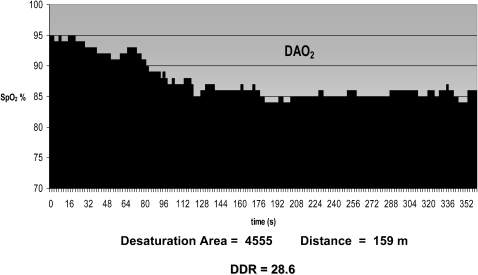
6MWT was performed by interstitial lung diseases patients and controls. Analyzed parameters were walked distance and desaturation area (DAO₂), obtained by taking the difference between maximal SpO₂ possible (100%) and patient's SpO₂ every 2 seconds. desaturation distance ratio was calculated using the ratio between DAO₂ and distance walked.
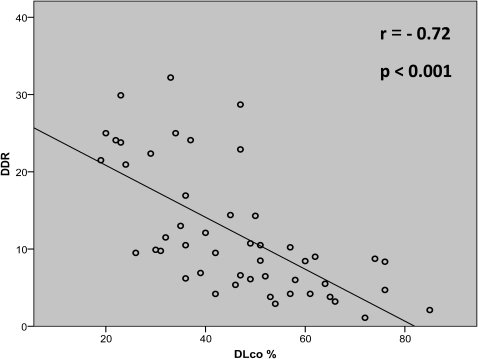
Forty-nine interstitial lung diseases patients and 11 control subjects completed the protocol. The mean (SD) age was 60 (12) years and 65 (9) years, respectively (p:NS). Data obtained from 6MWT showed a significant statistical difference between interstitial lung diseases patients and controls: mean walked distance (430 and 602 meters, respectively); SpO₂ minimal maintained at least 10 seconds - SpO₂ min (85% and 94%, respectively), and median desaturation distance ratio (10 and 2.5, respectively). A correlation analysis, considering interstitial lung diseases patients, revealed the best correlation between desaturation distance ratio and DLco (r= - 0.72; p<0.001), being the correlation between SpO₂ min and DLco of 0.61 (p<0.001) and among walked distance and DLco of 0.58 (p<0.05).
Desaturation distance ratio is a promising concept and a more reliable physiologic tool to assess pulmonary diseases characterized by involvement of the alveolar-capillary membrane, such as interstitial lung diseases.
在理解和管理间质性肺疾病患者时,功能评估变得越来越重要。心肺运动试验和六分钟步行试验(6MWT)通过其孤立的变量被用于进行这种评估,但存在一些局限性。
我们提出了一个新的综合指数(使用连续外周血氧饱和度(SpO₂)和距离的饱和度下降距离比),作为评估这些患者功能的更可靠工具。
对间质性肺疾病患者和对照组进行 6MWT。分析的参数为步行距离和饱和度下降面积(DAO₂),通过在每 2 秒时从最大可能的 SpO₂(100%)中减去患者的 SpO₂来获得。饱和度下降距离比是通过 DAO₂与步行距离的比值来计算的。
49 名间质性肺疾病患者和 11 名对照组完成了方案。平均(SD)年龄分别为 60(12)岁和 65(9)岁(p:无统计学意义)。6MWT 获得的数据显示,间质性肺疾病患者和对照组之间存在显著的统计学差异:平均步行距离(分别为 430 米和 602 米);SpO₂最低维持至少 10 秒 - SpO₂ min(分别为 85%和 94%),以及中位数饱和度下降距离比(分别为 10 和 2.5)。考虑到间质性肺疾病患者的相关性分析显示,饱和度下降距离比与 DLco 的相关性最好(r=-0.72;p<0.001),SpO₂ min 与 DLco 的相关性为 0.61(p<0.001),步行距离与 DLco 的相关性为 0.58(p<0.05)。
饱和度下降距离比是一种很有前途的概念,也是评估肺泡毛细血管膜受累的间质性肺疾病等肺部疾病的更可靠的生理工具。