Department of Anesthesiology, School of Medicine, Fatih University, Ankara, Turkey.
Clinics (Sao Paulo). 2011;66(7):1187-91. doi: 10.1590/s1807-59322011000700011.
The aim of this study was to evaluate the effect of dexmedetomidine on shivering during spinal anesthesia.
Sixty patients (American Society of Anesthesiologists physical status I or II, aged 18-50 years), scheduled for elective minor surgical operations under spinal anesthesia with hyperbaric bupivacaine, were enrolled. They were administered saline (group C, n = 30) or dexmedetomidine (group D, n = 30). Motor block was assessed using a Modified Bromage Scale. The presence of shivering was assessed by a blinded observer after the completion of subarachnoid drug injection.
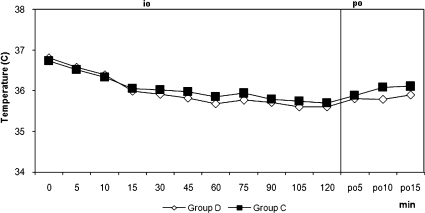
Hypothermia was observed in 21 patients (70%) in group D and in 20 patients (66.7%) in group C (p = 0.781). Three patients (10%) in group D and 17 patients (56.7%) in group C experienced shivering (p = 0.001). The intensity of shivering was lower in group D than in group C (p = 0.001). Time from baseline to onset of shivering was 10 (5-15) min in group D and 15 (5-45) min in group C (p = 0.207).
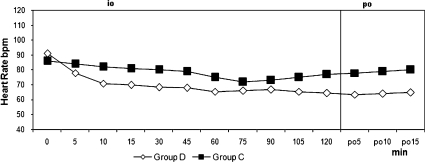
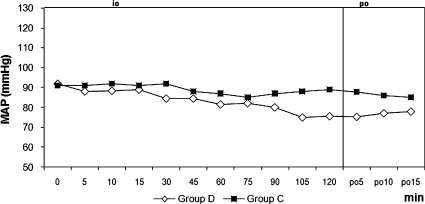
Dexmedetomidine infusion in the perioperative period significantly reduced shivering associated with spinal anesthesia during minor surgical procedures without any major adverse effect during the perioperative period. Therefore, we conclude that dexmedetomidine infusion is an effective drug for preventing shivering and providing sedation in patients during spinal anesthesia.
本研究旨在评估右美托咪定对椎管内麻醉寒战的影响。
60 例美国麻醉医师协会(ASA)身体状况 I 或 II 级、年龄 18-50 岁的择期行椎管内麻醉下小手术的患者入选本研究。患者随机分为生理盐水组(C 组,n=30)或右美托咪定组(D 组,n=30)。采用改良 Bromage 量表评估运动阻滞程度。蛛网膜下腔注药后由盲法观察者评估寒战发生情况。
D 组 21 例(70%)和 C 组 20 例(66.7%)患者发生低体温(p=0.781)。D 组 3 例(10%)和 C 组 17 例(56.7%)患者发生寒战(p=0.001)。D 组寒战强度低于 C 组(p=0.001)。D 组从基础值到寒战发生的时间为 10(5-15)min,C 组为 15(5-45)min(p=0.207)。
围手术期输注右美托咪定可显著减少小手术中椎管内麻醉相关寒战,且在围手术期无明显不良反应。因此,我们认为右美托咪定输注是预防椎管内麻醉期间寒战和镇静的有效药物。