Division of Allergy, Immunology and Rheumatology, Department of Internal Medicine, Taichung City, Taiwan.
Clinics (Sao Paulo). 2011;66(7):1217-22. doi: 10.1590/s1807-59322011000700016.
To investigate the association of body cell mass loss with disease activity and disability in rheumatoid arthritis patients.
Rheumatoid cachexia, defined as the loss of body cell mass, is important but under-recognized and contributes to morbidity and mortality in patients with rheumatoid arthritis.
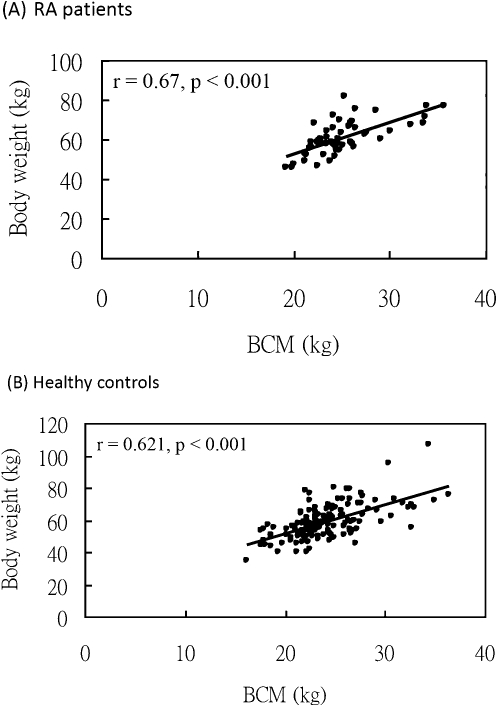
One hundred forty-nine rheumatoid arthritis patients and 53 healthy, non-rheumatoid arthritis control subjects underwent anthropometric measurements of body mass index and waist and hip circumferences. Bioelectrical impedance analysis was used to determine the subjects' body compositions, including fat mass, skeletal lean mass, and body cell mass. The disease activity of rheumatoid arthritis was assessed using C-reactive protein serum, the erythrocyte sedimentation rate and the 28-joint disease activity score, while disability was evaluated using a health assessment questionnaire.
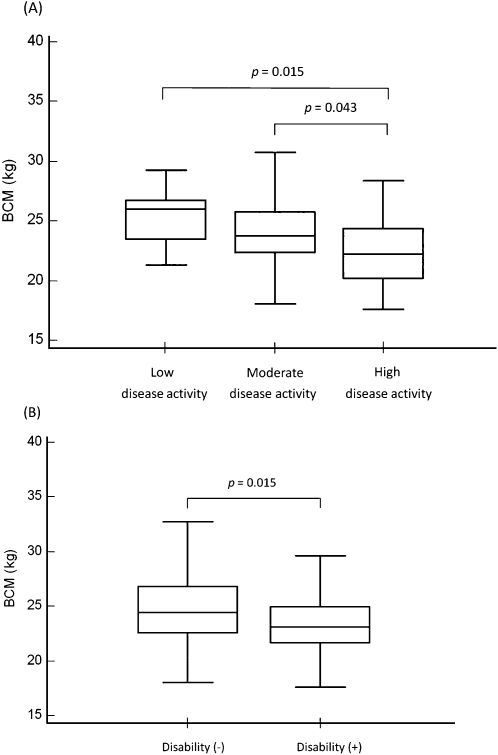
Rheumatoid arthritis patients had lower waist-to-hip ratio (0.86 ± 0.07 vs. 0.95 ± 0.06; p<0.001) and lower skeletal lean mass indexes (14.44 ± 1.52 vs. 15.18 ± 1.35; p = 0.002) than those in the healthy control group. Compared with rheumatoid arthritis patients with higher body cell masses, those with body cell masses lower than median had higher erythrocyte sedimentation rates (40.10 ± 27.33 vs. 25.09 ± 14.85; p<0.001), higher disease activity scores (5.36 ± 3.79 vs. 4.23 ± 1.21; p = 0.022) and greater disability as measured by health assessment questionnaire scores (1.26 ± 0.79 vs. 0.87 ± 0.79; p = 0.004).
The loss of body cell mass is associated with higher disease activity and greater disability in rheumatoid arthritis patients. Body composition determined by bioelectrical impedance analysis can provide valuable information for a rheumatologist to more rapidly recognize rheumatoid cachexia in rheumatoid arthritis patients.
研究类风湿关节炎患者的细胞体质量损失与疾病活动和残疾的关系。
类风湿性恶病质,定义为细胞体质量损失,是重要但未被充分认识的,会导致类风湿关节炎患者的发病率和死亡率增加。
149 名类风湿关节炎患者和 53 名健康、非类风湿关节炎对照者接受了体重指数、腰围和臀围的人体测量。生物电阻抗分析用于确定受试者的身体成分,包括脂肪量、骨骼肌质量和细胞体质量。通过 C 反应蛋白血清、红细胞沉降率和 28 关节疾病活动评分评估类风湿关节炎的疾病活动,通过健康评估问卷评估残疾。
与健康对照组相比,类风湿关节炎患者的腰围-臀围比(0.86 ± 0.07 比 0.95 ± 0.06;p<0.001)和骨骼肌质量指数(14.44 ± 1.52 比 15.18 ± 1.35;p = 0.002)更低。与细胞体质量较高的类风湿关节炎患者相比,细胞体质量低于中位数的患者红细胞沉降率更高(40.10 ± 27.33 比 25.09 ± 14.85;p<0.001),疾病活动评分更高(5.36 ± 3.79 比 4.23 ± 1.21;p = 0.022),健康评估问卷评分显示残疾程度更大(1.26 ± 0.79 比 0.87 ± 0.79;p = 0.004)。
细胞体质量的损失与类风湿关节炎患者的更高疾病活动和更大残疾有关。生物电阻抗分析确定的身体成分可以为风湿病医生提供有价值的信息,以便更快速地识别类风湿关节炎患者的类风湿性恶病质。