CNRS, Institut de Pharmacologie et de Biologie Structurale, F-31077 Toulouse, France.
Nucleic Acids Res. 2011 Dec;39(22):9605-19. doi: 10.1093/nar/gkr656. Epub 2011 Aug 31.
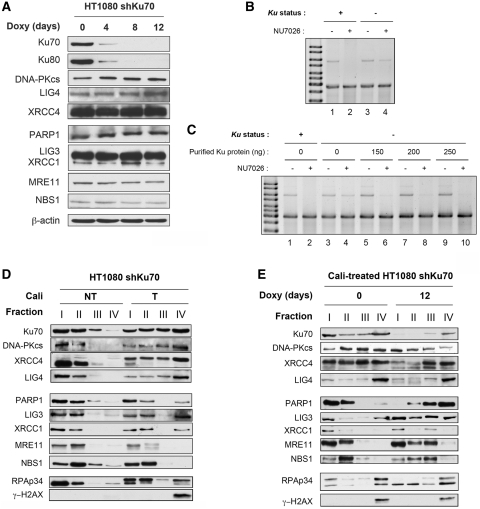
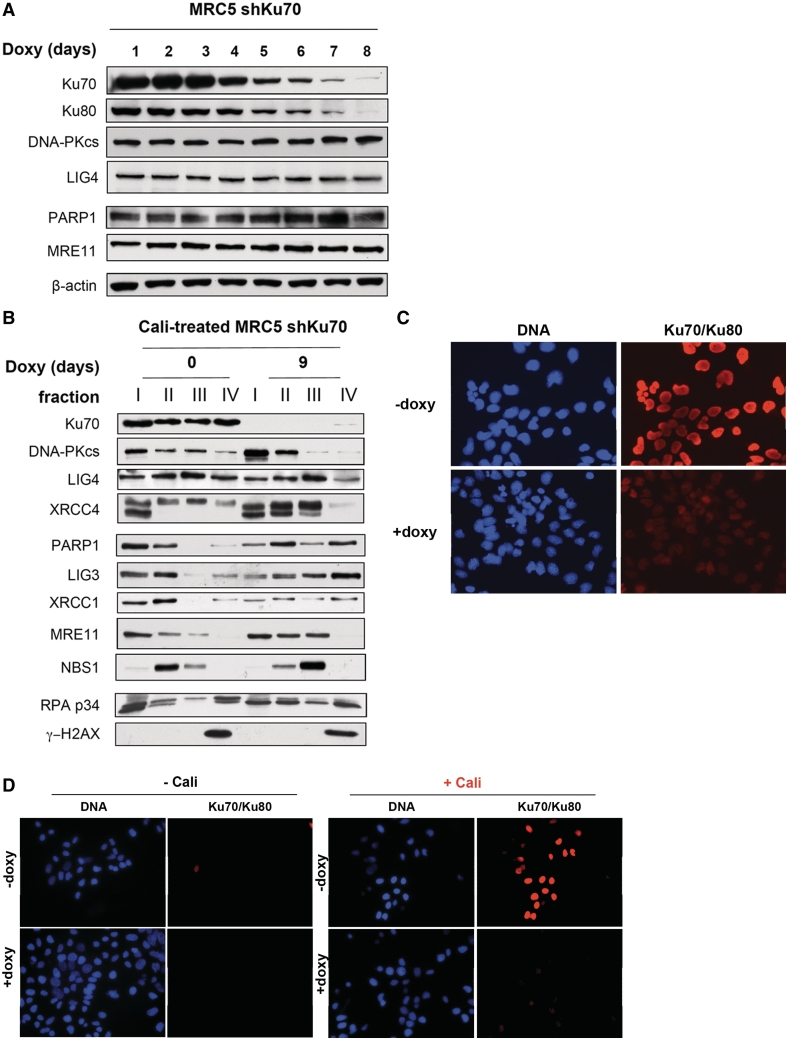
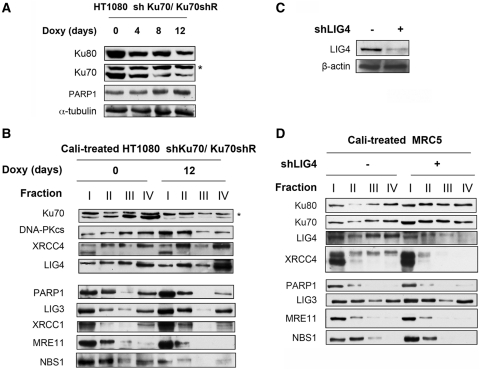
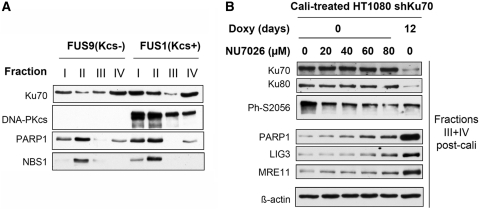
In mammalian cells, the main pathway for DNA double-strand breaks (DSBs) repair is classical non-homologous end joining (C-NHEJ). An alternative or back-up NHEJ (B-NHEJ) pathway has emerged which operates preferentially under C-NHEJ defective conditions. Although B-NHEJ appears particularly relevant to genomic instability associated with cancer, its components and regulation are still largely unknown. To get insights into this pathway, we have knocked-down Ku, the main contributor to C-NHEJ. Thus, models of human cell lines have been engineered in which the expression of Ku70/80 heterodimer can be significantly lowered by the conditional induction of a shRNA against Ku70. On Ku reduction in cells, resulting NHEJ competent protein extracts showed a shift from C- to B-NHEJ that could be reversed by addition of purified Ku protein. Using a cellular fractionation protocol after treatment with a strong DSBs inducer followed by western blotting or immunostaining, we established that, among C-NHEJ factors, Ku is the main counteracting factor against mobilization of PARP1 and the MRN complex to damaged chromatin. In addition, Ku limits PAR synthesis and single-stranded DNA production in response to DSBs. These data support the involvement of PARP1 and the MRN proteins in the B-NHEJ route for the repair of DNA DSBs.
在哺乳动物细胞中,DNA 双链断裂(DSBs)修复的主要途径是经典的非同源末端连接(C-NHEJ)。已经出现了一种替代或备用的 NHEJ(B-NHEJ)途径,它在 C-NHEJ 缺陷的情况下优先发挥作用。尽管 B-NHEJ 似乎与癌症相关的基因组不稳定性特别相关,但它的组成和调节仍然在很大程度上未知。为了深入了解这一途径,我们敲低了 Ku,这是 C-NHEJ 的主要贡献者。因此,通过条件诱导针对 Ku70 的 shRNA,可以显著降低人细胞系模型中 Ku70/80 异二聚体的表达。在细胞中降低 Ku 水平后,结果表明 NHEJ 有活性的蛋白质提取物从 C-NHEJ 转移到 B-NHEJ,这种转移可以通过添加纯化的 Ku 蛋白来逆转。通过使用强烈的 DSBs 诱导剂处理后进行细胞分级分离方案,然后进行 Western blot 或免疫染色,我们确定,在 C-NHEJ 因子中,Ku 是对抗 PARP1 和 MRN 复合物向受损染色质移动的主要拮抗因子。此外,Ku 限制了 PAR 的合成和单链 DNA 的产生,以响应 DSBs。这些数据支持 PARP1 和 MRN 蛋白参与 DSBs 的 B-NHEJ 修复途径。