Liang Kung-Hao, Fen Jun-Jeng, Chang Hsien-Hsun, Wang Hsei-Wei, Hwang Yuchi
Vita Genomics Inc,, Jungshing Road, Taipei County, 248 Taiwan.
J Clin Bioinforma. 2011 Jan 20;1(1):3. doi: 10.1186/2043-9113-1-3.
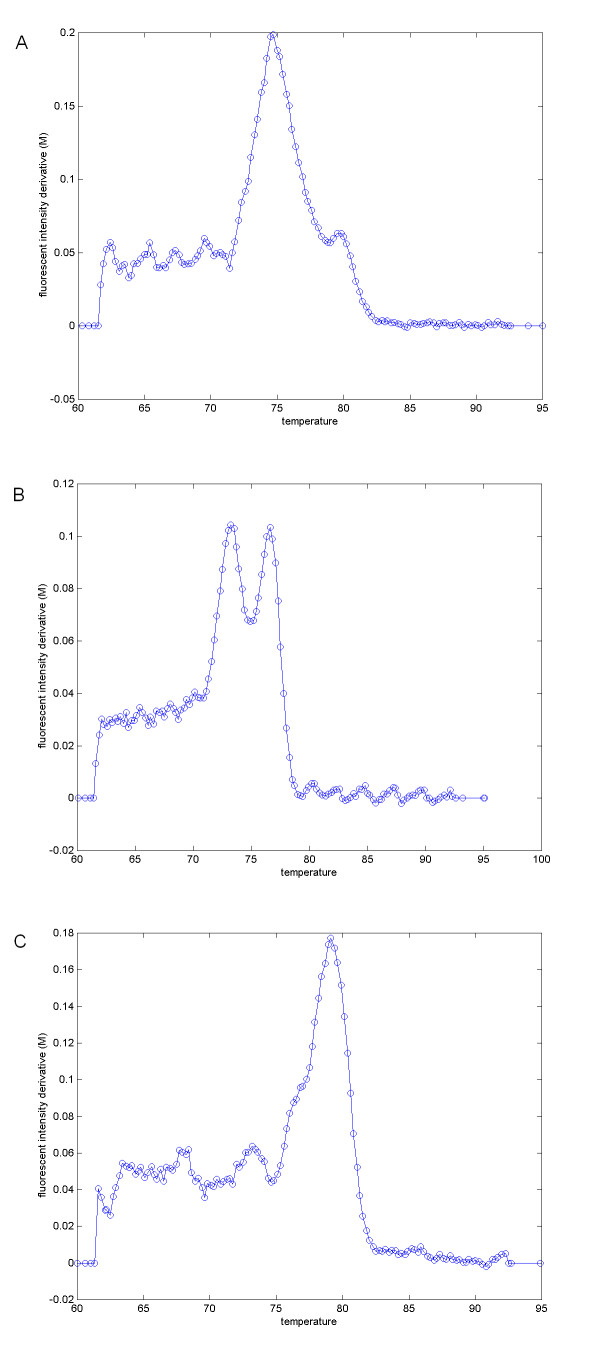
Tm-shifted melting curve SNP assays are a class of homogeneous, low-cost genotyping assays. Alleles manifest themselves as signal peaks in the neighbourhood of theoretical allele-specific melting temperatures. Base calling for these assays has mostly relied on unsupervised algorithm or human visual inspection to date. However, a practical clinical test needs to handle one or few individual samples at a time. This could pose a challenge for unsupervised algorithms which usually require a large number of samples to define alleles-representing signal clusters on the fly.
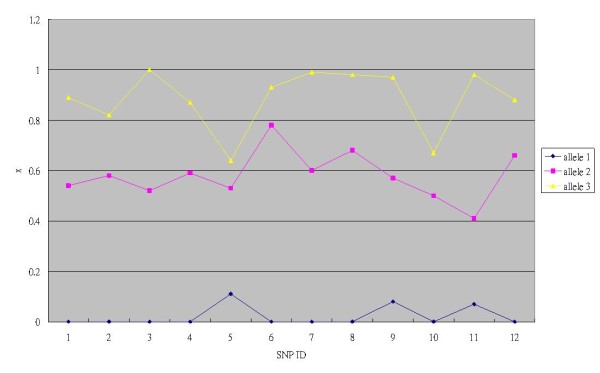
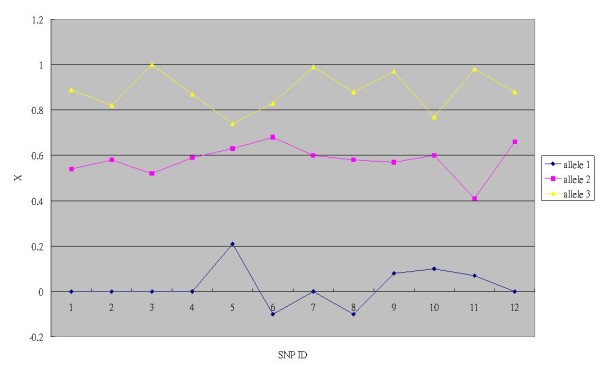
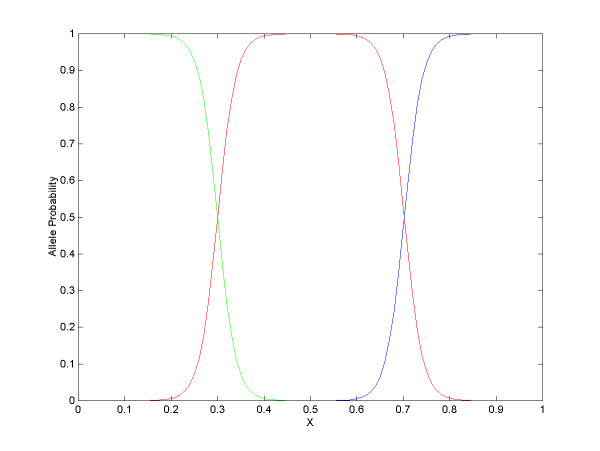
We presented a supervised base-calling algorithm and software for Tm-shifted melting curve SNP assays. The algorithm comprises a peak detection procedure and an ordinal regression model. The peak detection procedure is required for building models as well as handling new samples. Ordinal regression is proposed because signal intensities of alleles AA, AB, and BB usually follow an ordinal pattern with the heterozygous allele lie between two distinct homozygous alleles. Coefficients of the ordinal regression model are first trained and then used for base calling.
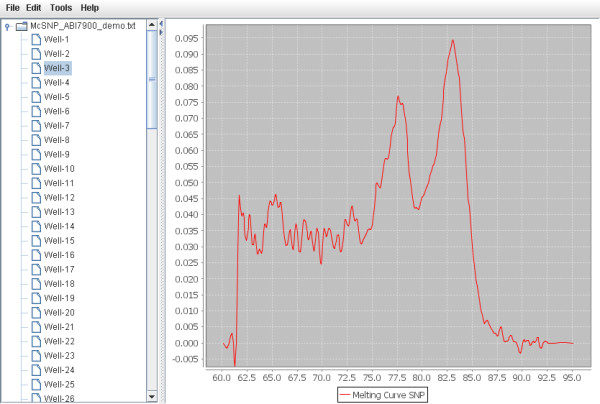
A dataset of 12 SNPs of 44 unrelated persons was used for a demonstration purpose. The call rate is 99.6%. Among the base calls, 99.1% are identical to those made by the sequencing method. A small fraction of the melting curve signals (0.4%) is declared as "no call" for further human inspection. A software was implemented using the Java language, providing a graphical user interface for the visualization and handling of multiple melting curve signals.
Tm-shifted melting curve SNP assays, together with the proposed base calling algorithm and software, provide a practical solution for genetic tests on a clinical setting. The software is available in http://www.bioinformatics.org/mcsnp/wiki/Main/HomePage.
Tm位移熔解曲线单核苷酸多态性分析是一类均相、低成本的基因分型分析方法。等位基因在理论上的等位基因特异性熔解温度附近表现为信号峰。迄今为止,这些分析的碱基识别大多依赖于无监督算法或人工目视检查。然而,实际的临床检测一次需要处理一个或少数几个个体样本。这对于通常需要大量样本才能即时定义代表等位基因的信号簇的无监督算法来说可能是一个挑战。
我们提出了一种用于Tm位移熔解曲线单核苷酸多态性分析的有监督碱基识别算法和软件。该算法包括一个峰检测程序和一个有序回归模型。构建模型以及处理新样本都需要峰检测程序。之所以提出有序回归,是因为等位基因AA、AB和BB的信号强度通常遵循一种有序模式,杂合等位基因位于两个不同的纯合等位基因之间。首先对等位回归模型的系数进行训练,然后用于碱基识别。
使用44名无关个体的12个单核苷酸多态性的数据集进行演示。调用率为99.6%。在碱基识别中,99.1%与测序方法得出的结果相同。一小部分熔解曲线信号(0.4%)被声明为“无法识别”,以供进一步人工检查。使用Java语言实现了一个软件,提供了一个图形用户界面,用于可视化和处理多个熔解曲线信号。
Tm位移熔解曲线单核苷酸多态性分析,连同所提出的碱基识别算法和软件,为临床环境中的基因检测提供了一个实用的解决方案。该软件可在http://www.bioinformatics.org/mcsnp/wiki/Main/HomePage获得。