Department of Microbiology and Immunology, Wake Forest University School of Medicine, Winston-Salem, NC 27157-1064, USA.
Virology. 2011 Oct 25;419(2):97-106. doi: 10.1016/j.virol.2011.08.005. Epub 2011 Aug 31.
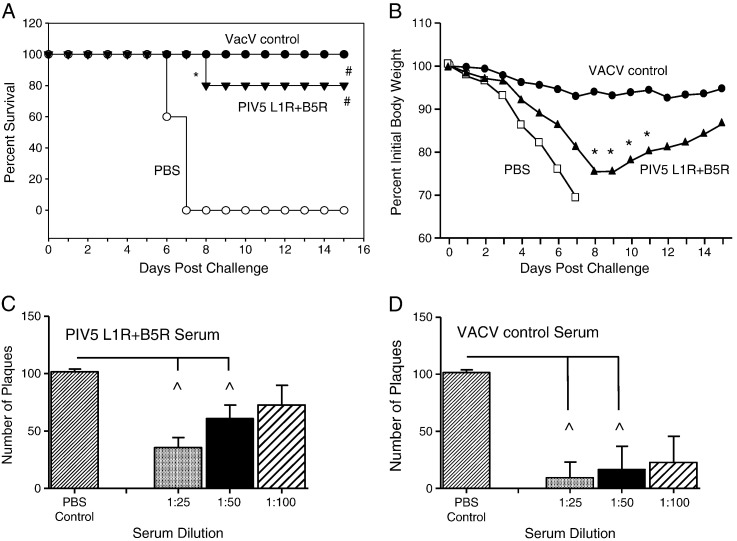
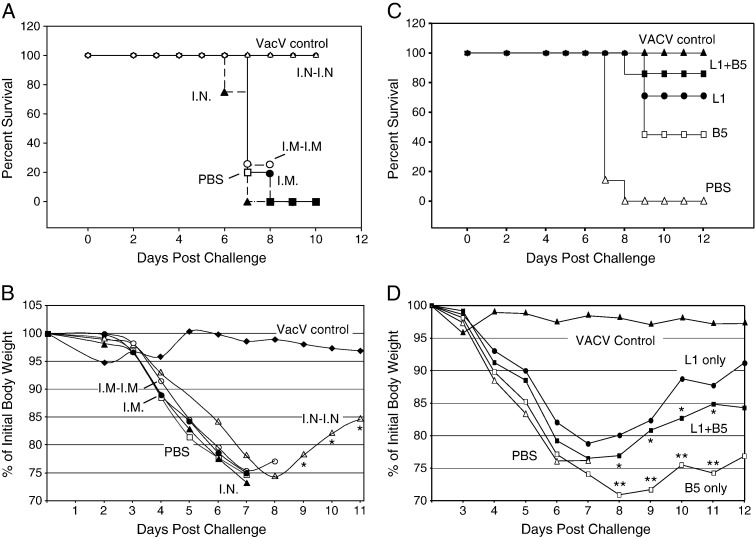
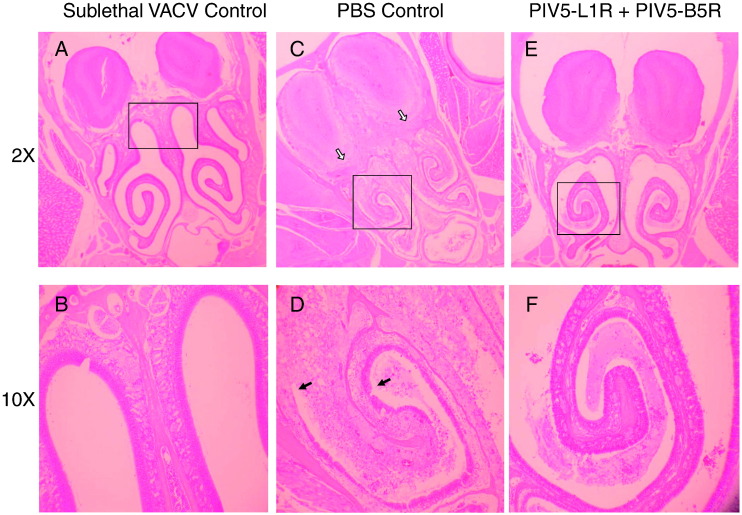
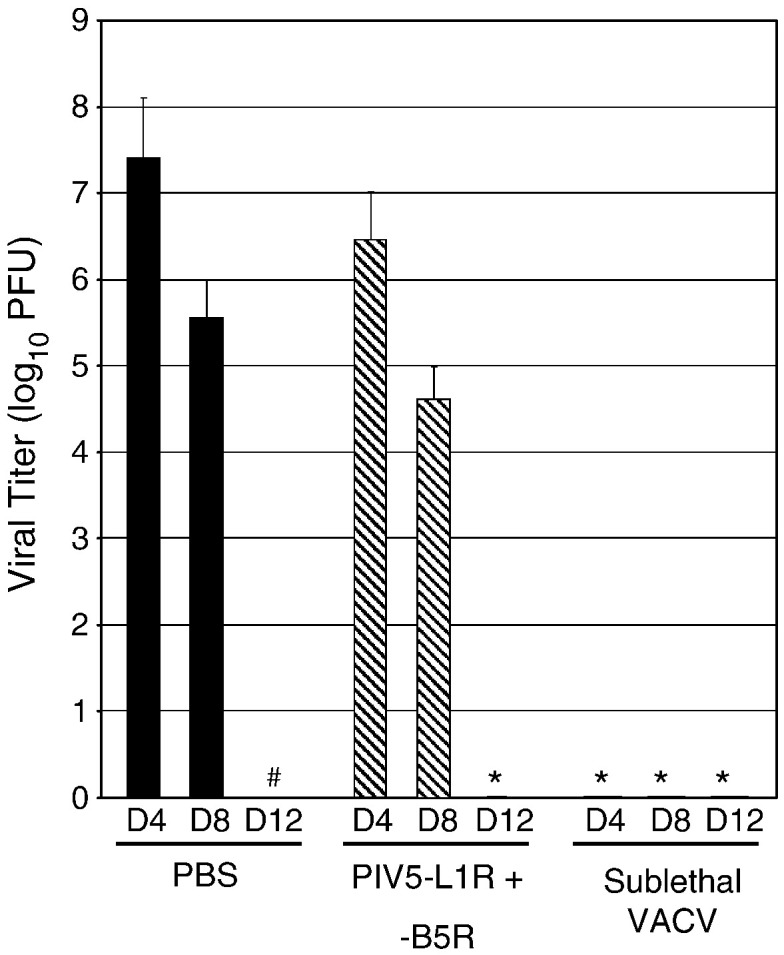
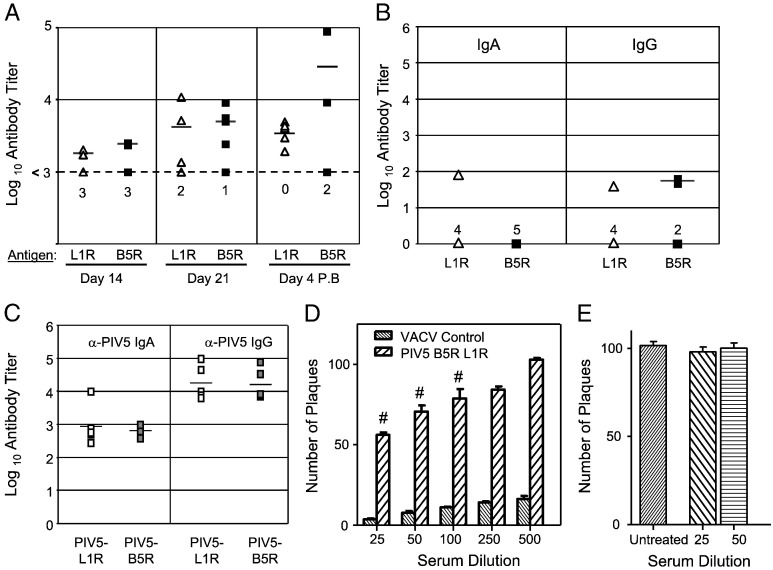
To test the potential for parainfluenza virus 5 (PIV5)-based vectors to provide protection from vaccinia virus (VACV) infection, PIV5 was engineered to express secreted VACV L1R and B5R proteins, two important antigens for neutralization of intracellular mature (IMV) and extracellular enveloped (EEV) virions, respectively. Protection of mice from lethal intranasal VACV challenge required intranasal immunization with PIV5-L1R/B5R in a prime-boost protocol, and correlated with low VACV-induced pathology in the respiratory tract and anti-VACV neutralizing antibody. Mice immunized with PIV5-L1R/B5R showed some disease symptoms following VACV challenge such as loss of weight and hunching, but these symptoms were delayed and less severe than with unimmunized control mice. While immunization with PIV5 expressing B5R alone conferred at least some protection, the most effective immunization included the PIV5 vector expressing L1R alone or in combination with PIV5-B5R. PIV5-L1R/B5R vectors elicited protection from VACV challenge even when CD8+ cells were depleted, but not in the case of mice that were defective in B cell production. Mice were protected from VACV challenge out to at least 1.5 years after immunization with PIV5-L1R/B5R vectors, and showed significant levels of anti-VACV neutralizing antibodies. These results demonstrate the potential for PIV5-based vectors to provide long lasting protection against complex human respiratory pathogens such as VACV, but also highlight the need to understand mechanisms for the generation of strong immune responses against poorly immunogenic viral proteins.
为了测试副流感病毒 5(PIV5)载体提供针对天花病毒(VACV)感染保护的潜力,对 PIV5 进行了工程改造,使其表达分泌型 VACV L1R 和 B5R 蛋白,这两种蛋白分别是中和细胞内成熟(IMV)和细胞外包膜(EEV)病毒粒子的重要抗原。通过鼻内免疫 PIV5-L1R/B5R 的初免-加强方案,可保护小鼠免受致死性鼻内 VACV 攻击,这与呼吸道中低 VACV 诱导的病理学和抗 VACV 中和抗体相关。用 PIV5-L1R/B5R 免疫的小鼠在 VACV 攻击后表现出一些疾病症状,如体重减轻和弓背,但这些症状比未免疫的对照小鼠延迟且较轻。虽然单独用 PIV5 表达 B5R 进行免疫可提供一定程度的保护,但最有效的免疫包括单独表达 L1R 的 PIV5 载体或与 PIV5-B5R 联合表达。即使耗尽 CD8+细胞,PIV5-L1R/B5R 载体也能引发对 VACV 攻击的保护,但在 B 细胞产生有缺陷的小鼠中则不然。用 PIV5-L1R/B5R 载体免疫的小鼠在至少 1.5 年后仍能免受 VACV 攻击,并显示出显著水平的抗 VACV 中和抗体。这些结果表明,PIV5 载体有可能提供针对复杂的人类呼吸道病原体(如 VACV)的持久保护,但也突出了需要了解针对免疫原性差的病毒蛋白产生强大免疫反应的机制。