Division of Oncology, Siteman Cancer Center, Washington University School of Medicine, St Louis, MO 63110, USA.
Leukemia. 2012 Jan;26(1):34-53. doi: 10.1038/leu.2011.197. Epub 2011 Sep 2.
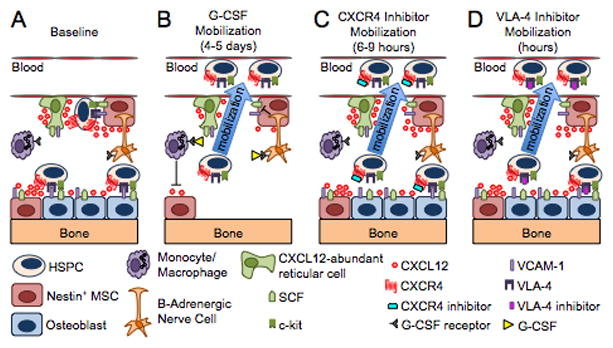
Successful hematopoietic stem cell transplant requires the infusion of a sufficient number of hematopoietic stem/progenitor cells (HSPCs) that are capable of homing to the bone marrow cavity and regenerating durable trilineage hematopoiesis in a timely manner. Stem cells harvested from peripheral blood are the most commonly used graft source in HSCT. Although granulocyte colony-stimulating factor (G-CSF) is the most frequently used agent for stem cell mobilization, the use of G-CSF alone results in suboptimal stem cell yields in a significant proportion of patients. Both the chemokine receptor CXCR4 and the integrin α(4)β(1) (very late antigen 4 (VLA-4)) have important roles in the homing and retention of HSPCs within the bone marrow microenvironment. Preclinical and/or clinical studies have shown that targeted disruption of the interaction of CXCR4 or VLA-4 with their ligands results in the rapid and reversible mobilization of hematopoietic stem cells into the peripheral circulation and is synergistic when combined with G-CSF. In this review, we discuss the development of small-molecule CXCR4 and VLA-4 inhibitors and how they may improve the utility and convenience of peripheral blood stem cell transplantation.
成功的造血干细胞移植需要输注足够数量的造血干/祖细胞(HSPCs),这些细胞能够归巢到骨髓腔,并及时产生持久的三系造血。从外周血中采集的干细胞是 HSCT 中最常用的移植物来源。虽然粒细胞集落刺激因子(G-CSF)是最常用于干细胞动员的药物,但单独使用 G-CSF 会导致相当一部分患者的干细胞产量不理想。趋化因子受体 CXCR4 和整合素 α(4)β(1)(非常晚期抗原 4 (VLA-4))在 HSPCs 在骨髓微环境中的归巢和保留中都发挥着重要作用。临床前和/或临床研究表明,靶向破坏 CXCR4 或 VLA-4 与其配体的相互作用会导致造血干细胞迅速而可逆地动员到外周循环中,并且与 G-CSF 联合使用具有协同作用。在这篇综述中,我们讨论了小分子 CXCR4 和 VLA-4 抑制剂的发展,以及它们如何提高外周血干细胞移植的实用性和便利性。