Division of Neurotoxicology, National Center for Toxicological Research, U.S. Food & Drug Administration, Jefferson, AR 72079, USA.
Curr Neuropharmacol. 2011 Mar;9(1):256-61. doi: 10.2174/157015911795017155.
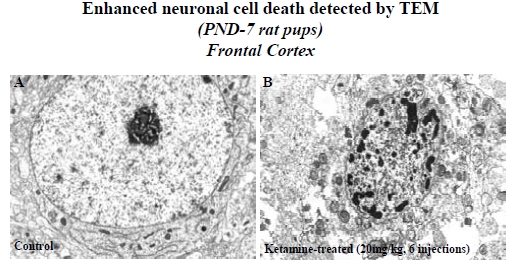
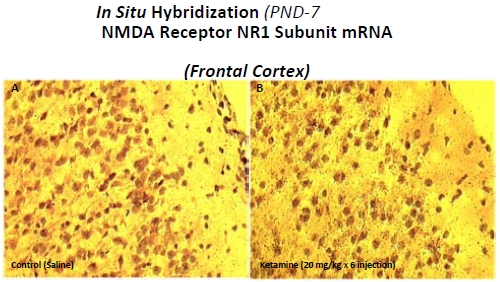
Ketamine, an N-methyl-D-aspartate (NMDA) receptor antagonist, is widely used for analgesia and anesthesia in obstetric and pediatric practice. Recent reports indicate that ketamine causes neuronal cell death in developing rodents and nonhuman primates. The present study assessed the potential dose- and time-dependent neurotoxic effects and associated changes in gene expression after ketamine administration to postnatal day 7 (PND-7) rat pups. Pups were exposed to ketamine subcutaneously at doses of 5, 10, or 20 mg/kg, in one, three or six injections respectively. Control animals received the same volume of saline at the same time points. The animals were sacrificed 6 h after the last ketamine or saline administration and brain tissues were collected for RNA isolation and histochemical examination. Six injections of 20 mg/kg ketamine significantly increased neuronal cell death in frontal cortex, while lower doses and fewer injections did not show significant effects. The ketamine induced cell death seemed to be apoptotic in nature. In situ hybridization demonstrated that NMDA receptor NR1 subunit expression was dramatically increased in the frontal cortex of ketamine treated rats. Microarray analysis revealed altered expression of apoptotic relevant genes and increased NMDA receptor gene expression in brains from ketamine treated animals. Quantitative RT-PCR confirmed the microarray results. These data suggest that repeated exposures to high doses of ketamine can cause compensatory up-regulation of NMDA receptors and subsequently trigger apoptosis in developing neurons.
氯胺酮是一种 N-甲基-D-天冬氨酸(NMDA)受体拮抗剂,广泛用于妇产科和儿科的镇痛和麻醉。最近的报告表明,氯胺酮可导致发育中的啮齿动物和非人灵长类动物的神经元细胞死亡。本研究评估了氯胺酮给药后对出生后 7 天(PND-7)大鼠幼仔的潜在剂量和时间依赖性神经毒性作用及相关基因表达变化。幼仔分别接受 5、10 或 20mg/kg 的氯胺酮皮下注射,单次、三次或六次注射。对照动物在相同时间点接受相同体积的生理盐水。最后一次氯胺酮或生理盐水给药后 6 小时处死动物,采集脑组织进行 RNA 分离和组织化学检查。六次注射 20mg/kg 氯胺酮可显著增加前额皮质的神经元细胞死亡,而较低剂量和较少注射则没有明显影响。氯胺酮诱导的细胞死亡似乎具有凋亡性质。原位杂交显示,NMDA 受体 NR1 亚基在氯胺酮处理大鼠的前额皮质中表达显著增加。微阵列分析显示,氯胺酮处理动物的大脑中凋亡相关基因表达发生改变,NMDA 受体基因表达增加。定量 RT-PCR 证实了微阵列结果。这些数据表明,反复暴露于高剂量的氯胺酮可导致 NMDA 受体的代偿性上调,并随后触发发育中的神经元凋亡。