Laboratoire de Psychologie Sociale et Cognitive, CNRS, UMR 6024, Université Blaise Pascal Clermont-Ferrand, France.
Front Integr Neurosci. 2011 Aug 9;5:33. doi: 10.3389/fnint.2011.00033. eCollection 2011.
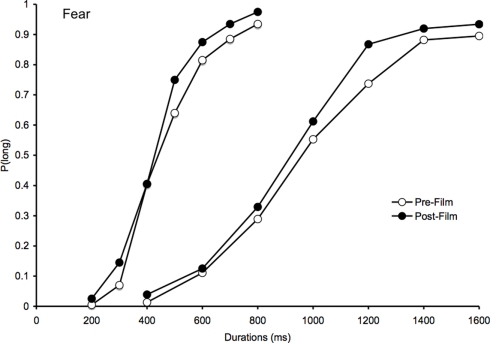
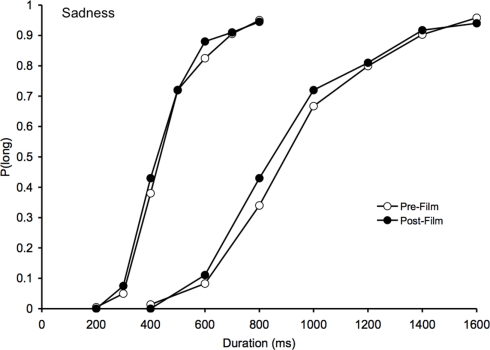
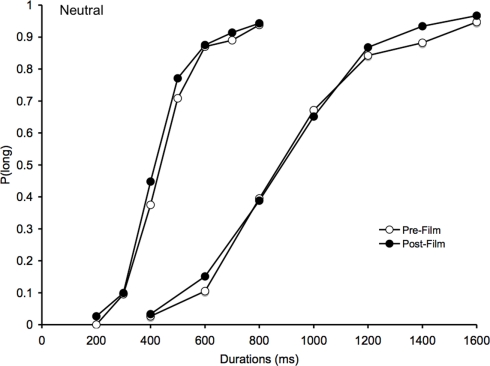
Previous research into emotion and time perception has been designed to study the time perception of emotional events themselves (e.g., facial expression). Our aim was to investigate the effect of emotions per se on the subsequent time judgment of a neutral, non-affective event. In the present study, the participants were presented with films inducing a specific mood and were subsequently given a temporal bisection task. More precisely, the participants were given two temporal bisection tasks, one before and the other after viewing the emotional film. Three emotional films were tested: one eliciting fear, another sadness, and a neutral control film. In addition, the direct mood experience was assessed using the Brief Mood Introspective Scale that was administered to the participants at the beginning and the end of the session. The results showed that the perception of time did not change after viewing either the neutral control films or the sad films although the participants reported being sadder and less aroused after than before watching the sad film clips. In contrast, the stimulus durations were judged longer after than before viewing the frightening films that were judged to increase the emotion of fear and arousal level. In combination with findings from previous studies, our data suggest that the selective lengthening effect after watching frightening films was mediated by an effect of arousal on the speed of the internal clock system.
先前有关情绪和时间感知的研究旨在研究情绪事件本身(例如面部表情)的时间感知。我们的目的是调查情绪本身对中性、非情感事件随后时间判断的影响。在本研究中,参与者观看了诱发特定情绪的电影,随后进行了时间二分任务。更准确地说,参与者进行了两次时间二分任务,一次在观看情绪电影之前,一次在观看之后。测试了三部情绪电影:一部引起恐惧,另一部引起悲伤,还有一部中性控制电影。此外,使用 Brief Mood Introspective Scale 在会话开始和结束时对参与者进行了直接的情绪体验评估。结果表明,观看中性控制电影或悲伤电影后,时间感知没有变化,尽管参与者在观看悲伤电影片段后报告感到更悲伤和兴奋度降低。相比之下,观看令人恐惧的电影后,刺激持续时间被判断为比观看之前更长,这些电影被判断为增加了恐惧和兴奋度。结合先前研究的结果,我们的数据表明,观看恐怖电影后出现的选择性延长效应是由唤醒对内部时钟系统速度的影响介导的。