Department of Orthopedics, Osaka University Graduate School of Medicine, Osaka, Japan.
PLoS One. 2011;6(8):e23199. doi: 10.1371/journal.pone.0023199. Epub 2011 Aug 23.
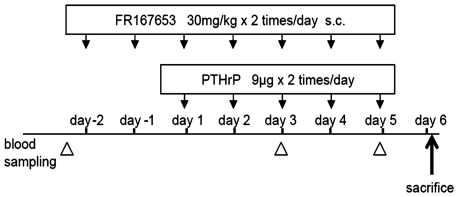
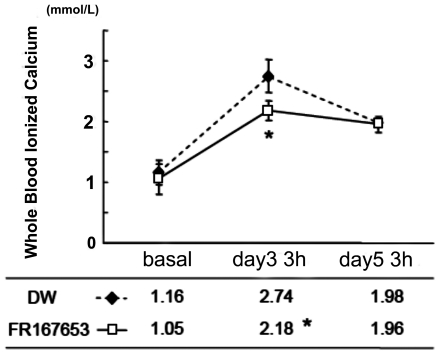
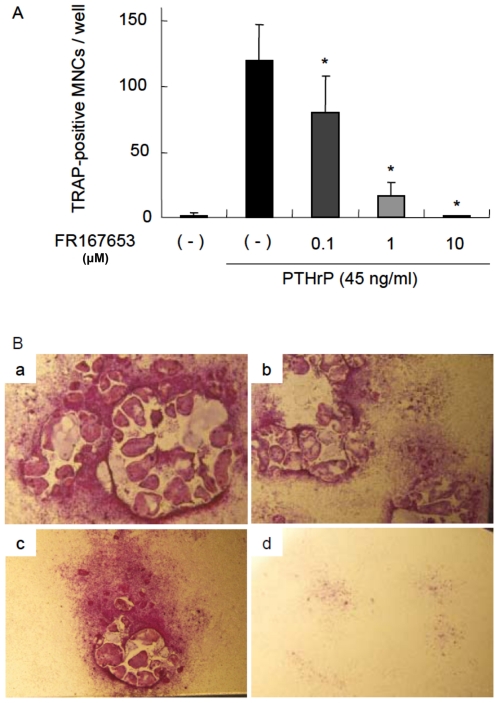
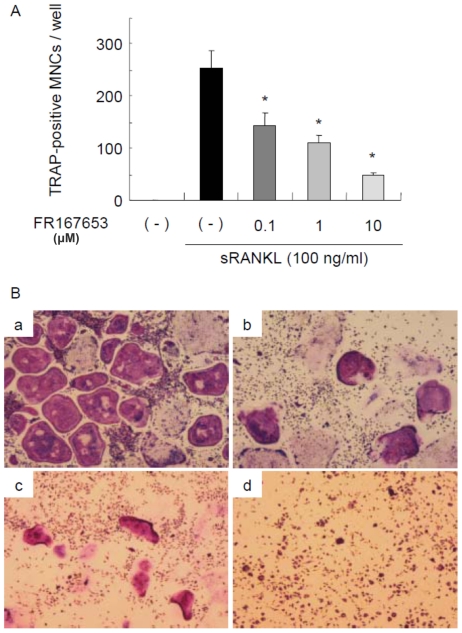
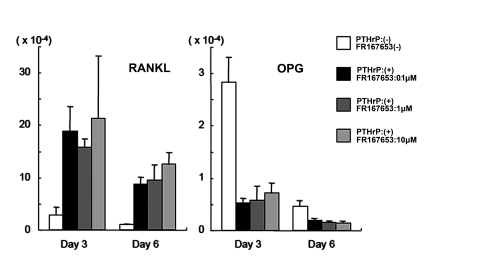
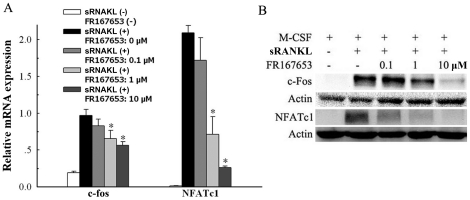
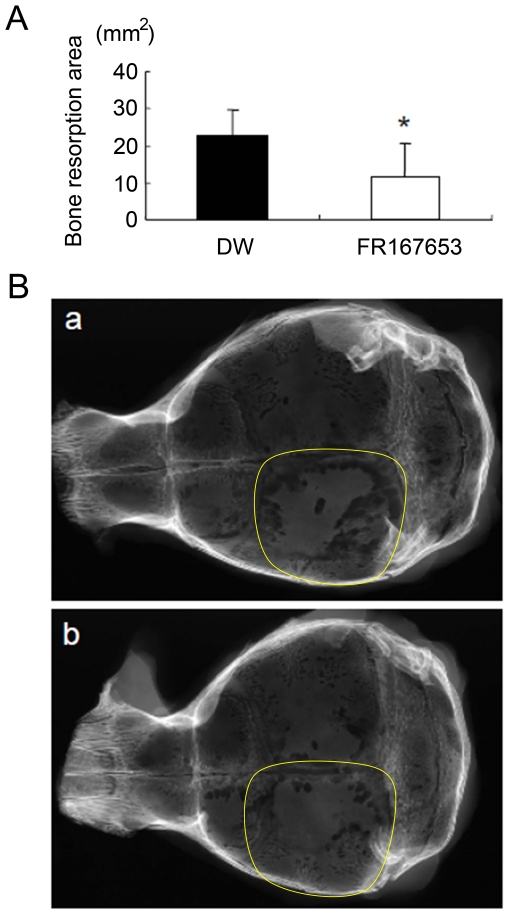
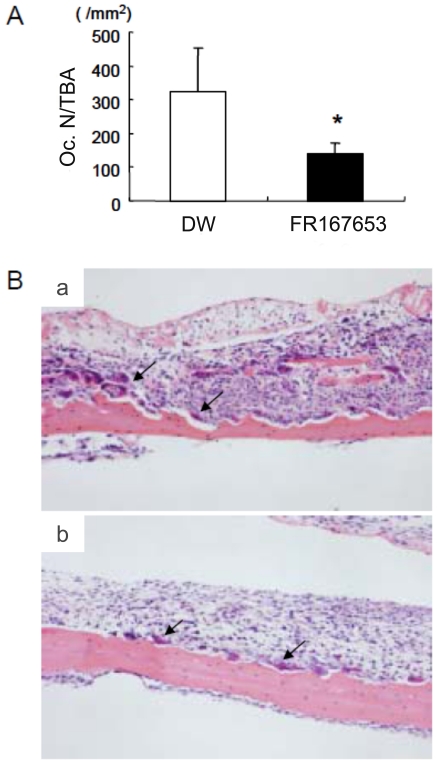
p38 mitogen-activated protein kinase (MAPK) acts downstream in the signaling pathway that includes receptor activator of NF-κB (RANK), a powerful inducer of osteoclast formation and activation. We investigated the role of p38 MAPK in parathyroid hormone related protein (PTHrP)-induced osteoclastogenesis in vitro and PTHrP-induced bone resorption in vivo. The ability of FR167653 to inhibit osteoclast formation was evaluated by counting the number of tartrate-resistant acid phosphatase positive multinucleated cells (TRAP-positive MNCs) in in vitro osteoclastgenesis assays. Its mechanisms were evaluated by detecting the expression level of c-Fos and nuclear factor of activated T cells c1 (NFATc1) in bone marrow macrophages (BMMs) stimulated with sRANKL and M-CSF, and by detecting the expression level of osteoprotegerin (OPG) and RANKL in bone marrow stromal cells stimulated with PTHrP in the presence of FR167653. The function of FR167653 on bone resorption was assessed by measuring the bone resorption area radiographically and by counting osteoclast number per unit bone tissue area in calvaria in a mouse model of bone resorption by injecting PTHrP subcutaneously onto calvaria. Whole blood ionized calcium levels were also recorded. FR167653 inhibited PTHrP-induced osteoclast formation and PTHrP-induced c-Fos and NFATc1 expression in bone marrow macrophages, but not the expression levels of RANKL and OPG in primary bone marrow stromal cells treated by PTHrP. Furthermore, bone resorption area and osteoclast number in vivo were significantly decreased by the treatment of FR167653. Systemic hypercalcemia was also partially inhibited. Inhibition of p38 MAPK by FR167653 blocks PTHrP-induced osteoclastogenesis in vitro and PTHrP-induced bone resorption in vivo, suggesting that the p38 MAPK signaling pathway plays a fundamental role in PTHrP-induced osteoclastic bone resorption.
p38 丝裂原活化蛋白激酶(MAPK)在包括核因子 κB 受体激活剂(RANK)在内的信号通路中起下游作用,RANK 是破骨细胞形成和激活的强大诱导剂。我们研究了 p38 MAPK 在甲状旁腺激素相关蛋白(PTHrP)诱导的体外破骨细胞生成和体内 PTHrP 诱导的骨吸收中的作用。通过在体外破骨细胞生成实验中计数抗酒石酸酸性磷酸酶阳性多核细胞(TRAP 阳性 MNC)的数量来评估 FR167653 抑制破骨细胞生成的能力。通过检测刺激物 sRANKL 和 M-CSF 刺激的骨髓巨噬细胞(BMM)中 c-Fos 和激活 T 细胞核因子 c1(NFATc1)的表达水平,以及检测刺激物 PTHrP 存在下 FR167653 刺激的骨髓基质细胞中骨保护素(OPG)和 RANKL 的表达水平,来评估其机制。通过测量皮下注射 PTHrP 诱导的骨吸收模型中颅骨的骨吸收面积和每单位骨组织面积的破骨细胞数,以及记录全血离子钙水平,来评估 FR167653 对骨吸收的功能。FR167653 抑制 PTHrP 诱导的破骨细胞形成和 PTHrP 诱导的骨髓巨噬细胞中 c-Fos 和 NFATc1 的表达,但不影响 PTHrP 处理的原代骨髓基质细胞中 RANKL 和 OPG 的表达水平。此外,FR167653 治疗可显著减少体内的骨吸收面积和破骨细胞数量。全身性高钙血症也部分受到抑制。FR167653 抑制 p38 MAPK 阻断了 PTHrP 诱导的体外破骨细胞生成和体内 PTHrP 诱导的骨吸收,表明 p38 MAPK 信号通路在 PTHrP 诱导的破骨细胞性骨吸收中起基本作用。